Uncover Local Competitors Hiding in Plain Sight with Scout
Most multi-location brands think they understand their competition – but do they know which brands are beating them in local search? Here’s why neighborhood-by-neighborhood analysis helps brands win.


TL;DR: National competitive tracking tells you who the big players are — not who's actually beating your locations in search. Yext Scout benchmarks each location against its real local competitors and surfaces gaps that brand-level dashboards typically miss. Here’s why it matters – and how it works.
Ask any multi-location brand who their competitors are, and you'll likely get a confident answer. They'll name the national chains in their category, and maybe a few fast-growing regional players.
But ask them who is actually beating their downtown Austin location on South Lamar in the specific local search results their customers see? You're likely to get a shoulder shrug.
That gap is a perspective problem, not a data problem – and it's costing multi-location brands real visibility – and in many cases, revenue.
Why brand-level tracking isn’t enough anymore
Traditional competitive analysis operates at the brand level: national rankings, market share snapshots, and designated market area (DMA)-level keyword tracking. For a long time, that was enough, but it isn't anymore.
Search results are increasingly localized and personalized — the competitor set your customer sees in downtown Denver is different from what someone sees two miles away in a suburb in the same city. AI-driven search amplifies this further, assembling results dynamically based on proximity, recency, reviews, and structured data signals that vary block by block.
The result: local competitor analysis is now a location-by-location problem, but most brands don't have the tools to analyze performance at that level.
Yext's Scout Index analysis of 8.7 million Google search results confirms how significant that variation is. Review responsiveness, profile completeness, and photo strategy all perform differently depending on industry and region — businesses in the South and West, for example, are penalized more heavily for slow review response times than those in the Northeast. Signals that earn a hospitality brand a spot in the Local Pack may be entirely different for another hospitality brand or a food and dining chain, even just two blocks away.
The competitors you don't know are the ones winning
One of the most consistent findings from Scout's hyper-local competitive benchmarking: the brands losing the most ground in local search often aren't losing to competitors they know about.
They're losing to:
-
Regional chains they've never tracked; fast-growing concepts with a strong footprint in specific metros
-
Local independents with exceptional review velocity and a highly optimized local page
-
Adjacent-category players. A McDonald's or Panera Bread may be showing up in coffee shop results because their local data is structured better than yours.
These kinds of details are exactly what show up on Scout's competitor leaderboard.
The leaderboard benchmarks each of your locations against the 20 closest competitors in that specific market — not a national average, but the actual players appearing in search results near your front door.
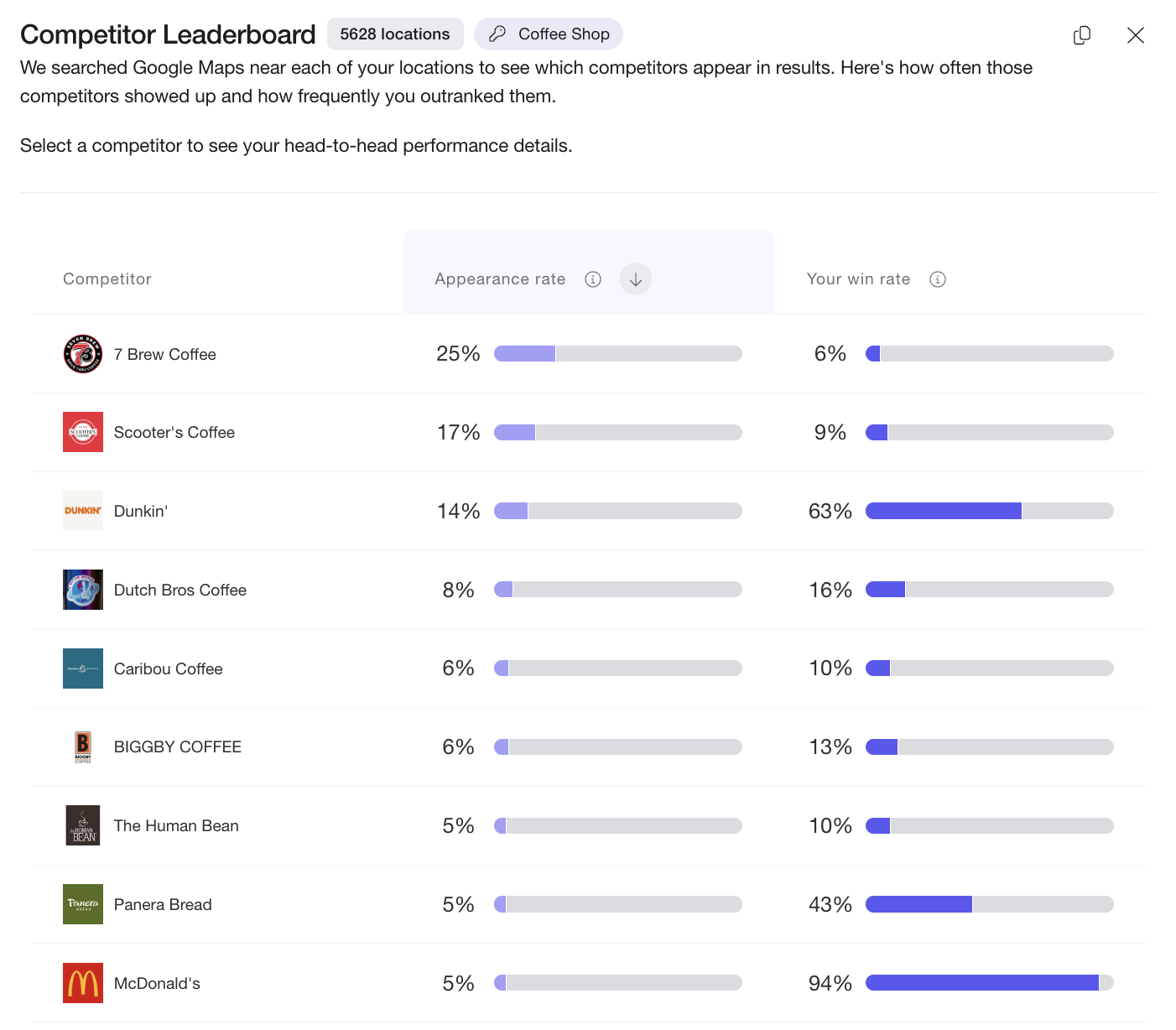
For this large coffee chain with thousands of locations, the competitive picture looks familiar on the surface — lots of well-known names competing for top billing. But win rates – the percentage of times you rank above a competitor when you both appear in the same Google search results – tell a different story.
The win rate against 7 Brew – a rapidly expanding regional chain – is only 6%. That's not a data anomaly; it’s a systemic gap in local performance concentrated in key markets where 7 Brew has built a better local presence.
Zoom into a smaller market segment with 149 locations, and the picture shifts entirely:
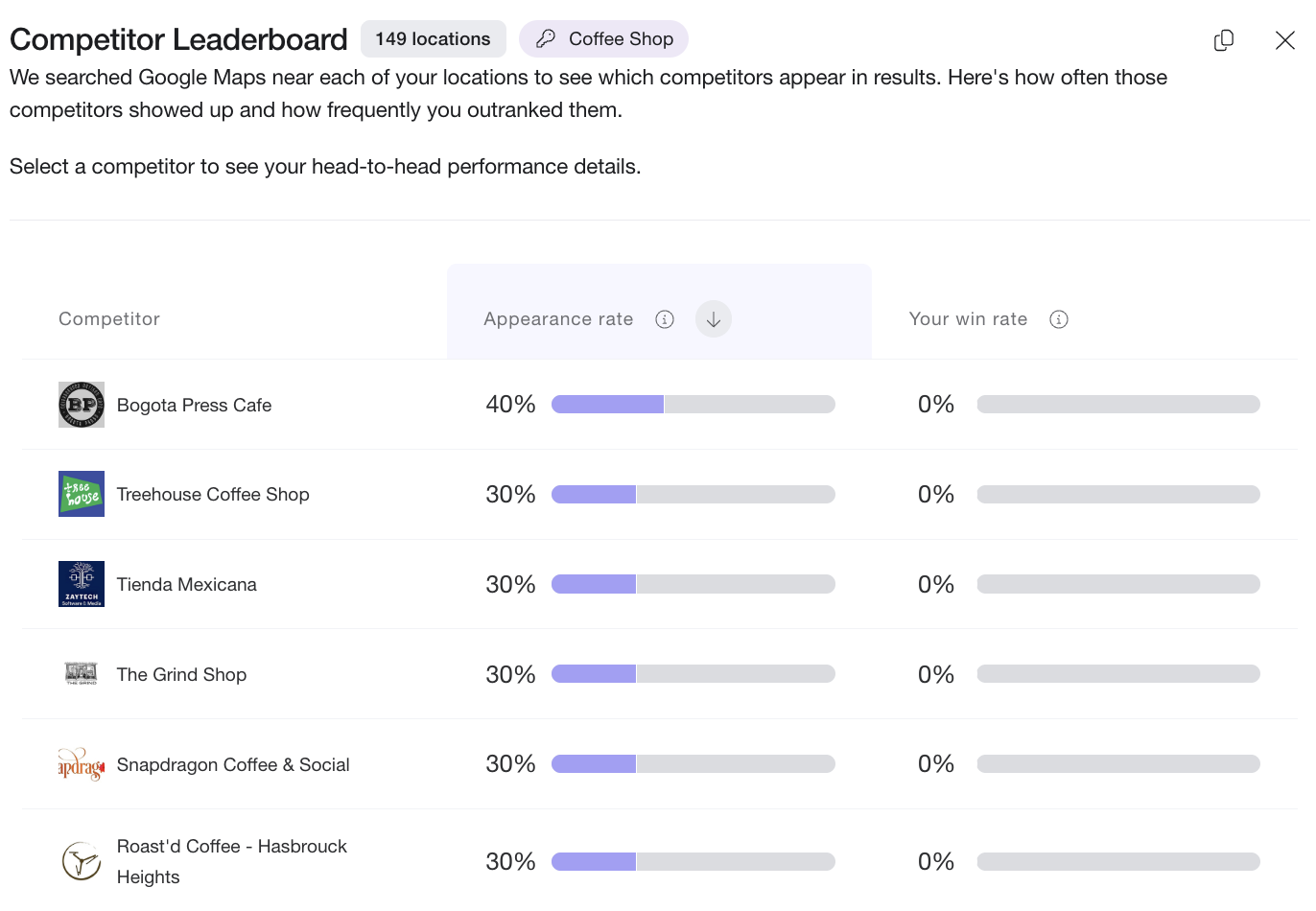
Here, you see names that won't appear on any brand-level competitive tracking report. But… they're showing up in 30-40% of searches near those locations. And the win rate against every single one of them? Zero percent.
It quickly becomes clear why allocating optimization resources based on national competitive intelligence is not an optimal strategy.
Why benchmarking local search requires different analysis
The core issue with standard local SEO competitive analysis is that it measures your performance — not your performance relative to the specific alternatives your customers actually see.
Your dashboards might show that impressions are up 12% quarter-over-quarter, which isn’t anything to shake a fist at. But, if competitors near those locations grew 40% in the same period? You're losing ground – even though your internal metrics look fine – because there’s no baseline to compare to.
Scout's approach to competitive local search benchmarking is built around cleanly defining that baseline. Rather than reporting on absolute performance, it measures citation share – how often you appear in local search results relative to competitors that are actually present in your market – for each individual location.
Unlike rankings, impressions, and traffic (which only tell you part of the story) citation share reflects your actual competitive position in local search.
Let’s look at one more example:
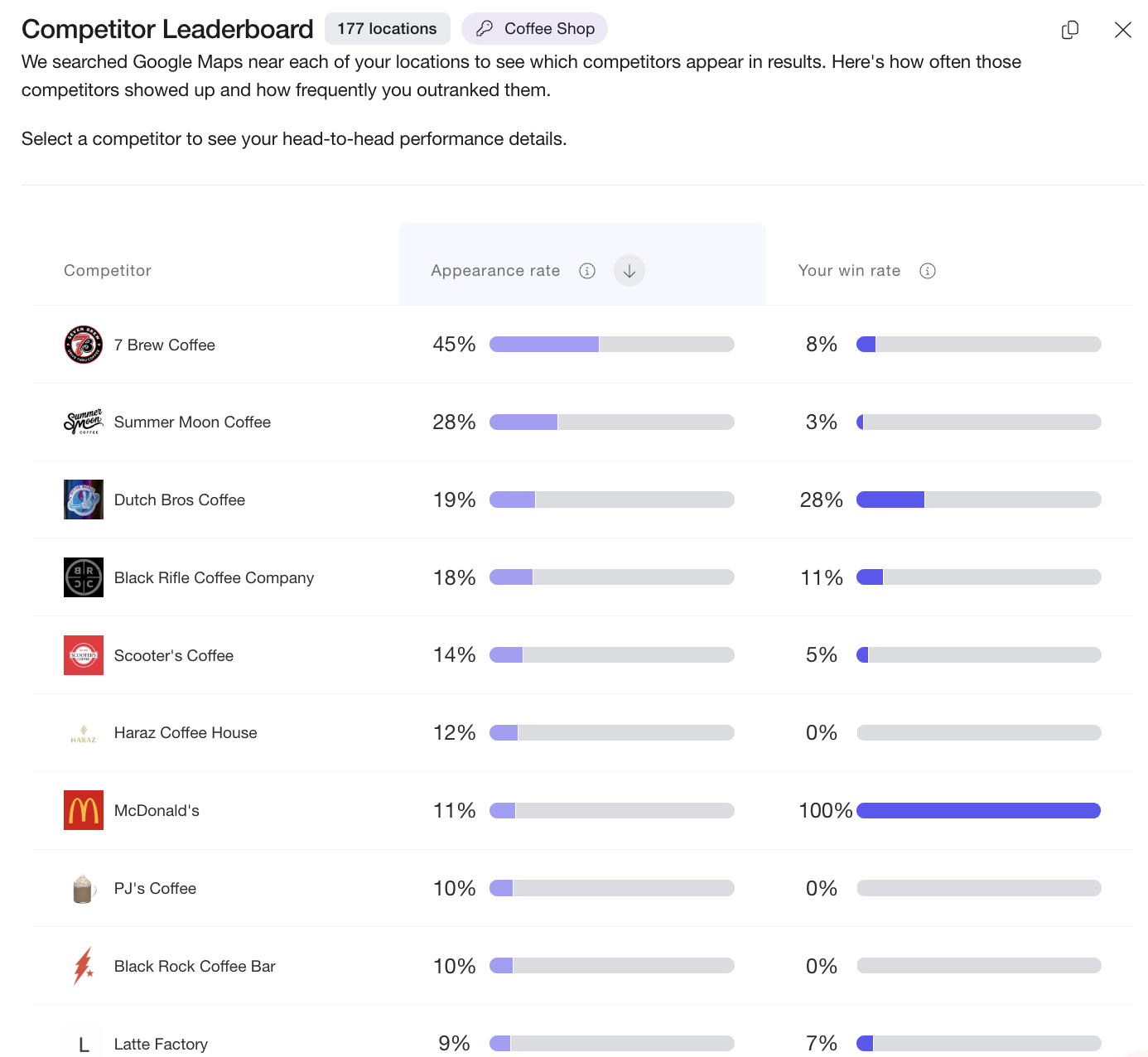
This market, with fewer than 200 locations, shows why the location-level view matters so much. McDonald's appears near 11% of locations, and the win rate against them is 100%. That's a strength worth knowing. But Haraz Coffee House appears near 12% of locations with a 0% win rate. Black Rock Coffee Bar? 10% win rate. PJ's Coffee? 10% win rate.
These are the actual competitors eroding visibility in this market, and…again…not a single one of them would surface in a national-level competitive analysis.
What hyper-local competitive intelligence actually changes
The practical value of this level of local search competitive intelligence isn't just knowing who's beating you; it's being able to prioritize where to invest.
When you have visibility into which locations have the largest competitive gaps, which competitors are involved, and what’s causing the issue (lack of reviews, content inaccuracies, or data quality issues, etc.), you can stop spreading optimization resources evenly across locations and focus on investing in the biggest opportunities.
Scout is built for this shift. It surfaces gaps and translates them into a location-specific action plan:
- For CMOs, it answers the question: where are we actually losing?
- For SEO and digital marketing managers, it answers: which locations should I prioritize this quarter, and what specifically do I fix?
- For field marketing and franchise teams, it answers: what does my territory look like relative to the competition on the ground?
You get clarity on who you’re truly competing with and what opportunities you have to strengthen your position.
The new standard for local SEO competitive analysis
In an AI-first, hyper-local search environment, brand-level competitive analysis is no longer sufficient. The brands winning in local search are the ones that understand their competitive position at the sidewalk level — location by location, market by market — and have the intelligence infrastructure to act on it.
That's the shift Scout enables. And it starts with knowing who you're actually competing against.
Scout allows users to analyze location-specific appearance and win rates against each competitor, so you can quickly see where you’re outperforming rivals and where you’re losing business. Drilling down into any specific metric lets you compare performance across markets, analyze which of your locations are above or below the benchmark for specific visibility actions, and recommend ways to improve.
So, what are you waiting for? Get your brand visibility score and see who's outranking your locations right now.