The Marketing Playbook, Rewritten: A Strategic Guide for CMOs
The Marketing Playbook, Rewritten: A Strategic Guide for CMOs




Search just changed. (Yes, again).
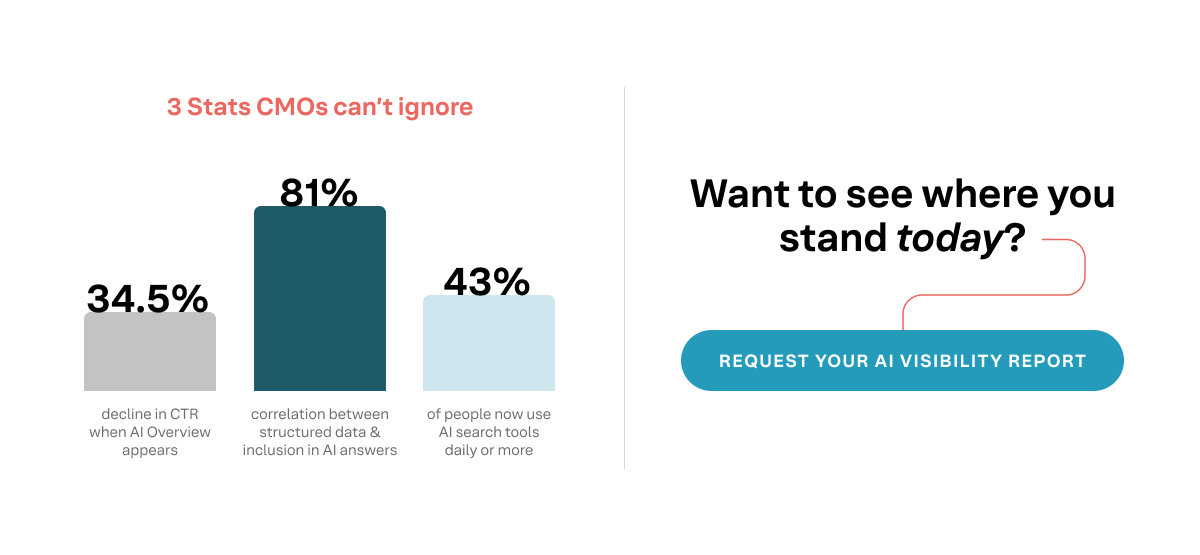
By 2026, a quarter of all search traffic is predicted to shift from Google to AI-powered answer engines like ChatGPT and Gemini, Gartner estimates. (If you've already noticed a drop in organic traffic, you're not alone: a recent study found that click-through rates (CTR) are down 30% YoY.)
Maintaining visibility on these platforms requires a different approach from classic SEO and unlike Google, you don't have a paid ads option to boost visibility if you can't rank organically. This means fewer impressions, fewer clicks... and far fewer opportunities to control how your brand shows up when people search.
This problem can't be solved with a simple tweak to your SEO strategy. In today's AI-first world, you need a much more comprehensive plan to drive visibility everywhere customers find, evaluate, and choose brands (including ChatGPT, Claude, Perplexity, Google Gemini, and more, all of which operate a little differently).
And this shift from traditional to AI search is happening quickly. People are adopting AI faster than any prior innovation - faster than mobile device adoption when the first smartphone launched, and faster than social media. (In fact, 43% of people now use AI search tools daily or more.) And it's already redefining how marketing leaders allocate budget, structure teams, measure results, and define success. Brands that wait to adapt risk falling permanently behind in the channels that matter most.
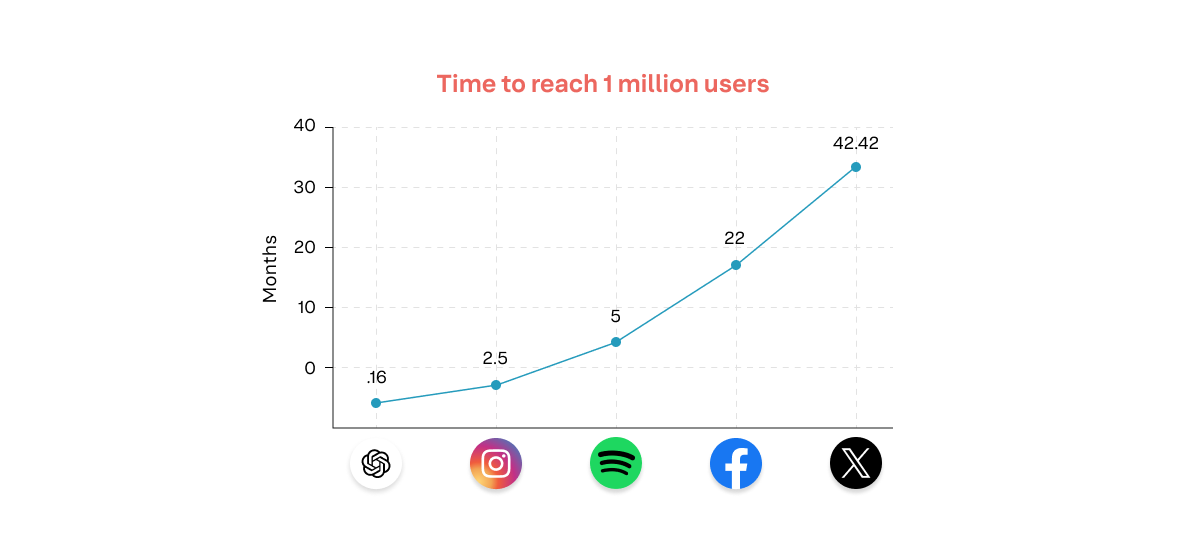
To stay visible and competitive, marketing leaders need to reimagine their strategy across three key shifts:
- How customers find your brand
- How your brand is described
- Who (and what) your content is for
This playbook helps CMOs lead through this transformation. Each section below breaks down:
- What's changing
- What that shift means for your brand's visibility
- What CMOs should start, stop, and continue doing
Shift 1: How customers find you has changed
 The shift:
The era of AI search is here and is already reshaping how people find brands. They're starting their search journeys on platforms like ChatGPT, Perplexity, and Gemini — not just Google alone.
And across these platforms, they're no longer sticking to simple questions like, "Best pizza near me?" They're having full conversations that include detailed, contextual questions, like "What are the top five Sicilian slice spots with gluten-free slices in downtown Manhattan that are open late?" In response, AI answer engines give direct, synthesized answers based on trusted data pulled from multiple sources (citations) — not a list of links the user must explore to find the answer.
The impact:
To show up, you don't need to "rank;" you need to be cited. Brands must diversify beyond Google search — and feed all AI answer engines trusted, structured information that they can find, "read," and reuse.
To become a trusted authority — a source that gets cited — when customers ask AI engines questions:
(Often called generative engine optimization, or GEO, or optimizing your data so AI will find and cite it.)
✅ Start:
-
Reallocating budget to AI visibility. Similar to the above: it's time to move an estimated 10-20% of SEO and Google Ads spend toward building a centralized source of brand truth, scaling local content, and measuring AI search visibility.
-
Tracking where your brand is cited in AI responses. It's time to start measuring when your brand appears in AI-generated summaries and knowledge panels — and how often you're absent when you should be visible. If your teams are KPI'd against traditional search rankings, but not AI search visibility, you're poised to fall behind.
Pro tip: Yext Scout can help you start tracking AI search visibility today.
-
Benchmarking visibility against rivals. Visibility is contextual—you may be surprised who shows up in answers when you don't.
-
Assessing the factors that drive visibility and sentiment so you know which levers to pull. With this clarity, you can prioritize the right markets and the right actions to move the needle fastest.
-
Structuring brand facts in formats AI engines can read. Has your organization invested in a centralized, complete, trusted data layer? If you don't have one central source of truth for all of your brand's information, it's time to discuss the right solution with key stakeholders (including your CTO or IT if applicable).
-
"Feeding" AI engines accurate, consistent hyper-local data. Do your teams know that your brand's information should be published everywhere online that AI engines might look? This includes smaller, third-party publishers that might not traditionally be top-of-mind. (See where AI engines really get their information.)
-
Publishing hyper-local content on pages, at scale. All of your brand's local pages should list relevant local details, like services offered, provider specialties, hours, insurances accepted, menus, amenities, and/or pricing. This makes it easier for AI to answer those detailed, contextual questions when people ask.
For example: If AI can't find or read the right information about your downtown pizza location — that it has sicilian slices and is open late — you won't appear in the answer to that detailed question, "What are the top five sicilian slice spots in downtown Manhattan that are open late?"
❌ Stop:
-
Thinking visibility = Google only. People start searches directly on AI platforms, TikTok, Reddit, and vertical-specific engines, and the search visibility metrics you track within your org must reflect that.
-
Chasing blue links and keyword stuffing. These tactics are now completely outdated. Search today is multi-surface and multi-modal. Success is no longer just about keyword rank — it's about being the answer.
-
Anchoring performance only to organic traffic or SERP rank. Clicks are disappearing. What matters is whether you're cited at the decision moment.
-
Relying on paid ads to boost performance. There's no option for this when it comes to AI-generated answers from the likes of ChatGPT or Claude. Either you're cited in the answer or you're not.
🔁 Continue:
- Managing local listings across a diverse publisher network. Remember, AI engines don't only look at brand websites. They look at various sources — and they want fresh, consistent information they can verify. (Our recent research backs this up: when a query is subjective (e.g., "What is the best...?"), OpenAI's citation behavior shifts to third-party directories becoming a primary citation source — peaking at 46.3% of citations. Click here to learn more.)
- Building structured, accurate, and complete data foundations. Structured data is the new SEO. It's what engines reuse as trusted sources. In fact, a recent study from Organic Labs found an 81% correlation between schema presence and inclusion in AI results.
- Investing in local visibility. Customers still make decisions locally. Continue to publish local pages that align with specific needs in specific geographies.
- Fostering real customer feedback. Review platforms are frequently cited by AI engines for subjective queries like "best," "most recommended," or "trusted."
CMO Takeaway: Even a 10% drop in organic traffic could represent a significant loss in pipeline contribution. Reallocating budget from low-yield tactics toward AI visibility can offset this, and unlock competitive advantage before others catch up.
Shift 2: How your brand is described is no longer in your control
 The shift:
As described above, ChatGPT, Perplexity, and Google's AI Overviews are already writing summarized answers about your brand. And these are the descriptions customers see most often — not your website copy or paid ads.
If the findable data about your brand is thin, outdated, or inconsistent, AI engines fill gaps on their own. They may get your hours wrong. They may cite a competitor. They may hallucinate services you don't offer — or miss the ones you do.
The impact:
You're no longer the sole author of your brand narrative.
The good news? You have an opportunity: your job now is to influence the inputs to these summaries, because they're built from the data AI can find about you across the web. Brands that don't take control of their data risk misrepresentation — or invisibility.
To influence how AI describes your brand's narrative:
✅ Start:
- Validating how you're described today. Use tools like Yext Scout to see how AI engines are currently interpreting and summarizing your brand. Is it accurate? Are local competitors showing up instead? When you are mentioned, is it positive or negative?
- Monitoring your brand reputation across all surfaces — including Google, Yelp, TikTok, Reddit, and more. Remember, reviews and third-party descriptions shape AI responses.
- Structure your data and build a robust knowledge graph. Structured data is what makes your brand understandable, findable, and accurately represented across discovery platforms. In other words: you can't shape the AI summary narrative about your brand without the right data foundation.
❌ Stop:
- Assuming your website copy controls your brand story. AI doesn't crawl pages the way old search algorithms did (or even the way people sometimes do). It synthesizes data from trusted sources — and you don't get to choose which ones.
- Letting inconsistent or outdated data live on third-party directories. Again, the opportunity for misrepresentation or errors in AI summaries is just too high.
🔁 Continue:
- Responding to customer reviews and FAQs with accurate, useful information. Do you have a strategy for how reviews are monitored and responded to on the local level? This isn't just a CX tactic — it's a visibility driver.
CMO Takeaway: In the age of AI search, your data is your brand voice. Inconsistent or missing facts lead to you being misrepresented, or competitors being cited instead.
Shift 3: Who you create content for has changed
 The shift:
The majority of site visits are now from bots and crawlers — not people. In fact, a recent report found that bots now make up 51 percent of all web traffic, meaning non-human visitors outnumber people online.
Visually rich websites and branded content still matter for customers, but if that content isn't structured and accessible, AI engines won't see it. (And remember, these AI engines extract facts from your digital channels to power answers.)
The impact:
Your content must now serve two audiences: people and machines.
To create content for dual audiences:
✅ Start:
- Writing for both people and AI. All of the content your organization creates should be compelling for humans and consumable by machines.
What does this look like in practice? Advise your teams to picture a marriage of well-written and easy-to-digest content. Key tactics include creating shorter chunks of text, and writing "TL;DRs" at the top of long content pieces.
- Publishing content on local and service pages that answer specific questions. AI engines favor clearly structured, Q&A-style content that mirrors how customers ask questions. Pilot adding an "FAQs" section to content and writing posts that answer commonly asked questions.
- Testing AI agents to see what answers they generate for key brand queries.
❌ Stop:
- Treating content like a brand moment only. It's now a data input. Treat every piece of content created as a source AI may use (or ignore).
- Assuming humans will be your only "visitors." Your website might be beautiful, but is it smart? Is all of your site content — from your blog (if you have one) to your local landing pages — following the AI best practices outlined above?
🔁 Continue:
- Investing in content creation... but investing differently. Focus on structure, clarity, and coverage, not just polish or word count. If you're overspending on lengthy content — or, say, paying freelancers by the word — your content strategy isn't built for the future.
- Training teams to write for clarity, precision, and specificity. Continue to create space for team members to read resources or attend events — specifically ones that focus on how to optimize content for the AI era.
- Investing in creative brand storytelling. The value of "brand" hasn't disappeared. But all brand storytelling must be supported with the best practices described here (and backed up with structured facts underneath).
CMO Takeaway: If AI can't crawl it, it can't cite it. Your web content must be structured to perform in a zero-click world.
No more middle ground: you're either in the answer, or you're not
The old world of "page two" fallback is gone. There's no backup plan when AI delivers just one result — and if your brand isn't cited, you're out of the conversation.
But this isn't all downside: there's a massive competitive opportunity for brands to seize (if they act now).
For early movers, AI search offers a durable advantage. Once an engine trusts and cites your data, it often reuses it. You can become the go-to source — a default answer— across thousands of high-intent queries.
This isn't just a small shift. It's a full-spectrum marketing transformation. CMOs must:
- Fund visibility by reallocating budget toward structured content and AI-friendly surfaces
- Staff for execution by aligning digital, content, and local teams
- Measure visibility by tracking citations and presence in AI answer sets
This shift is happening faster than the one to mobile or social did. But with a modern playbook, the right data foundation, and a clear visibility strategy, you can win in the age of AI search.
Want to see where your brand stands? Request your free Scout Visibility Report — with location-level breakdowns across AI and traditional search.