Agentic search is the next frontier for retailers. Platforms like ChatGPT, Gemini, and Perplexity are becoming the shopping companion for consumer discovery, summarizing product comparisons, and recommending brands before shoppers even land on a website. The question for retail marketers isn’t how to rank higher on Google. It’s how to be the source AI decides to quote.
In a search environment where a thousand product pages collapse into one confident answer and the last mile is being integrated into the conversational interface, being cited will be the lifeblood of many retailers.
The retail signal
Using a Location-Context framework to source more than 265,000 citations from 2,284 unique domains (note a domain likely has multiple pages) from the Big 3 AI Models (OpenAI, Gemini, and Perplexity), we find that retail follows a familiar pattern in AI citations: where approximately 87 percent of the sources used by generative models come from places brands directly control, i.e., their own websites, verified directories, and structured listings.
That’s about a point higher than the cross-industry average, suggesting the opportunity is still wide open, with only about 5% of AI citations overlapping per model, but this game is becoming increasingly competitive. Retail marketers who rely solely on website best practices will be outpaced by those optimizing their entire digital footprint for AI visibility.
From this scale, we can get a clear signal of the state of play.

Your website isn’t the only thing AI sees. Third-party directories form the rest of your controllable surface area, and they matter more than most brands realize. The top-ten third-party directories drive 52% of all directory citations. That means visibility isn’t evenly distributed; it’s concentrated among a small cluster of authoritative sources that AI models consistently return to.
Another notable finding is that Google’s Gemini frequently does not cite itself. We found that Google citations in Gemini showed up less than 2% of the time.
While more than half of the citations are directed to the top ten domains, the long tail is impressively significant. This demonstrates how differently AI and humans gather information. The sources most trusted by AI systems are often the ones least likely to appear in a person’s browsing history. While we won’t unpack the full implications of this topic here, it’s worth noting the noticeable distance between Mapquest and Google, and other pack leaders versus sources like Instagram, Reddit, and YouTube.
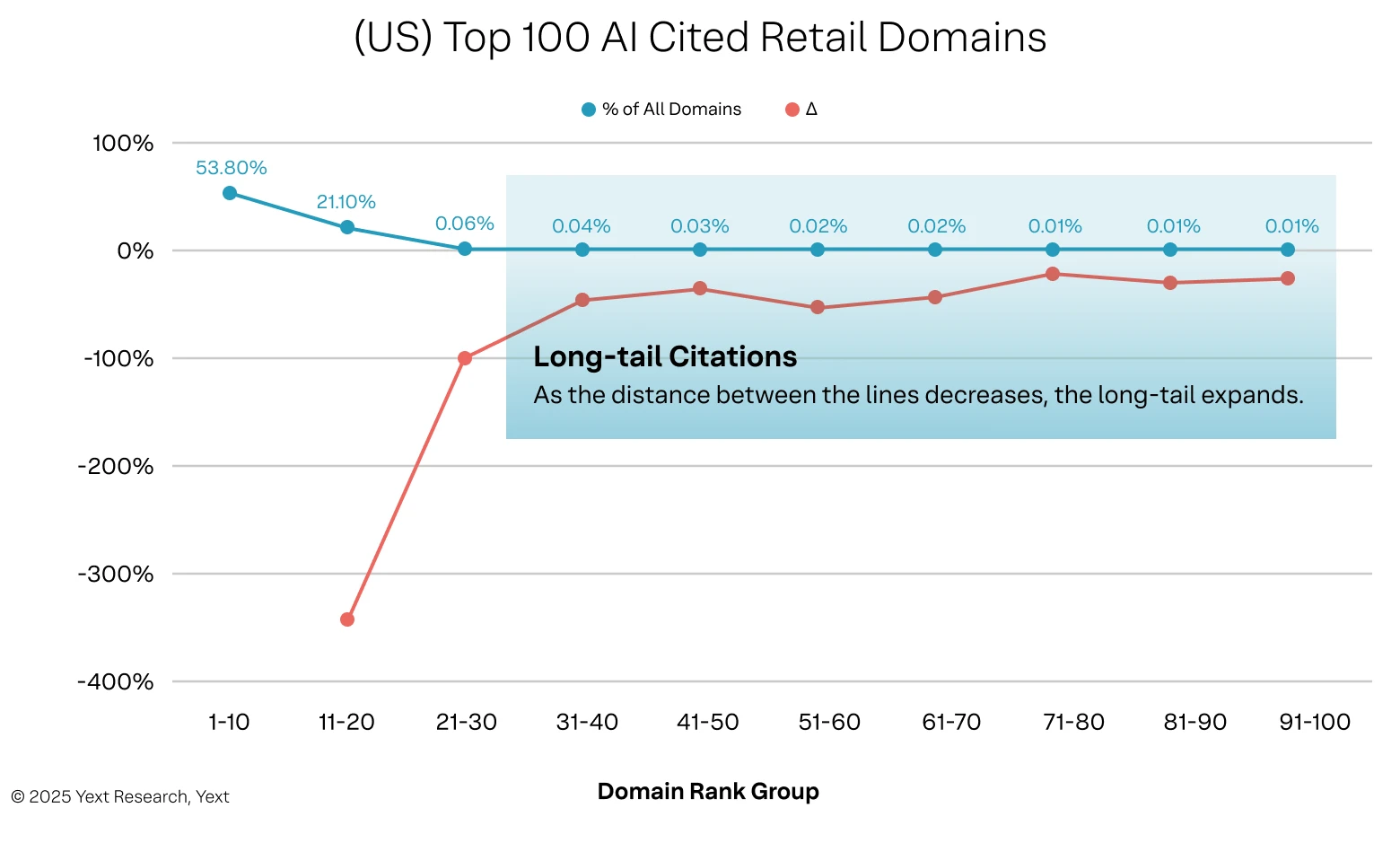
The long tail begins with the next group of smaller, credible platforms that consistently appear ahead of consumer giants like Uber Eats, DoorDash, and Reddit. These are the signals AI systems repeatedly pull from to validate, contextualize, and rank brand information.
In other words, AI appears to prefer structured, reference-style data, while humans still lean into conversational, experiential, and visual sources. That gap says a lot about where the models find reliability versus where people find relevance, and it hints at a growing divergence between what machines know and what people trust.

Success in AI is not about keywords; it’s about showcasing value. When a user asks a question, AI looks for intent and context, and it applies the same logic when sourcing an answer. Studies of generative search systems show how selective that process has become.
One analysis of four major AI engines found that only about half of the generated sentences were fully supported by citations, and just three-quarters of those citations accurately backed the statements they were linked to. That gap exposes how critical it is for brands to make their data easy to verify and clearly attributable.
For retail marketers, this means treating your website and directory listings as critical infrastructure. AI models assess whether content is recent, factual, and mapped cleanly to entities within their internal knowledge graphs. The brands that organize their information like a database — consistent schema, accurate metadata, and verifiable claims — are the ones AI systems will trust and quote. In short, if the model can read you clearly, it can cite you confidently.
Five ways to build a real competitive advantage in AI search
-
Authority still rules. AI doesn’t guess—it cites what it trusts. If your content reads like a secondhand source, the model will treat it that way. Brands with clear expertise, data transparency, and a verifiable digital footprint dominate citations.
- Keep content factual, not speculative.
- Publish first-party or institutional data whenever possible.
- The major models — Gemini, ChatGPT, and Perplexity — consistently prefer original, data-driven, first-party sources.
-
Structure matters more than style. AI systems don’t “read” your content; they parse it. That means technical clarity is a competitive edge. Clean markup, consistent schema, and machine-readable structure determine whether your brand is even in the index that powers generative answers.
- Use Schema like: Product, FAQPage, HowTo, and Dataset to define what your content represents.
- Keep metadata transparent and aligned with on-page text — hidden or mismatched tags are ignored or penalized.
-
Relevance has an expiration date. Generative models reward freshness and penalize neglect. Old numbers, broken links, and outdated inventory tell the system you’re unreliable. Frequent updates signal you’re active and relevant.
- Refresh timestamps and validate facts regularly.
- Replace aging statistics or claims with current data.
- Lead with the most important information — AI looks for concise, verifiable facts, not storytelling arcs.
-
Earned mentions beat self-promotion. AI checks its sources against the wider web. If others don’t validate your information, it’s unlikely to surface you as an authority. Credibility comes from corroboration, not repetition.
- Strengthen your presence across trusted third-party directories and associations.
- Pursue legitimate editorial mentions and data citations that link back to your domain.
- Remember: AI reads the footnotes — make sure you’re in them.
-
Measure what actually matters. Rankings are a relic of pre-AI search. The new visibility metric is citation frequency — how often your brand is referenced by AI systems, in what context, and for which topics.
- Track citations across Gemini, ChatGPT, and Perplexity using source-visibility tools.
- Benchmark your presence against competitors to understand which entities models favor in your vertical.
- Treat AI citations as a brand-equity signal, not just a technical KPI.
The new shelf space
As discovery shifts from search results to synthesized answers, every retailer is competing not just for attention, but for inclusion in the machine’s worldview. AI doesn’t reward clever copy or paid placement; it rewards clarity, accuracy, and trust. The retailers that treat their content as structured data, their brand mentions as citations, and their listings as infrastructure will define how consumers encounter products in this next phase of digital commerce.
Generative AI is turning discovery into a conversation, and that conversation is increasingly one-sided. Most users won’t see the list of options beneath the surface — they’ll see the single recommendation that made the cut. That makes your visibility in AI answers a high-stakes competition for credibility.
This holiday season, every brand will fight for clicks. But the smart ones will fight for citations. Because when the algorithms decide what shoppers see, being quoted is the new conversion.