AI Doesn’t Rank, It Cites. And 86% of Its Sources Are Brand-Managed

New research from Yext reveals how geography, query type, and user context shape AI citations — and where marketers can take action to drive visibility today.

Yext

Oct 9, 2025

6 min

TL;DR: AI is changing how people search: 75% are using AI tools more than last year, and nearly half use them daily*. The good news for brands? New Yext research, based on 6.8M AI citations, reveals that 86% of sources AI cites are within marketers' sphere of influence (websites, listings, and reviews).


Whether it's asking ChatGPT for a nearby dentist or using Gemini to compare local banks, AI search is reshaping how people find brands and make decisions. A full 75% of people say they're using AI tools more today than they were just a year ago — and 43% use them daily or more.

Yet many marketers are still flying blind over this new terrain. They've already noticed a drop in organic traffic as search behavior shifts, but they don't know how AI tools decide what to cite in an answer — or how to influence that process.

Yext's latest research changes that.

We analyzed 6.8 million citations from over 1.6 million AI-generated responses across Gemini, OpenAI, and Perplexity, and the findings are clear: 86% of citations come from sources marketers can directly manage or strongly influence — like a brand's website, listings, and reviews.

That's good news if you're a marketer looking for concrete ways to drive visibility in AI search.

Below, let's dive into three key takeaways from the report.

1. Marketers can influence the majority of AI citation sources

So, where do AI models really look in order to generate direct answers to questions?

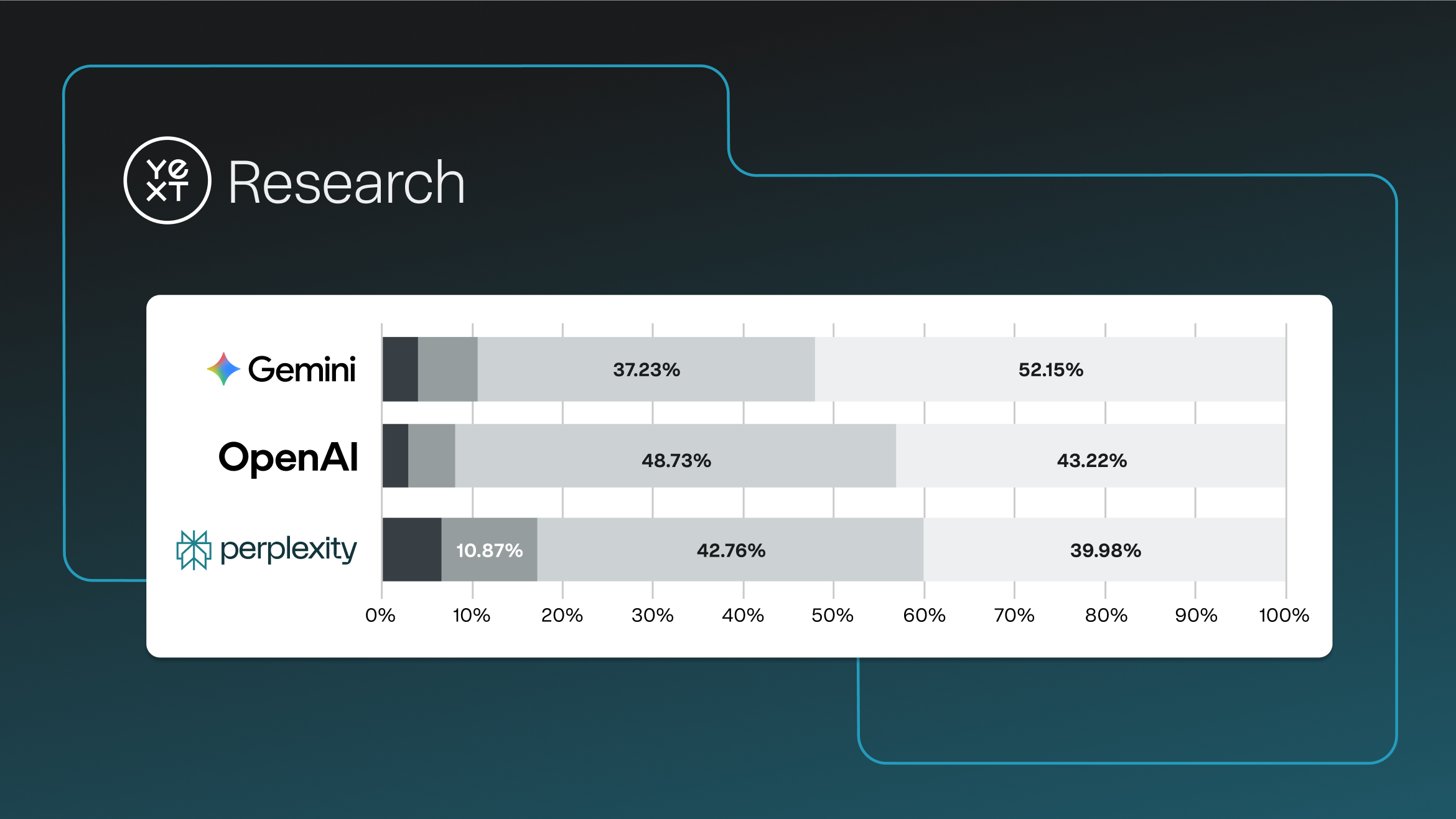
In our research, we categorized every source AI models cited into four buckets based on how much control a brand has:

  • Category 1: Full Control (Websites) – 44% of citations

  • Category 2: Controllable (Listings) – 42% of citations

  • Category 3: Influencable (Reviews & Social) – 8% of citations

  • Category 4: Uncontrollable (News, Forums, Other) – 6% of citations

When AI search first took off, many marketers worried that platforms like Reddit would dominate the cited answers. But the data tells a different story: most of what AI cites isn't out of your hands. Marketers can shape 86% of the sources that AI engines use to build their answers. And doing so is the difference between being part of the conversation and being invisible.

Also important to note? These sources do vary by industry.

  • Retail relies on owned websites: 47.6% of citations come from first-party websites, underscoring the importance of structured, authoritative local pages.

  • Finance favors authoritative domains: 48.2% of citations are tied to brand-owned websites like local banking pages, reflecting customer demand for trusted sources.

  • Healthcare depends on third-party directories: Listings account for 52.6% of citations, with WebMD and Vitals and industry-specific directories dominating visibility.

  • Food service is reputation-driven: Reviews and social content make up 13.3% of citations, the highest of any industry, while listings remain the single largest driver at 41.6%.

To dive further into the vertical-specific findings, click here.

2. Brands need to benchmark and optimize at the brand and local level

Most current research into AI citations stops at the brand level. That's helpful for tracking general share-of-voice, but not for understanding how real people actually ask questions.

Our analysis takes a different approach. We looked at AI answers through the lens of how someone actually searches — accounting for a person's location, their query type (an objective query, like "coffee shop hours" versus a subjective query, like "best coffee"), and their intent (branded versus unbranded). That context changes everything.

All the major AI models consider a user's location as part of their calculus. This means it's important to have local landing pages and regionally specific content.

For example, when someone searches for "best pourover coffee near me," — a subjective, unbranded, location-based question — the AI isn't pulling from Wikipedia; it's pulling from individual listings, review platforms, and local pages. In fact, general forums like Reddit made up just 2% of citations in our study. That's a far cry from what brand-level analysis alone might suggest.

The bottom line: Customers — and the AI tools they consult — make a lot of purchase decisions at the location level. Managing only at the national or brand level risks losing customers "at the sidewalk" where purchase decisions actually happen.

3. Marketers need to be everywhere AI looks

Another truth about changing search behavior in the AI era? People are using more channels than ever. A search journey might start with a conversation with ChatGPT, an answer from Google Gemini, or even a scroll on TikTok — or all three. And behind each of those experiences, AI platforms are crafting answers from many different sources — often in mere seconds.

Our research confirms what many marketers already feel: a one-channel strategy won't cut it anymore. Here are a few of the citation nuances we discovered:

  • Gemini favors first-party websites

  • OpenAI leans heavily on third-party listings

  • Perplexity diversifies across a mix of sources, including review platforms and local pages

The common thread? These sources live across your brand's entire digital footprint. If your information isn't structured and consistent everywhere, you risk being misrepresented or overlooked entirely.

Visibility isn't about playing favorites with channels anymore. It's about being trusted by all of them.

How brands can take action today

The good news: AI citations aren't random. They're earned through data that's complete, consistent, and easy for machines to understand. That means you can take control starting today.

Here's what to do:

  • Measure visibility across platforms and locations. You can't improve what you can't see. Benchmark where your brand is being cited — and where it's missing. (Yext Scout makes this simple.)

  • Structure your brand facts in one central source of truth. AI rewards clarity. Centralizing data — like locations, services, providers — makes it easier for AI to understand, trust, and cite your brand. (Hint: you can power all of this with the Yext Knowledge Graph.)

  • Distribute information everywhere AI looks. From websites and local pages to listings, reviews, and directories — coverage and consistency across trusted sources is the new visibility strategy. (Enter, the Yext Brand Visibility Platform.)

The brands that win in AI search aren't guessing. They're structuring their data, distributing it strategically, and tracking performance.

Staying visible in an AI-first world

AI doesn't rank brands — it cites them. And when it comes to those citations, brands have more control than they think. Whether you're in charge of 5 locations or 5,000, our research shows a path forward that's clear, scalable, and grounded in data — so you can stop chasing mystery metrics and start shaping how your brand shows up in AI-generated answers.

Click here to read the full AI citations report.

*Survey details: The results in this report are from an online survey of 2,237 adults who made a purchase online within the past three months and used voice search (e.g., Siri, Google Assistant, Alexa) or conversational AI (e.g., ChatGPT, Perplexity, Claude) to find information online. The survey was conducted from March 20 to April 6, 2025, by Researchscape International on behalf of Yext. Results were weighted by country population, age, and gender. Respondents were from four countries: the United States, the United Kingdom, France, and Germany.

Share this Article

Read Next

loading icon

Get the Latest Insights from Yext Research