The Best AI Experience for Finding a Doctor Might Not Be a Chatbot
See how smarter matching gets patients to the right provider faster.

Rob Cameron
Oct 15, 2026

TL;DR: By the time patients reach a Find-a-Doctor experience, they’ve often already done their research in Google, ChatGPT, or Gemini, so the goal isn’t to start another conversation but to get them to the right provider as fast as possible. LLMs make that possible by understanding the way patients actually talk (like “heart doctor” instead of “cardiologist”) and matching that intent against specialties, subspecialties, and provider data, asking a clarifying question only when it’s grounded in the query and would genuinely improve the match. The best AI experience here meets patients where they are and builds the shortest path to the right provider.
The best AI for finding a doctor uses an LLM to understand patient intent without forcing a conversation. See how smarter matching gets patients to the right provider faster.
With their ability to understand natural language and reason through complex information, LLMs are changing how people navigate their daily lives — including how they make healthcare decisions.
In response, healthcare organizations have started exploring how generative AI can improve experiences across the patient journey. But there’s an important distinction between using an LLM to understand a patient and requiring a patient to have a conversation with one.
By the time someone is actively searching for a provider, they may already have meaningful intent: they might need a cardiologist, an OB-GYN, a knee doctor. At that moment, the job isn’t necessarily to start another conversation. It’s to get them to the right provider as quickly as possible.
The best AI experience at this stage may therefore be one that uses the intelligence of an LLM while requiring surprisingly little interaction from the patient.
Patient intent can come from anywhere
Patients don’t begin every healthcare journey on a health system’s website.
They might start with Google. They might ask ChatGPT or Gemini about a symptom or condition. They might consult their payer network, get a referral, or already know what kind of specialist they’re looking for.
And, increasingly, that initial research is happening outside the health system’s own digital experience. Pew Research Center found in 2026 that 22% of Americans get health information from AI chatbots like ChatGPT or Gemini at least sometimes. In separate research, Pew found that 44% of U.S. adults use ChatGPT, compared with 24% for Gemini, 17% for Copilot, and 6% for Claude.
Further, patients aren’t just using AI for generic health information. Pew found that 34% of Americans use AI chatbots for at least one health or medical purpose, including 25% who use them to understand what’s causing symptoms and 15% who use them to help decide whether to see a doctor.
All of this matters because a patient may have already done significant research before they reach a Find-a-Doctor experience.
Once that research turns into “I need a cardiologist” or “I need an OB-GYN near me,” the job changes. They don’t necessarily need another open-ended conversation. They need an efficient way to turn that intent into the right provider.
A modern provider-matching experience should be able to pick up from there, regardless of where the patient’s intent was formed.
The breakthrough isn’t chat. It’s better matching.
The problem is that patient language doesn’t always map neatly to healthcare taxonomy. Someone might search for “heart doctor” instead of “cardiologist.” They might use an acronym, a misspelling, or an alternate term. And even when they identify the right specialty, that can still be too broad: the right provider might actually be an electrophysiologist, an interventional cardiologist, or another subspecialist.
This is where LLMs can fundamentally improve provider search. They can understand the language patients actually use and reason across specialties, subspecialties, and richer provider information. A conversation likely isn’t required, but some simple follow up questions might be able to refine the results.
How this works in practice
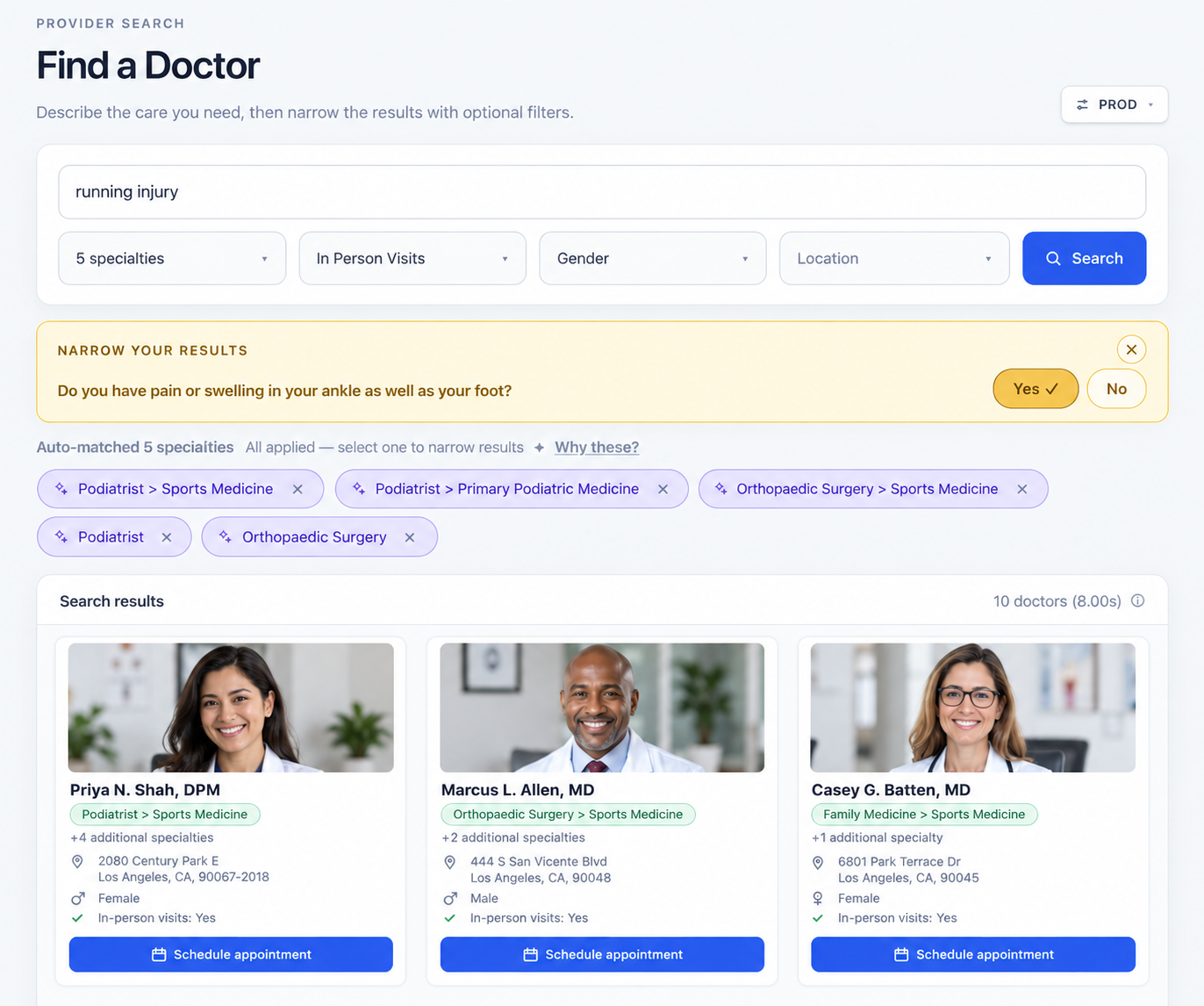
Consider someone searching for “foot doctor for running injury.”
There’s already meaningful intent in that query. “Foot doctor” gives us a broad area of care, while “running injury” provides additional context that may point toward a more specific match. An LLM can understand those signals together, map them against the health system’s provider taxonomy and provider information, and immediately return relevant providers.
It can also recognize that there’s an interpretation worth confirming. If the available provider set includes specialists whose expertise in sports medicine makes them particularly relevant to the query, the experience could ask:
Do you have pain or swelling in your ankle as well as your foot?
A “yes” confirms a signal that was already present in the original query and can prioritize those providers. A “no” keeps the broader set of relevant foot specialists in consideration.
The important part is that the question isn’t arbitrary. It’s grounded in both what the patient has already told us and what the available providers actually specialize in.
If there aren’t providers in the available pool for whom that distinction would improve the match, there’s no reason to ask the question. And if the original query doesn’t provide a reasonable basis for the clarification, we shouldn’t invent one to make an experience feel like a conversation.
Don’t recreate the journey. Pick up where the patient is.
Conversational AI has plenty of applications in healthcare. But Find-a-Doctor doesn’t need to recreate the research and exploration a patient may have already done somewhere else.
That’s particularly important as more of that journey happens across third-party search and AI experiences. A patient who has already researched their symptoms, learned what type of specialist they might need, and decided to find one doesn’t necessarily benefit from being dropped into another conversation that starts gathering context all over again.
The better experience is to meet the patient where they are.
Take the intent available at that moment. Understand it accurately. Identify the most relevant providers. And resolve only the ambiguity necessary to improve the match.
Sometimes that intent will come directly from a patient typing into a Find-a-Doctor experience. Increasingly, it may come from a journey that started somewhere else.
Either way, we don’t need to own every interaction that led to the patient’s intent. We need to be excellent at turning that intent into the right provider.
Build the shortest path to the right provider
Sometimes AI needs to understand an imperfect query. Sometimes it needs to distinguish between subspecialties. Sometimes one clarifying question can dramatically improve the match.
And sometimes… the patient has already told you everything you need to know.
The promise of LLMs isn’t that every healthcare experience can finally “become a chatbot.” It’s that our technology can understand patient intent much better than it could before.
For Find-a-Doctor, that’s an opportunity to make the experience faster, smarter, and more precise. Conversation not required.