The Four Pillars of Trusted Agentic Marketing: Brands Need Governance and Oversight
Most platforms only cover one of the four. Here’s what every marketing leader needs to know before they let agents execute.


This is part four of a five-part series on agentic marketing. Click here to read part three.
The fourth pillar of agentic marketing: governance and oversight
The standard objection to governance in agentic execution is that it creates friction: teams want to move fast, and they want agents to take action without jumping through dozens of approval hoops. But that objection misses the point. Trustworthy data makes agents predictable. And predictability — knowing what actions agents will take and exactly what concerns they’ll escalate — is what safe speed actually depends on.
What makes this possible? Two things working together.
-
A verified source of truth, maintained in real time. Data that was accurate six months ago is not necessarily accurate now. In part, “governance” just means keeping the verified source of truth from pillar two (Knowledge Graph) accurate and fresh. Agents acting from fresh, verified data can execute confidently. They know they are working from something authoritative, not something stale or contradictory.
-
Second: Human owners who set guardrails and catch edge cases. AI agents are excellent at pattern execution. They’re not as good at intuiting when a situation is novel and requires a different call. Someone has to be responsible for the permissions agents have, and in what circumstances. Someone has to be accountable for catching the moments when the rules need to change. That ownership is what boards demand, and it is what brands need.
Governance in practice: Yext Action Center
With the Action Center in Yext Scout, users don’t have to face down an interminable review queue; they have a command center.
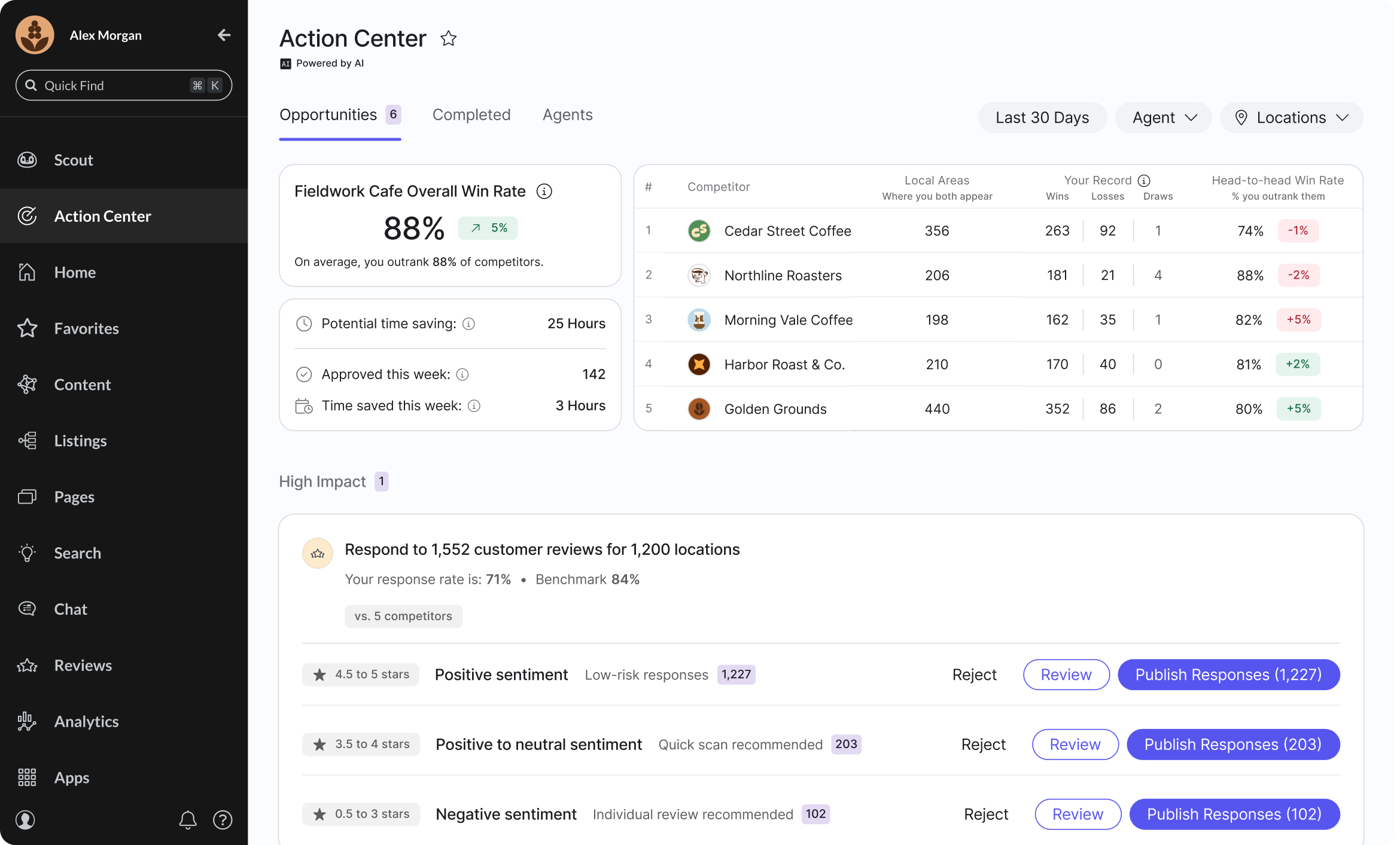
The last section detailed what Yext agents can do to help brands create and syndicate the content that helps them win in AI search. But Action Center is where brands can monitor and govern that execution — across all agents, in one place. It gives brands the control to decide what runs, who approves it, and what gets logged.
One example: review response
Here’s what that looks like in practice.
Imagine a brand with thousands of unresponded reviews across hundreds of locations. Manually responding to all of them would take hundreds of hours. But responding to reviews is also a best practice every brand needs done.
This is where intelligent tiering in the Action Center makes speed possible without brand reputation risk.
A brand could decide that responding to positive sentiment reviews is generally a low-risk activity. With permission, agents could use approved language and information to draft a response and publish it instantly. If a brand has already created approved responses for positive reviews in settings, there is nothing to think about. The response is good to go.
Negative sentiment reviews, on the other hand, might require much more care. A brand could set up that these review responses be routed to a human take a deeper look, edit if needed, and make sure they’re properly handled — before an agent takes any autonomous action.
This same model applies across all agent-driven actions: adding photos, creating pages, updating listings, publishing social posts. Brands decide where they want full automation, where they want a quick human check, where they want careful review.
What governed agentic execution looks like with Yext
Four things work together:
- Clear data ownership: Someone is accountable for what the Knowledge Graph contains. Not a committee. One owner, one person responsible for keeping it accurate and current.
- Clear escalation paths: When an agent encounters a situation it has not seen before — a scenario outside its training — it flags it for human review instead of guessing. The escalation is automatic and logged.
- Continuous verification: Agents surface data inconsistencies automatically, before they propagate to customers. The system tells you when something is wrong, not after a customer complains.
- Speed without brand risk: The guardrails are built into the source, not bolted on at the end. Agents can act decisively because the foundation is sound. Approval is not required for every single decision. It is required only where you determine it should be.
The brands moving fastest with agentic marketing are the ones that built the governance infrastructure first.