The Four Pillars of Trusted Agentic Marketing: Brands Need Better Content and Direct Distribution
Most platforms only cover one of the four. Here’s what every marketing leader needs to know before they let agents execute.


This is part three of a five-part series on agentic marketing. Click here to read part two.
The third pillar of agentic marketing: content creation and direct distribution
A unified, structured source of truth for all brand data (across locations) is a must-have, but no brand can win in AI search with just data sitting in one place. Content and distribution are the third pillar of trusted agentic marketing because they're where verified data becomes visible, citable, and actionable across every endpoint where AI looks.
Why most content creation and distribution strategies fall short
Let’s start with the big picture. Brands know that creating and publishing content is key to getting cited in AI search. So, when generative AI made content incredibly cheap to produce, the market response from many brands was to flood the internet with it: generic pages, duplicate copy, content created for sheer volume.
After all, content is still king, right? The answer is a frustrating “yes, but.” The modern content problem brands face is that it has to be exactly the right content in all the right places in a consistent manner.
The “volume trap” content strategy fails in the AI search era for two main reasons:
-
LLMs reward specificity. If content doesn't actually answer the question a customer is asking — if it's generic filler instead of location-specific detail — the LLM simply skips it. For example: a page that says "We're open and serve great food" answers nothing. A page that says "We host private dining events for up to 40 people, and here's what it looks like" answers something real. Highly specific content and clear CTAs are also key to getting AI agents to book on a page. (Read more here.)
-
LLMs reward consistency: Yext Research looked at 155 million distinct AI citations gathered globally across four major AI models and found that they look at brand-owned websites, local pages, listings, and reviews, and social media profiles. The good news? Brands have a lot of control over the majority of those sources. The challenge? LLMs reward consistency across every single one of them. If a brand is claiming fast service across all its marketing content but customer reviews at that location are full of complaints about wait times, AI sees both. And it doesn't favor the content the brand controls. It looks for consistency across everything it can access. When it finds a contradiction, it downgrades credibility or skips the brand entirely.
Next, there’s the distinct — yet related — distribution problem. Most brands still manage their presence and business information on the “big four” publishers (Google, Apple, Bing, Meta) and let everything else drift. “Who looks at Yellowpages anyway,” is the common assumption.
That strategy made sense when humans were searching, because people usually do click through a few Google or Bing links, or look at a few photos, and then make a decision. But AI works differently. It “reads” across a massive set of sources simultaneously — including third-party directories most marketing teams have never touched. (Did you know? Yext Research found that MapQuest is actually the top-cited URL for location-based queries — not Google.) And inconsistent data on those sources is — once again — a negative signal.
But most brands distribute information to these endpoints through aggregators. They hand data to a vendor, the vendor hands it to an aggregator, the aggregator (eventually) redistributes it downstream. That handoff creates three specific “failure modes” when it comes to AI:
- Latency: brand information/content updates take days or weeks to reach publishers
- Silence: brands get no confirmation of what actually went live
- Decay: data becomes stale over time, and LLMs trust old data less
None of these issues were good in the Google-only era, but they might have been tolerable. They're catastrophic now. When, for example, an AI agent is booking an appointment for a patient in real-time based on hours or specialties, being a week behind isn't acceptable. The booking fails. That failure has a cost.
So, what does genuine content creation and distribution actually look like?
A successful strategy for content creation and distribution requires three things: specificity, consistency, and reach.
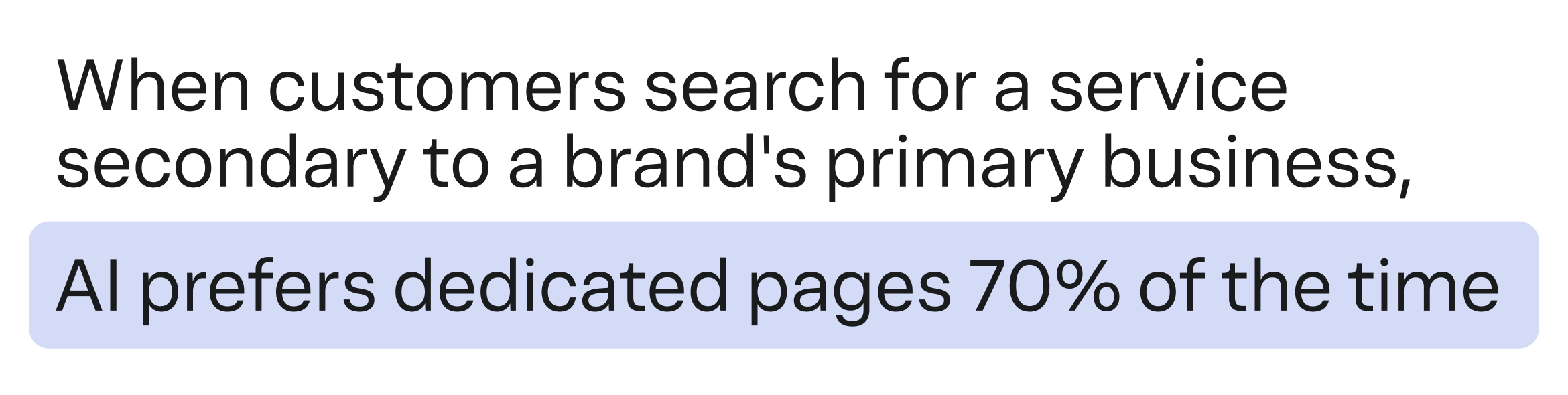
Specificity: Content built to answer the exact questions customers are asking, not generic filler. Yext Research shows that about 47% of AI citations link to websites and local pages — and those citations convert 31% higher than traditional search. But here's the real opportunity: when customers search for a service secondary to a brand's primary business, AI prefers dedicated pages 70% of the time.
Consider a pack-and-ship retailer. For primary category searches (mailing), 61% of AI citations go to the location page. That’s expected, right? But as queries get specific: shredding (84% cite a dedicated page), notary (86%), passport photos (89%). The more specific the question, the less a location page can answer it — and the more AI rewards a page built for that exact intent. For multi-location brands, every secondary service, every location, every query intent is a citation opportunity being captured or ceded to competitors.
Consistency: Consistency matters across every place a brand’s information can be found. Again, Yext Research found that LLMs search across owned websites, local pages, listings, and reviews simultaneously in order to generate citations. Every fact needs to be accurate and in sync across every one of these endpoints. That repeated verification — over and over — is how AI gains the confidence that the information is correct (and should be cited for inclusion in an answer).
People do this, too: Yext’s 2026 consumer survey found that, after receiving an AI-generated answer, 95% perform an additional verification step — looking to confirm information is correct across social platforms, reviews, or a brand’s website.
Reach and recency: Again, information must be distributed everywhere AI looks, not just via the “big four” sites. This means 200+ publishers, owned websites, review platforms, social channels, and the AI systems themselves. It means direct connections, not aggregators. Real time, not batched. One source, every destination.
But scaling this across every location, every channel, and every query intent can't happen by hand. It requires agents.
How Yext helps brands execute this content and distribution strategy
Yext provides the infrastructure for content and distribution at scale through two types of agents working from one verified source.
Content generation agents create on-brand content across every channel, including:
- Publishing Pages that answer specific customer questions: Most platforms give you brand-level content with no way to localize it — and nowhere to publish it at scale. Yext solves both: brands launch thousands of tailored location, professional, product or service pages in days using no-code templates and live data syncs. Marketers move at the speed of AI without waiting on developers.
- Generating review responses drawn from verified data: Brands can issue personalized, not generic, responses — with custom levels of human oversight.
- Creating social posts: Yext lets you make sure each post is tailored to local markets and audience intent.
Everything pulled from the Knowledge Graph, everything is location-specific, and everything is created to answer a real question customers are asking.
Distribution agents reach everywhere that matters. They work to:
- Push core business facts (name, address, hours, phone, services) to 200+ publishers — and Yext Pages — in real time
- Maintain Location.com : Publish data to a Yext-owned directory, structured for AI crawlability and citation
- Connect to the Yext MCP: This allows brands can plug in their own agents and systems (read more here)
Together, these agents turn a unified source of truth into visibility and citations across every endpoint where AI looks. And every endpoint really means every endpoint: Yext Research confirms that models weigh sources a bit differently: Gemini leans ~52% on brand websites, OpenAI ~36% on listings, Perplexity ~51% on websites, and Anthropic ~20% on social and reviews. Only ~5% of citations overlap across models, so covering every one is a must.
From there, brands can scale content and distribution at the velocity their markets demand — without falling into the volume trap or struggling with the aggregator delays that kill visibility today.
When all three pillars — intelligence, verified data, and content distribution — work together in one system, that's where brands win with AI: intelligence becomes action, which in turn becomes visibility, citations, and transactions.
But there’s one more piece to the puzzle of responsible agentic execution in the AI search era: governance and oversight.