The Four Pillars of Trusted Agentic Marketing: Brands Need a Verified Source of Truth
Most platforms only cover one of the four. Here’s what every marketing leader needs to know before they let agents execute.


This is part two of a five-part series on agentic marketing. Click here to read part one.
The second pillar of agentic marketing: the verified source of truth
Intelligence tells you where you stand and what needs to change. But knowing what the problem is doesn't solve it. That leads us to the next foundational pillar of agentic marketing: the verified source of truth. Brands need a single, authoritative source to store and structure their information — and to give agents the right base to then distribute all of that data from.
What is a verified source of truth?
A verified source of truth is a single, structured repository of accurate, current data for every location in a brand's portfolio. Fields map to schema.org — the standard language AI models use to interpret brand data. Then, when agents need to execute on a task — whether that's responding to competitive gaps or updating location information — they can work from this one source, not a dozen fragmented systems.
The truth? Even in 2026, most brands don't have this. Their location data lives scattered across Google Business Profiles, their website, e-commerce platforms, their POS system, local spreadsheets, and more. Each system claims to be the source of truth until it isn't. And often, they don’t agree with each other.
Why AI needs a reliable foundation
The top-level answer is simple: marketing leaders wouldn’t want a junior team member making autonomous decisions or publishing updates based on bad or unverified information. Why would they let an AI agent do so? For any task an agent initiates, or any answer it gives, operating from one centralized, approved source of truth makes sure that contradictory information doesn’t turn into costly mistakes. (More on this in pillar three, “content and distribution.”)
The second reason is technical. One central hub for structured, AI-ready data — again, presented in the language LLMs already “speak” — helps AI reliably parse, ground, and represent a business. It’s the base-level unlock for leaders looking to make sure their brand shows up with accurate answers wherever results are generated.
How the Yext Knowledge Graph gives brands the right advantage
The Yext Knowledge Graph was designed exactly for this reason.
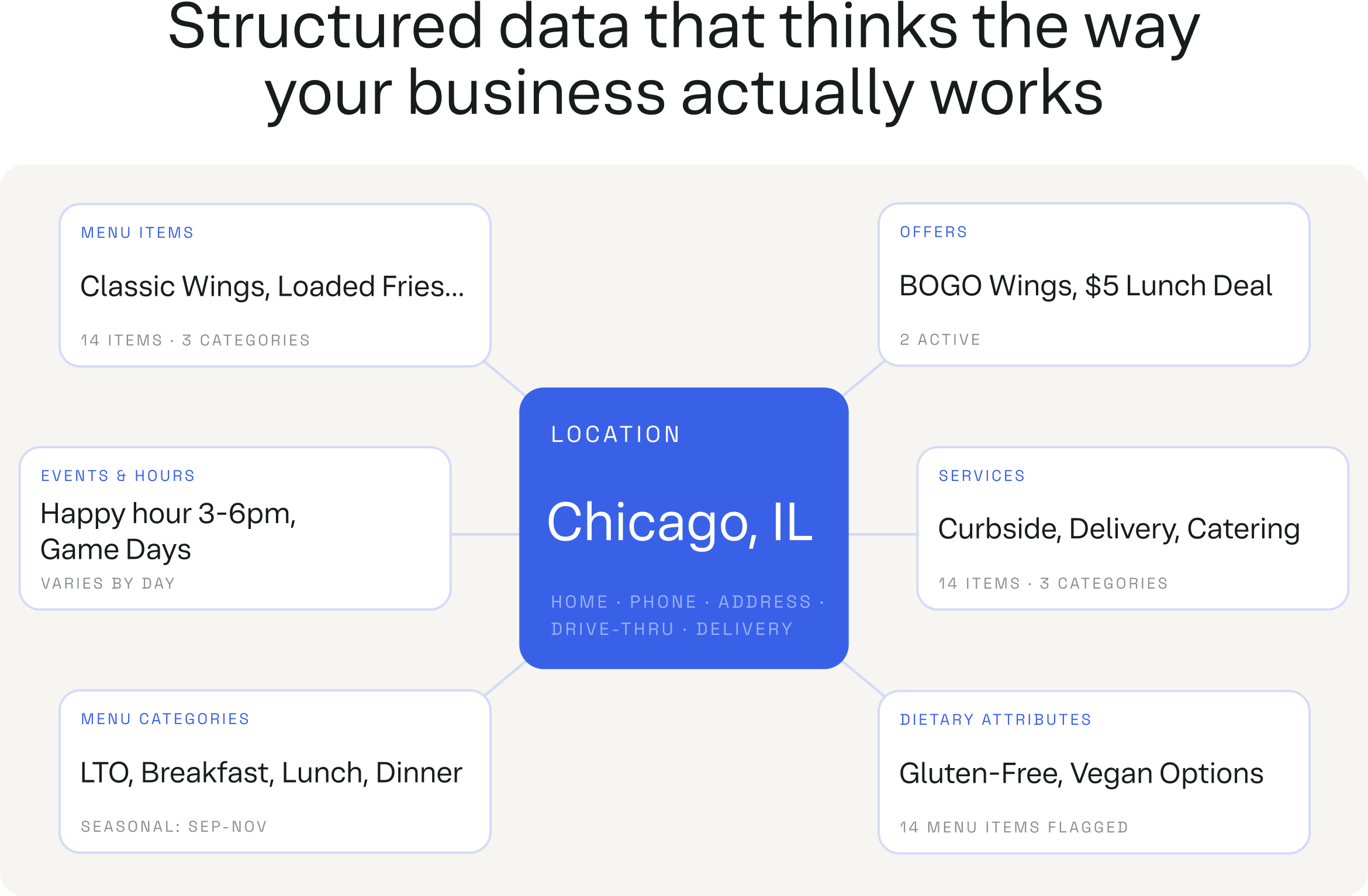
Brands that build a unified Knowledge Graph with Yext gain a structural advantage: faster execution, greater consistency, better AI visibility. That’s because the Knowledge Graph Model lets brands mirror the real world by defining complex relationships between locations, professionals, products, services, and more as structured entities and fields. These connections give both internal AI agents and LLMs the basic context they need to understand a brand.
But it’s not a “set it and forget it” solution.
Next, data agents work continuously within the Knowledge Graph to connect data across sources, verify it at scale, and surface inconsistencies automatically. When a location's hours change in a POS system, for example, data agents can pull that update into the Knowledge Graph. When a new service is added to one location but the Knowledge Graph shows it at another, agents flag the discrepancy. They optimize and maintain this “source of truth,” keeping every fact accurate and current over the long run.
Those consistent and fresh core business facts — name, address, hours, phone, services — give AI the baseline it needs to know a brand exists and trust it.
But having this source of truth is only part of the solution. That source needs to reach every endpoint where AI looks to create the answers it gives customers — and it needs to reach them all at the same time.