The Four Pillars of Trusted Agentic Marketing: Brands Need Competitive Intelligence
Most platforms only cover one of the four. Here’s what every marketing leader needs to know before they let agents execute.


This is part one of a five-part series on agentic marketing. Click the link at the bottom to read part two.
Why agentic marketing (and why now)
Marketing leaders know that AI has changed how their customers make decisions about where to go, what to do, and what to buy. Recent research shows that nearly half (42.7%) of people globally used AI for local search in the past month — and for high-income households, AI has already overtaken Google as the starting point for search. With 71% of people using AI more than they did last year, and a growing number of customers comfortable delegating purchase decisions to AI agents, brands who are absent from AI answers are functionally invisible.
In this landscape, winning looks like appearing in AI answers accurately, consistently, and favorably relative to competitors in every local market. It also means being the brand both humans and machines can easily take action with at the moment a booking or purchase needs to be made.
But accomplishing this is impossible with a manual approach. In response, CMOs — nearly half of whom now own AI investment decisions in their function — are embracing agentic marketing to get the job done. McKinsey estimates that agentic AI will eventually power at least 60% of tasks across marketing teams. And almost all (96%) CMOs surveyed by BCG acknowledge that AI is driving end-to-end transformation of their function.
But the “awareness” of the need to evolve and its execution are not the same thing. Only about a third of those CMOs have started the work to support agentic marketing at scale. That gap between what marketing leaders claim they understand and what they have actually built is the defining challenge of 2026.
Because the risks involved are real: agentic marketing on a shaky foundation doesn’t just fail; It scales mistakes. For example, a brand that deploys agents to generate and publish content without verifying the underlying data will confidently distribute… a lot of conflicting or wrong information across dozens of endpoints for every one of their locations. AI models will see the contradictions and lower the brand's credibility — or skip it entirely.
The main point for marketing leaders: getting agents to execute marketing tactics is easy. Making sure they do it in a trusted way — a way that truly helps their brand get cited in answers and chosen by buyers — is the hard part. That’s especially true amid rampant “agent washing,” where Gartner estimates that only about 130 of the thousands of agentic AI vendors in the market today are actually “real”; the rest are old solutions or automations with AI labels slapped on.
So what does trusted execution actually require?
Whether agents help or harm depends entirely on the foundation underneath. Four things have to work together in order for brands to succeed in leveraging agentic marketing. Those are:
- Deep competitive intelligence: knowing exactly where your brand stands in the competitive search landscape and what needs to change
- A verified source of truth: maintaining unified brand data that agents can act from
- Direct distribution: getting that verified, accurate data to reach every endpoint where AI looks (and might cite in answers)
- Governance and ownership: clear data ownership and clear escalation paths that keep agentic speed safe, not reckless
Brands that build this foundation can move fast without doing damage. This guide walks through each pillar of responsible agentic marketing, explains why it matters, and shows you how Yext can help.
1. The first pillar of agentic marketing: deep competitive intelligence
No leader can improve AI search performance, drive actions, or win business without adequate information about where they stand. Intelligence is the first pillar of trusted agentic marketing because it’s where all execution has to start.
Why most intelligence falls short
Most marketing teams today operate with brand-level visibility data: aggregate sentiment, top-line share of voice, a rough sense of how their brand ranks or gets cited across a few search engines or AI tools. That's directional, but it's not actionable.
Here’s why. Imagine that a national retailer with 4,000 locations runs a “visibility scan” and gets back a single number: an AI visibility score of 72 out of 100. The tool calls it a win. But that score tells the CMO almost nothing useful, such as:
- Which of 4,000 stores are actually underperforming?
- Against which local competitors are they losing?
- On which answer engines (ChatGPT? Gemini? Others?)
- For which categories or query types?
Without those answers, any budget allocation or strategy built on that number optimizes for the average — meaning it's likely wrong for a lot of the locations that matter.
Most AEO vendors deliver exactly this level of data: aggregate scores, top-level rankings, brand-wide sentiment. The output looks comprehensive until you try to act on it.
What does genuine intelligence look like?
Deep, actionable intelligence requires three things: depth, breadth, and competitive context.
Depth: Granularity down to the individual location, not national averages. Leaders need to know which specific store is losing, to which specific competitor, on which specific answer engine. As just one example: a restaurant chain might rank well for its own name across ChatGPT and Gemini, but perform poorly for "casual dining with private dining rooms" or "best brunch spot near me." That gap is invisible at the brand level. It's entirely visible at the location level.
Breadth: Information about every endpoint where AI might look to source its answers, not just a brand’s website and the “big four” publishers (Google, Apple, Bing, Meta). LLMs check dozens of sources for location-based, high-intent queries, many of them long-tail directories.
Competitive context: A brand’s metrics measured against the competitors that actually matter at each location. A score only means something when benchmarked against the competitors who are actually there. Visibility is relative; leaders need to know whether their location(s) is losing to a national chain, a local competitor, or both.
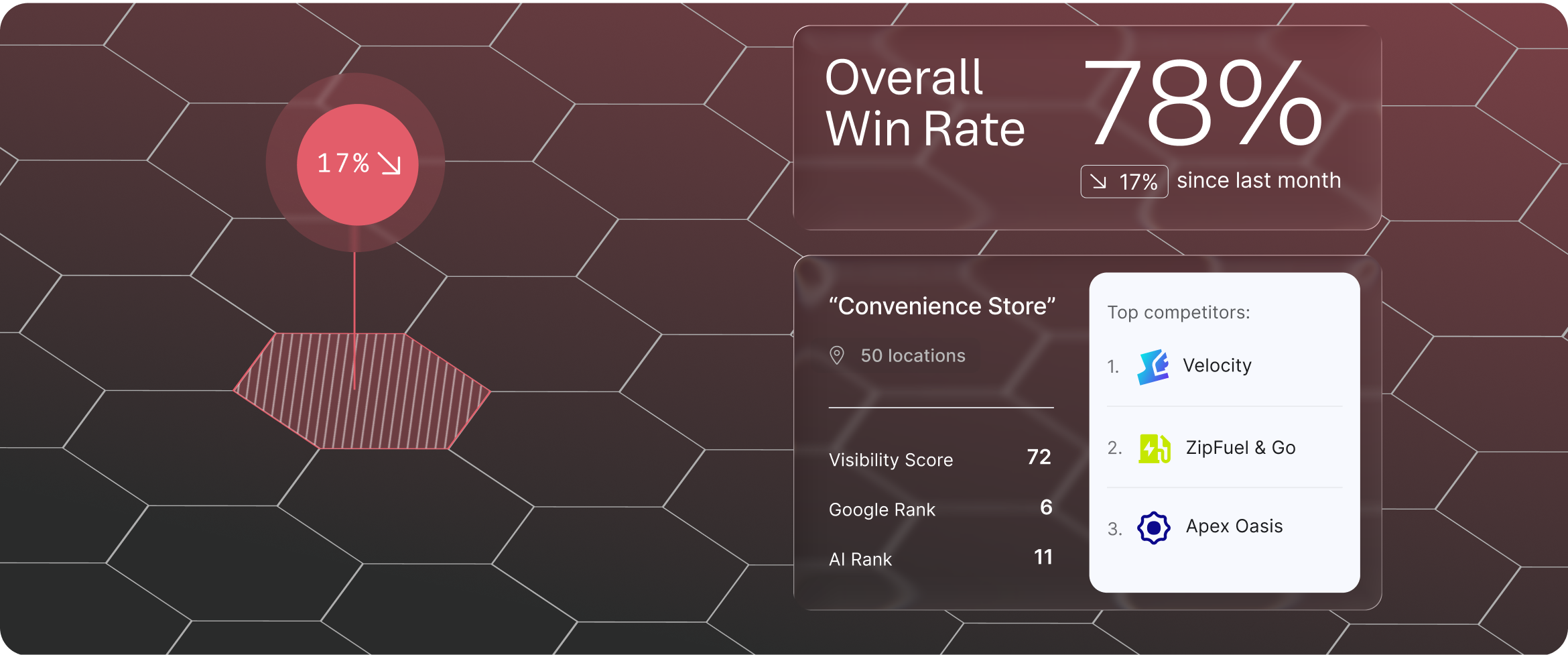
How Yext Scout gives brands the deep competitive intelligence they need
Yext Scout was built with those exact necessities in mind. Scout delivers:
- 10B+ signals analyzed across ChatGPT, Gemini, Perplexity, Claude, and Google
- 12M+ business locations benchmarked
- 150 visibility metrics per scan
- 19 competitors benchmarked per location
The result is intelligence at the location level, not general national rollups. And every recommendation comes with a reason behind it: with Scout, the output isn’t simply "your visibility dropped at location 1247," but "you lost to Competitor X on this category keyword at this location, and here are the three factors driving that."
A black-box overall visibility score gives a CMO nothing to stand behind in a board meeting. But structured, benchmarked intelligence does. It answers the questions that actually matter: where exactly do we need to act, and why.
Intelligence without the ability to act on it is just another report to read. When intelligence is paired with agents that can execute on it, however, that's where brands gain a competitive edge.
But that’s only true if those agents are working from the right data foundation.