TL;DR: Structured data gives AI a clear, trustworthy understanding of your brand so you can be found and cited more often. By organizing your information in a machine-readable way, you remove ambiguity and strengthen visibility across search and answer engines. With Yext's Knowledge Graph, you can structure and distribute that data at scale, ensuring every detail is accurate, consistent, and ready for AI to use.
What is structured data?
Structured data is information that's formatted in a predictable, machine-readable way. Instead of burying key details inside paragraphs, structured data presents facts as discrete fields that AI engines can easily interpret. Examples include:
Location details: address, hours, geocoordinates
Product attributes: price, availability, dimensions, specifications
Service information: specialties, accepted insurance, appointment types
Menu items: ingredients, nutritional values, allergens
Professional credentials: provider bios, certifications, expertise
Structured data gives search engines and AI models a clear understanding of what your brand offers, how it's organized, and which entities relate to one another. In the AI era, that clarity is often the difference between being understood and being overlooked.
What role does schema markup play?
Schema markup is the code behind structured data. It's a shared vocabulary, maintained by Schema.org, that helps search engines and AI systems interpret content on your website in a consistent, standardized way.
By tagging your content with schema markup, you're giving machines explicit context for your information. For example, marking up a street address tells AI that the numbers and words relate to a physical location, not just text on a page. That clarity powers everything from rich search results to voice assistants and generative AI answers.
In short: structured data makes information readable. Schema markup makes it understandable.
Why structured data matters for AI Search and SEO
Structured data has long been a key component of search engine optimization, powering rich results, knowledge panels, and local packs in traditional search. But as AI search grows, its importance has expanded from enhancing results to enabling discoverability itself.
AI engines don't skim your site the way humans do. They are looking to extract facts. Structured data makes those facts easy to find, validate, and use.
It builds trust. Models cite sources they trust. Structured data provides consistency and reliability, reducing ambiguity and improving the likelihood of winning AI citations.
It improves brand visibility. AI engines lean on entity-level information. The more complete and structured your data is, the more likely you are to appear in objective, local, or product-specific queries.
It reduces ambiguity. If information is inconsistent or incomplete, AI fills the gaps with third-party sources — sometimes competitors or outdated information. Structured data prevents that drift.
It powers modern SEO and AI search. Structured data is a major signal for AI search, even moreso than it has been for traditional SEO. Schema-rich pages, clean IDs, and well-modeled relationships help both search engines and LLMs understand context and respond accurately.
Together, these elements make structured data one of the strongest AI trust signals that brands can control today. By giving machines clean, consistent facts, you increase AI search visibility and ensure your information is used — not invisible — in answers across search and AI platforms.
How structured data works
Structured data works by breaking your brand's information into a predictable system of entities, attributes, and relationships. Instead of forcing search engines or AI models to infer meaning from paragraphs, structured data gives them a clear, machine-readable model of what each thing is, the details that describe it, and how everything connects. This structure enables AI to accurately interpret your brand, deliver precise answers, and confidently cite your content.
Entities
Entities are the foundation of structured data. An entity represents a real-world "thing" your brand manages: a location, a provider, a product, a service, or even the brand itself. Each entity is defined as a distinct object with a unique identity, making it easy for AI systems to recognize and retrieve it reliably.
In practice, entities anchor your data model. When AI engines scan your content, they need to identify the primary objects they're evaluating. A restaurant, a shoe, a doctor, or an appointment type are all examples of entities. By clearly modeling each one, you reduce ambiguity and give AI a stable reference point to interpret your information.
Attributes
Attributes are the facts that describe an entity. They turn a basic object into something detailed and useful — the kind of structured information AI systems rely on to answer questions accurately.
For example:
A Location entity may include attributes such as address, hours, geocoordinates, and amenities.
A Product entity might store information such as price, SKU, availability, dimensions, or materials.
A Service entity could include duration, accepted insurance, eligible providers, or required preparation steps.
Attributes matter because AI engines extract facts, not prose. The more complete and consistent your attributes are, the easier it is for AI to match your data to user intent: "Is this store open now?" "What's the price?" "Which provider offers this service?" Structured attributes ensure AI can answer correctly — and cite your brand as the source.
Relationships
Relationships define how your entities connect to one another. They give AI models the contextual understanding required to interpret your brand the way a human would.
Examples include:
A location offers specific services.
A provider practices at certain locations.
A product belongs to a category.
A service can be performed by particular providers.
These connections matter because AI engines rely on relational context to generate accurate recommendations. Without modeled relationships, platforms must infer connections — and can often do so incorrectly — or default to third-party data. With relationships in place, AI can answer multi-step questions like "Which eye exams are available at clinics that take my insurance?" or "Which locations have this product in stock?" with far greater precision.
Examples of structured data in practice
Schema markup on a local page
Schema markup is one of the most direct ways to help search engines and AI systems understand your business. In the example below, a restaurant is described using a standard vocabulary from Schema.org. Instead of scanning a page for clues, an AI engine can instantly recognize the entity type ("Restaurant"), confirm the address, interpret hours, and understand what cuisine is served.
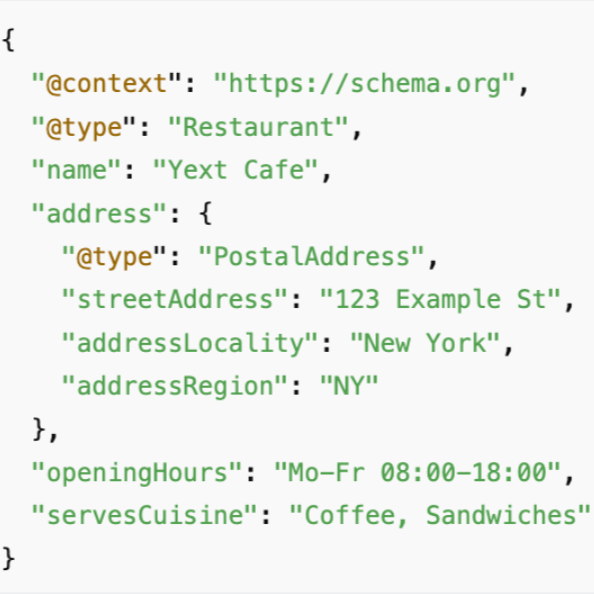
When this information is structured the same way across all your locations, AI engines can answer questions like "Is this place open now?" or "Where can I get a coffee near me?" with far greater confidence. Your brand becomes easier to understand and easier to recommend.
A product feed built with structured attributes
Product feeds help AI engines compare, filter, and match your products to user needs. Instead of semantic descriptions, each product includes a predictable set of attributes such as size, price, availability, and materials.
Product name: Running Shoe Model X
Size: 8–13
Price: 129.99
Availability: In stock
Materials: Mesh upper, rubber sole
This structure allows AI to answer detailed questions like "Which running shoes are available in size 11?" or "What shoes under 150 dollars are best for trail running?" Because your data is clear and consistent, the engine can map your products directly to real customer intent.
A service line modeled as an entity
Services are often more complex than products, but structured data makes them easier for AI to interpret. In this example, a healthcare service is expressed as a set of data points that reflect what patients actually ask:
Service: "Comprehensive Eye Exam"
Duration: 45 minutes
Eligible providers: Dr. Smith, Dr. Lopez
Insurance accepted: Aetna, Cigna
With this structure in place, AI platforms can respond accurately to questions like "How long is an eye exam?" "Which providers near me perform this service?" or "Does this clinic take my insurance?" By making the details explicit, you reduce confusion and increase the chances your service appears in relevant answer sets.
How Yext's Knowledge Graph makes structured data simple
Structured data only works if it's complete, consistent, and kept up to date. But for most brands, managing data across dozens or hundreds of locations or service lines is unmanageable.
The Yext Knowledge Graph solves this by giving brands a centralized, AI-ready source of truth.
With the Knowledge Graph, you can:
Model your brand accurately: create entities for locations, services, products, and more
Populate detailed attributes: hours, menus, prices, amenities, certifications, FAQs
Ensure consistency: updates reflect everywhere your data is distributed
Generate structured outputs automatically: from schema markup to AI-optimized pages Feed AI engines the truth: providing verified, complete, and durable data models
Instead of hand-coding schema or managing dozens of disconnected systems, brands use the Knowledge Graph as a unified foundation that powers both human experiences and machine understanding.
Ready to make your brand's information accurate, consistent, and AI-ready? Explore Yext's Knowledge Graph.