The Cost of Inaction in AI Search: What Happens When Your Brand Isn’t in the AI Answer Set?
AI search visibility is binary: Your brand is either in the answer set, or it’s invisible. If you’re not showing up? You’re already paying the price. Here’s what’s at stake, and what you need to do to stay one step ahead.


TL;DR: Search has changed, AI adoption is not slowing down, and the longer you wait to AI-ify your brand? The more it'll cost you. This post breaks down how AI picks which brands it includes in answer sets – and how to make sure yours is one of them.
How AI chooses brands (and why success is binary)
When a customer asks AI a question, models like ChatGPT, Perplexity, and Gemini analyze structured data, trust signals, recency, and consistency to determine which brands to recommend. What does that mean for marketers?
Instead of focusing on ranking for target keywords, you have to make sure your brand is trusted enough to show up in the 'answer set' AI surfaces.
But before you start going down your traditional SEO checklist; pause. That's not the golden ticket anymore.
Optimizing for AI visibility requires:
- A structured data strategy
- Accurate, up-to-date brand information everywhere
- Content optimized for AI
And there's real urgency to act fast.
The hidden costs of being left out of AI answer sets
AI is rapidly gaining momentum. In a recent episode of The Visibility Brief, Yext’s EVP and Chief Data Officer, Christian Ward, said, “ChatGPT alone has nearly 800 million users. And that doesn’t even count every other LLM out there!”
The fact is, AI is redistributing attention and authority at breakneck speed, and brands that fail to adapt will quickly fall behind.
Here’s how it plays out:
First, you lose market share: AI cites your competitors, not you.
In the AI era, visibility equals market share. If competitors show up in a ChatGPT response and you don't, they quietly absorb demand that once came your way.
This isn’t theoretical.
If your location, service, and product data isn’t structured for AI, competitors with structured data will become the “default” authorities in your category.
And to put it bluntly, if your brand doesn’t surface, you’re not even part of the conversation.
Second, you lose demand: Customers choose from the brands AI recommends.
Today, AI does research for you, leaving brands to compete within a much smaller, more contextual internet.
In this new customer journey:
- AI ‘thinks through’ the question, ‘decides against’ certain options, and omits them.
- Customers learn only about the brands presented, often choosing to forgo deeper research.
- People convert faster with less information because the ‘vetting’ is done on their behalf.
Which brands make the cut? Those with the most reliable structured data, the best reputation signals, and the most consistent facts across channels.
Third, you lose trust: Outdated or inconsistent data gets reinforced, and misinformation sticks.
When AI models can’t find clear, verified information about your brand, they don’t stay silent — they fill in the blanks. That’s how misinformation creeps in.
What goes wrong:
- Outdated hours, inconsistent details, or incomplete info lead to AI-generated inaccuracies
- Models learn and reinforce patterns, so inaccuracies can persist or even amplify over time
- Mismatched information shapes perception and undermines trust – for both AI and customers
Without structured, authoritative data feeding AI, you’re effectively ceding control of your brand’s story to a model.
Why waiting to adapt hurts your AI visibility
Gartner predicts that by 2026, traditional search engine volume will drop 25% as users turn to AI chatbots and virtual agents instead — effectively shifting roughly one in four searches away from classic search engines.
The longer a brand waits to optimize for AI, the more models reinforce its competitors as authoritative sources.
Every quarter:
- Your visibility erodes
- Your acquisition costs rise
- Your recovery becomes harder
You end up with a silent funnel problem, where every lost answer has high potential for becoming a lost customer.
In the AI era, doing nothing is not a neutral choice — it’s a strategic loss.
How to optimize your brand to appear in AI answers
First, recognize that, at least for now, you have a lot of control and influence over your brand’s AI visibility. Yext Research found that 86% of AI citations come from brand-managed sources.
Here’s the platform-by-platform breakdown:
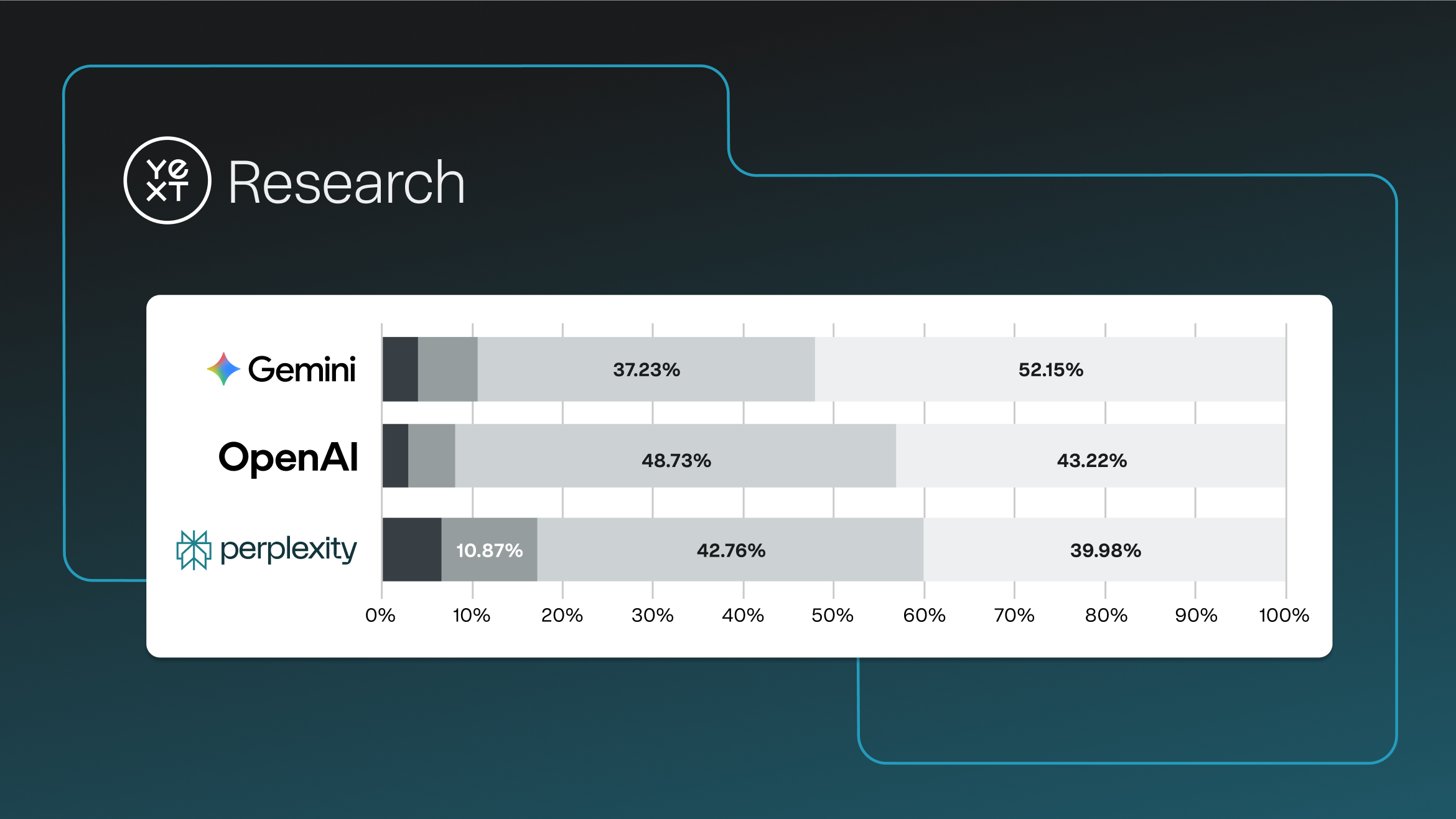
Looking at averages:
- Brand-controlled websites make up 44% of citations
- Brand-managed listings make up 42% of citations
- Brand-influenced reviews and social make up 8% of citations
- Uncontrolled categories (news, forums, other) only make up 6% of citations
Winning AI visibility requires structure, consistency, and attention to detail.
Here’s where to start:
- Structure your data. Use schema and a knowledge graph to make brand facts machine-readable.
- Keep your information consistent. Make sure your business information is accurate and aligned across every digital surface.
- Measure your visibility. Track how and where your brand appears in AI-generated answers.
- Build trust signals. Manage reviews, audit your information for consistency, and optimize authoritative sources that AI models use for validation.
You need to connect the dots internally so AI knows what your brand is all about (and includes you in AI answers your customers trust).
Brands must act now to win in the era of AI search
Optimizing for AI visibility today helps you build a lasting advantage because you’re training the next generation of models to see your brand as a trusted authority. If you wait, recovery becomes significantly harder.
So let’s get started! Run a Scout scan now to see if your brand is showing up in AI search today.