Your Old Content Isn't Neutral. It's Working Against You in AI Search
Publishing more won't fix your AI search visibility if stale pages still contradict you. Why cleaning up old content can lift citations more than creating new.


TL;DR: AI search checks a claim against many sources before it repeats it, so every outdated, duplicate, or conflicting page a brand leaves live counts against it. For many brands, correcting, consolidating or retiring old content will do more for AI visibility than publishing something new.
If you’re following how AI search visibility works, this stat probably doesn’t shock you: about 80% of the AI citations come from sources a brand manages. So, brands have a good deal of influence over what AI says about them.
But now, read that stat from the other direction. If most of what AI cites comes from a brand’s own properties, then that means most of what AI gets wrong about brands does too.
That’s because most marketing teams hear "AI visibility" and default to one solution: publishing more content. More blog posts, more FAQs, more pages covering more terms. It feels productive, and it’s easy to measure. But it also ignores the pile of old content already sitting on the website, in listings, and across the web — and which is often the source of wrong or outdated information that becomes a problem.
Because that old content pile isn’t neutral; AI doesn’t read one page and take its word for it. It checks a claim against many sources, and when those sources disagree, it either skips the brand in its answers or gets important facts wrong. Every stale, duplicate, or conflicting page left live can be a negative signal against your brand.
Often the best next step is fixing or retiring the ten outdated pages that are confusing the model, not building a new asset.
Why AI gets brand information wrong
The LLMs behind AI search experiences have no way to know which of a brand’s pages still reflect the truth. They simply see everything that’s published, weigh it against what’s found on the rest of the web, and decide how confident they can be. When the signals are 1. Fresh and 2. In agreement, the brand is likely to get cited.
But when they don’t agree, the model has two bad options: skip the brand, or pick a version and hope.
What types of content are to blame? Nothing out of the ordinary. It might be a pricing page from two redesigns ago, or a location page with hours that changed last spring. A press release that still uses a retired product name. A blog post recommending an approach the brand dropped years back. Taken separately, none of them seem like a problem. But together, they result in a brand that’s contradicting itself in front of the model.
Marketing leaders at Sitecore, Acquia, and WordPress VIP describe the same pattern in a recent Content Marketing Institute report. WordPress VIP CMO Jodi Cerretani framed the risk this way: AI can cite a brand’s 2021 pricing page right next to its current one, and the reader has no way to tell which the brand still stands behind.
Sitecore’s team found something else worth noting. When it tracked which pages shaped AI answers, a page it had planned to retire turned out to be a frequently cited source about the brand. The team updated the page instead of deleting it.
That detail matters. Cleanup isn’t a purge. Old pages often carry authority, so the job is deciding which to correct, which to merge, and which to retire, with an eye on what AI is actually citing.
What the data says about managed and unmanaged brands
A recent Yext Research study of 21.6M search results points in the same direction. Looking at how brands maintain their profiles, brands that actively manage their data came out well ahead of those that don’t.
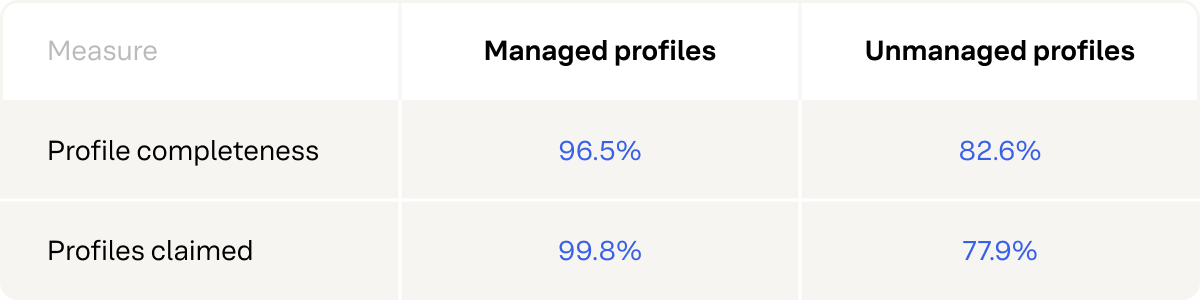
Yext’s read of that gap: it’s largely stale or unmaintained data, not a lack of effort. Unmanaged profiles don’t fall behind because brands never tried. They fall behind because nobody keeps them current.
Now put that next to the citation numbers. Again, roughly 80% of the 155 million location-grounded citations Yext analyzed came from sources a brand manages.
That’s good news and uncomfortable news at once. A controllable signal is a fixable signal. It also means the outdated page nobody got around to updating is a signal the brand left in place, and it’s working against the brand.
What cleanup looks like by industry
Stale content might look different from one industry to the next. But the pattern doesn’t change.
Financial advisors
Referrals have long been how advisors win new clients, and that hasn’t gone away. What’s changed is the step after the referral. A prospect hears a name, then asks AI about the firm before picking up the phone. In a Financial Reporter write-up of a Wealthtime survey of 175 advisors, 63% said clients are independently using AI tools in relation to their financial advice. Researching the firm before a first meeting was one of the most common uses, cited by 44% of respondents, and 50% pointed to clients using AI to check advice already given. The same piece notes FCA research finding that four in five investors aged 18 to 40 have used AI for help with investing.
That makes an outdated website expensive. Whether it’s an advisor bio that names a former firm, a services page describing an offering the practice dropped, or market commentary from 2022 that reads like current advice…. each one gives AI a reason to hedge. And a prospect who gets a muddled answer has an easy next step: the next name on the list.
Healthcare
In this industry, provider and location pages go stale particularly fast.
Physicians leave, practices move, accepted insurance changes, and urgent care hours shift with the season or year. When the website says one thing and a directory says another, AI has to guess. A potential patient will either be given the wrong information, or the name of a competing practice.
Retail
It’s common in retail to have store pages for locations that closed and never came down. Or a page might still list last year’s holiday hours, or promotions that expired in the spring.
Across dozens or thousands of locations, even a small error rate adds up to a lot of wrong answers about where to shop and when — and, once again, LLMs are more likely to skip your brand.
Food service
Menus change far more often than the pages that describe them. Seasonal items rotate out, dishes get repriced, and a location stops carrying something that’s still listed on the website, in a delivery profile, or in an old PDF menu.
When a diner asks AI what a restaurant serves, or whether the nearest location has a particular item, conflicting sources force a guess. The likely outcome is a wrong answer, or a suggestion for the place down the street whose information is consistent.
Hospitality
Hospitality runs on pricing, and pricing is where stale content does the most damage. Rates shift by season and demand, packages and promotions expire, and amenities get added or retired. An old offer page or a rate listed on a third-party site that no longer matches the booking page puts the brand at odds with itself.
A traveler comparing options through AI wants a clear answer on what a stay costs and what’s included. If the sources disagree, the model may hedge, quote an outdated rate, or skip the property for one that’s easier to verify.
How brands can influence what AI says about them
Brands can’t control AI directly, but they do control most of what it reads. Here’s a sensible order of operations.
- Fix the source of truth first. When one verified set of brand facts feeds the website, local pages, and listings, a correction made once reaches every place AI might look. Patching pages one at a time is how the same error comes back.
- Audit for conflicts. With that source of truth in place, check what’s live against it. Inventory the pages, listings, and profiles that disagree with the current facts, starting with the ones AI is actually citing. A knowledge graph or brand messaging library gives you the benchmark, and an AI agent can scan website pages for drift from it at scale.
- Decide whether to correct, merge, or retire. Retiring rarely means deleting. The CMI report cautions that deleting can wipe out backlinks and citations a brand spent years earning. Consolidating overlapping pages into one strong page and redirecting the old URLs keeps that authority in place. Learn more about how Yext helps brands maintain their verified source of truth — and why it’s essential for agentic marketing — here.
- Create on a cleaner field. New content works harder when it doesn’t have to compete with contradictions. The strongest pieces answer a real question, offer something specific, and match everything else published about the brand.
- Make maintenance routine. WordPress VIP’s team shifted its capacity from an 80/20 split between new and existing content to 70/30 as AI search grew, according to the same CMI report. The exact ratio matters less than having one.
Clean up first, then create
Publishing content that answers key AI search questions still matters — a lot. But publishing on top of a pile of contradictions is like adding new testimony to a case where the record is already in dispute. The model still has to reconcile everything, and the old material doesn’t go away just because something newer exists.
The encouraging part is how much of this a brand can fix. If most citations come from sources a brand controls, the fastest gains often come from pages already live. Start with the ones AI is citing today. Correct what’s wrong, merge what overlaps, retire what has outlived its purpose, and then decide what’s worth publishing next.
Ready to create content that’s grounded in your verified brand facts? See how Scout helps you generate on-brand content at scale.