The Intelligence Advantage: How CMOs Can Optimize Paid and Organic in an AI-Driven World
The Intelligence Advantage: How CMOs Can Optimize Paid and Organic in an AI-Driven World
A playbook from Dentsu & Yext for multi-location brand leaders

TL;DR: Organic traffic is declining for many brands as AI-generated answers absorb the search volume brands used to earn — and the instinct is to pour the difference into paid social and paid search. But that instinct is aimed at the wrong target: you can't buy your way into an AI's citation or an agent's short list. The real problem underneath the channel debate is that brands have never been able to see, market by market, where they already win organically and where they don't — so they overspend on paid where organic already carries them, and underinvest where paid is the only lever left. This playbook shows how hyper-local competitive intelligence closes that gap: how to see where you're winning and losing in every local market, how to make paid and organic finally answer to one signal, and how teams and their agents can act on that signal in every market at once. The recommendation for CMOs: stop treating paid and organic as separate budgets to defend, and start treating market-level intelligence as the input that governs both.
Chapter 1: The Traffic Breaking Point
For twenty years, online search was oriented around a simple deal: a customer had a question, they typed it into a search engine, and your brand’s job was to show up in the results when they did. Doing so ultimately won clicks to your site.
Marketing built its entire measurement system on that click. It was how teams tracked intent, attributed spend, and proved the work.
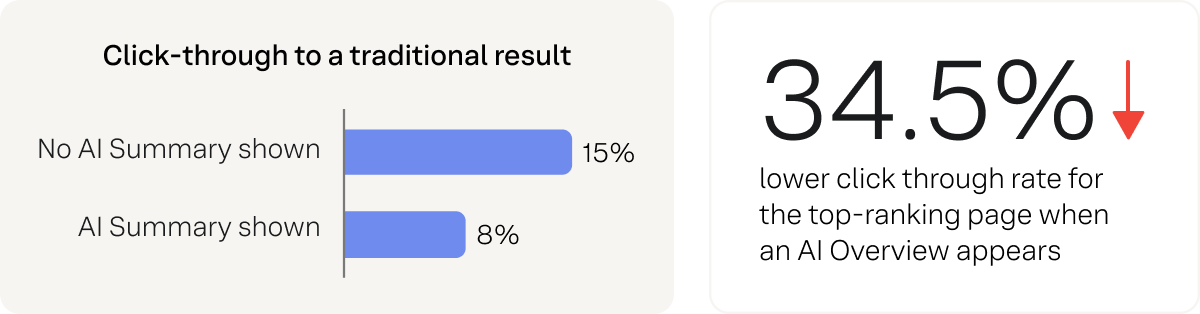
But that deal no longer holds up: in the first four months of 2026, 68% of Google searches ended without a click to any website — up from roughly 60% two years earlier. When Google shows an AI summary, users click through to a traditional result in just 8% of searches, versus 15% when no summary appears. And finally, the presence of an AI Overview in response to a query correlates with a 34.5% lower click-through rate for the top-ranking page.
Put simply, many customers now get the answer(s) they need before they ever reach your site — and those answers come in the form of a direct recommendation from an AI model. The decision that used to happen on your site now happens in an AI-driven environment you don’t control.
So, what are brands doing in response?
The reflex is almost muscle memory: traffic is falling, so go get it back — through more paid search, more paid social, and buying back the clicks organic used to deliver. But that instinct misreads what's really happening, and the mistake is getting more expensive by the day: as more brands compete for a shrinking pool of paid impressions, Google CPC rose 5% year over year in 2025 even as the clicks available keep shrinking.
The clicks aren't vanishing because you're losing a bidding war; they're vanishing because the customer doesn't need to come to your site to decide anymore. Spending to win back traffic is spending to win a race the customer increasingly finishes somewhere else.
In other words: the real “brand visibility” question for marketing leaders today shouldn’t be "how do I get more people to my site?" Instead, it’s "am I in the answer when someone is deciding — and if I'm not, where, and why?"
That question can't be answered at the budget line. A channel decision — more paid, less organic, shift the mix — assumes brand visibility is a single number you can prop back up by buying more of something. It isn't. Instead, multi-location visibility is thousands of local markets, each winning or losing for its own reason: down in one city because a regional competitor owns the reviews, holding in the next, quietly bleeding in a third because a cluster of listings still shows last year's hours. No budget shift touches any of that because none of it is a channel problem.
So, the objective changes: don’t just optimize the channel mix, but find the markets where you're losing, and fix them.
Closing that gap — seeing market by market where your brand wins and where it doesn’t, and acting there as fast as those markets change — is what the rest of this playbook is about. Get it right, and the old channel-mix debate mostly settles itself: you stop paying to recapture traffic that was never the point, and start winning the markets you can actually win.
Chapter 2: Why Silos Are a Liability for Brands

To reiterate: a growing share of “searching” online is no longer done by a person. Instead, an AI model acting on a customer's behalf does the researching, comparing, and shortlisting. Then, it gives a recommendation — and, in a growing number of cases, even completes the action outright.
This trajectory shows up clearly in the numbers. Over the 2025 holiday season, visits to US retail sites referred from generative-AI sources were up nearly 700% year over year, and those AI-referred visitors converted about 31% more and spent 45% longer on site than other traffic. The base is still modest — fast growth off of a small number — but the behavior is telling: people arriving through an AI recommendation show up more ready to act.
For an AI agent to take action with a brand on a customer’s behalf, though, two things have to be true.
- It has to trust the data it finds: AI wants to see fresh, relevant, and consistent across the website, listings, reviews, and social. When the site and the listing disagree, the model sees the contradiction and drops the brand rather than risk a wrong answer.
- It has to be able to complete the required task: AI needs to see an interface it can operate on, the qualifiers stated plainly, and a way to ask a human when something's missing. Give it a page with no clear "book now" button, and it does what a confused human would do: give up. Give it a real endpoint it can call, and it books — and when a competitor only offers a click-through, it isn't a close race. The agent completes the task with the brand it can actually transact with.
That consistency requirement is exactly what a paid-and-organic silo breaks.
The separation between the two functions was never entirely logical, but it was manageable when search was simpler: organic teams focused on rankings and content, paid teams on bids and efficiency, and the two shared reporting decks and occasionally aligned on campaigns while operating as independent functions. That worked because the customer journey was predictable — search, click, website, conversion — so even separate channels converged at the same website.
But they no longer converge anywhere. The customer journey increasingly passes through AI-generated responses, recommendations, maps, and reviews — surfaces that evaluate a brand holistically rather than by marketing channel. And when a consumer asks ChatGPT, Gemini, or Claude for a recommendation, the model doesn't distinguish between inputs owned by the paid team, the SEO team, or the social team. It evaluates the totality of a brand's digital presence.
As Michael Dobbs, SVP, Head of SEO/LLMO, Dentsu Media US, puts it, "these siloed [teams] now need to be looking at the new layer of intelligence... to orchestrate a unified position for the brand." In an AI-driven environment, the brand is judged as one entity, even when it's managed as many — and disconnected teams create disconnected signals that can limit visibility at exactly the moment an AI system is deciding whether to recommend it.
The challenge extends well beyond paid and organic search. Search teams once focused primarily on the website and the results page. Today, influential signals come from an expanding ecosystem — YouTube, Reddit, influencer content, PR coverage, community conversations, local listings, social — and AI systems draw from many of these when constructing an answer.
"It's the full spectrum of planning within media," Dobbs notes, pointing to how influencer, affiliate, PR, community, organic social, and search teams all contribute signals that shape how a brand appears across AI-driven experiences. What was once a search problem has become an enterprise visibility problem.
The website's role is evolving too. Every landing page now has to satisfy human visitors, search crawlers, AI models, and increasingly autonomous agents at once. A page optimized only for paid conversion, or only for SEO, isn't enough anymore. Brands need, as Dobbs puts it, "a more unified landing page experience that meets both objectives of having content that is going to be rewarded by the algorithm, by the AI, and be AI-ready."
Underneath all of this is an organizational problem: most teams still make decisions from separate systems that produce incomplete or conflicting views. Paid sees media efficiency. SEO sees rankings and traffic. Social sees engagement. None sees the whole picture. The fix, in Dobbs's view, is an intelligence layer that connects traditional search metrics with emerging AI visibility metrics — a shared source of truth that gives every specialty "more data and information so they can understand where the influence opportunities have the biggest upside." Without it, teams optimize for local wins while missing the bigger opportunity to move the brand's overall visibility.
Before the paid-media conversation can even start, brands need the data-and-distribution motion right: a structured source of truth pushed directly to the endpoints agents trust, kept consistent everywhere. The endpoints that decide are largely in a brand’s control: 80% of the sources AI cites are brand-managed, websites and listings, not third-party opinion. Direct distribution is what keeps those sources verified and consistent; when a brand stops actively managing them, records pulled from an aggregator drift apart from one surface to the next — which is exactly why defending paid and organic as separate budgets, measured separately and rarely compared, is about to look expensive.
The organizations that adapt fastest won't be the ones with the largest media budgets. They'll be the ones that replace channel-centric thinking with intelligence-centric decision-making — aligning every team around a shared understanding of performance and a single objective: becoming the most trusted answer wherever customers, or their agents, choose to search.
Chapter 3: The Intelligence Layer: Seeing What Was Previously Invisible
Replacing channel-centric thinking is easier said than done.
That's because brands over-index on paid for a rational reason: they can't see where organic is already winning, and no one cuts spend from a market they can't prove they own. The result is paid budget defending positions that no longer need it, in markets no one has measured.
But now, market-level competitive intelligence can close that gap.
True market-level competitive intelligence shows three things a brand-level view can't:
- Where a brand wins organically
- Where a competitor outranks it
- Where paid spend is propping up a result a stronger organic foundation could hold on its own.
With that view, budget allocation stops being a standoff between two teams and becomes a decision grounded in evidence. As Meredith Spitz, EVP, Head of Total Search, Dentsu, puts it, "The goal isn't to spend less on paid, it's to spend it where it actually moves the needle."
How do leaders know what actually moves the needle?
The right measurement starts from looking at the questions customers actually ask.
A brand querying its own name, for example, learns nothing: the model already knows the brand and will name it the answer. What matters is whether the brand surfaces for the unbranded, high-intent, local queries that precede a purchase: "where do I refinance my home in Tampa," not "what do you think of [my financial services brand]." In an AI answer there's no second page. A brand is either the answer or it's absent.
This is exactly why a national visibility view or score misleads. A single brand-level number averages away the only unit that can actually be acted on: the individual market. It can't show that one city is losing to a regional competitor, or that a cluster of listings in another still carries last year's hours. The measurement has to run the other direction: queries set per location, run against every model on a schedule, and then aggregated up. Location is where the customer is, and where the model resolves the question — inferring it even when no one actually types "near me."
The layer produces three outputs. First, whether a brand appeared at all — the citation or mention rate. Second, how often it appears against everyone else in that local market — a win rate. Third, the citation URLs: the specific sources the model drew on. A score without its sources can't be moved; the sources identify the fix.
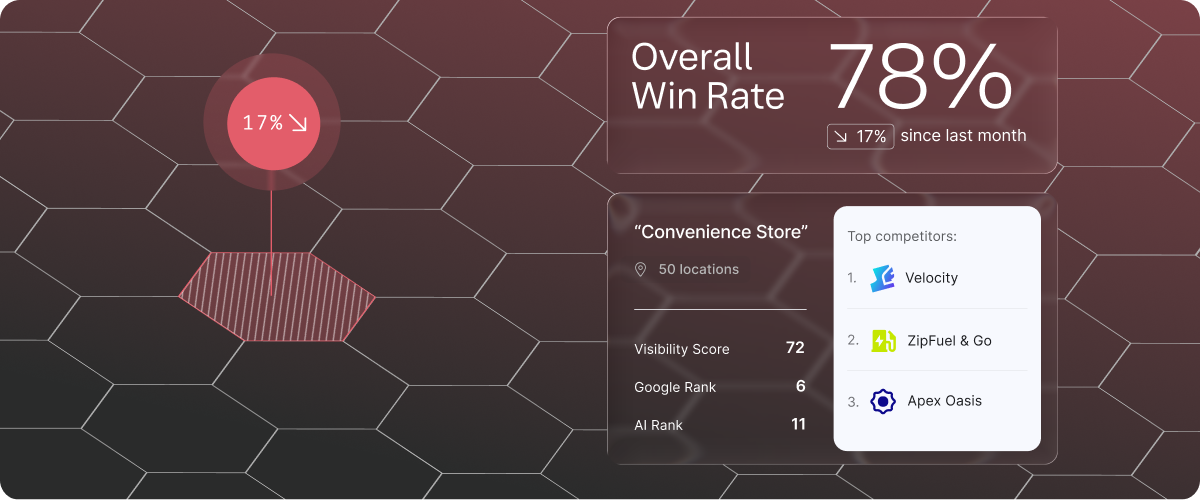
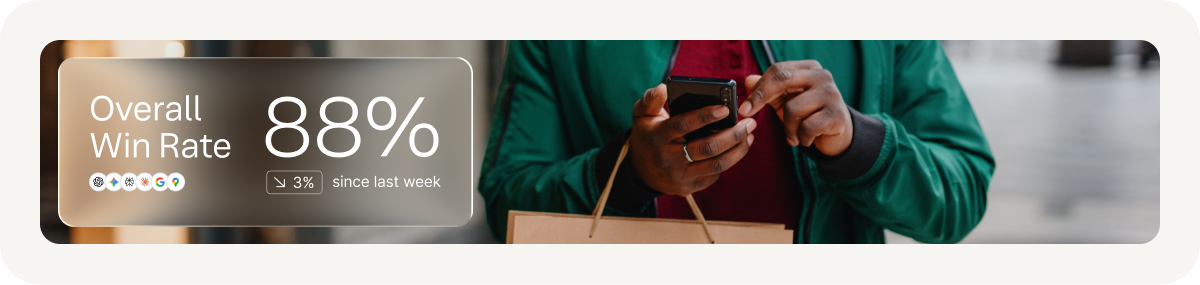
Win rate anchors the rest: how often a brand outranks its competitors across the surfaces that decide. It's measured on both sides — a Google component (whether the brand appears within Google's top 40 local results ahead of its competitors) and an AI component measured across four engines (ChatGPT, Gemini, Claude, and Perplexity), combined into an overall score. It's a benchmark, never an absolute — it means nothing except relative to the competitors a brand actually faces in that market, which is why a single national comparison is useless for local decisions. The signal to watch is velocity, not level: a win rate falling quickly in one market is what should move investment, because that's rapid loss to a local competitor.
Beneath the win rate are the signals that explain it: lost review velocity, incorrect hours on a map listing, or local pages missing the structured data a model reads — three causes, three owners, three different fixes that the win rate alone can't distinguish. Each location's target is set to the average of the top-ranking businesses in that location's own results, and a signal that falls more than 10% below it triggers a prescribed action. That's why a location can sit below benchmark in one city with more reviews than a location that clears it in another. From there, the work gets ranked by impact against gap: if 900 of 1,000 locations are missing an attribute, that correction moves the brand more than any single page.
This is the decision the layer makes possible: with organic performance visible market by market, a brand can finally answer a question paid and organic teams could never resolve together, because their data never met — where is paid spend redundant, and where is it the only thing holding the position up?
Chapter 4: Smarter Paid Strategy When Costs Are Rising

"We often had a single view of the marketplace," Spitz says, "but we didn't have a single action plan against it." Answering that requires joining paid and organic data — and part of what that unified view reveals is competitive paid activity: the same intelligence that surfaces organic ranking signals can also show which competitors are actively bidding for paid positions in those same local markets. That's intelligence that's invisible when teams are looking only at their own side of the fence.
As AI reshapes search behavior, the instinct is to respond the way brands always have: when organic traffic declines, increase paid investment. But that risks solving the wrong problem. The objective isn't to replace lost traffic with more media dollars — it's understanding where paid creates incremental value and where it's duplicating performance that already exists organically. That distinction matters more as media costs rise and marketing leaders face growing pressure to show efficiency.
This is where local intelligence changes the economics of paid media. Rather than treating every market the same, brands can allocate resources to actual opportunity. The clearest signal for paid investment is the intersection of three conditions:
- Organic presence is already built out and optimized
- Visibility in that market still lags, and
- Competitors are actively bidding for paid positions in those same searches.
When all three are true, paid isn't propping up a weak foundation; it's competing for a position the brand has already earned organically. Absent any one of those conditions, the weighting changes. A market where competitors dominate organic visibility may need paid support while the broader visibility issue gets fixed. The result is a market-specific investment strategy grounded in evidence rather than a blanket spending model.
The intelligence layer often reveals that visibility is being shaped by channels outside traditional search — YouTube, Reddit, local content, community platforms — and these increasingly influence how AI systems evaluate and recommend a brand. That means the smartest paid strategy doesn't always mean buying more search clicks; in some cases, it means redirecting investment toward the content, influencer activation, or community engagement that's demonstrably shaping the recommendation.
Getting there requires a new operating model between paid and organic teams, who have historically worked from the same marketplace but interpreted it through different metrics and objectives. A shared intelligence layer changes that — giving both teams a common understanding of where a brand is winning, where competitors are gaining ground, and where investment creates the greatest return, so teams optimize around one business outcome instead of two channels independently.
Smarter paid strategy isn't about spending less. It's about spending with more precision and driving greater impact. The brands that combine paid performance, organic visibility, and market-level intelligence into one decision framework will be the ones that can shift resources with confidence — not necessarily the ones spending the most.
Want more on where paid spend actually moves the needle? Meredith Spitz of Dentsu joins Yext’s Wendi Sturgis and Paul Ehlinger for Paid Media in 2027, a live panel with a first look at paid media in Yext. Save your seat.
Chapter 5: Building a Unified Strategy

But it didn’t just occur to marketers in the age of AI paid and organic search should (theoretically) work together.
The challenge was operational, not philosophical. Different teams, budgets, and success metrics made real collaboration hard, so most organizations settled for alignment rather than integration: sharing reports, coordinating occasionally, each still optimizing for its own objectives. That was acceptable when search behavior was stable. It no longer is. And as AI keeps changing how people discover and evaluate brands, fragmentation has become a competitive disadvantage.
The reason is that the underlying KPIs are shifting. Organic teams have historically focused on rankings and traffic; paid teams on clicks, conversions, and efficiency. Neither set tells the whole story anymore, because visibility isn't confined to a search results page and traffic isn't the primary measure of success.
"The KPIs are shifting between both channels in rapid succession," Spitz says. "There's a need to rebuild the KPIs for both channels and unify them, as traffic is effectively no longer the goal." Success increasingly means measuring contribution to business outcomes, not performance within a single channel.
AI-driven search makes this coordination more urgent. Landing pages that once served mainly as conversion destinations now influence visibility in search results, AI recommendations, and agent-based discovery at the same time — meaning optimization decisions once isolated to SEO or paid now affect both channels simultaneously. What was once a "nice-to-have" relationship between teams, Spitz says, has become "imperative that they're in lockstep with each other."
A unified strategy doesn't mean every team performs the same role. Paid search remains a real-time signal of changing demand. SEO continues to build authority and discoverability. Content teams create the assets that inform both AI systems and human audiences. Local marketing strengthens relevance at the community level. The goal isn't organizational consolidation — it's orchestration: every team bringing a different capability toward the same business outcome. The brands that succeed will be the ones that move from channel-based planning to market-based decision-making, turning a shared view of the marketplace into a shared plan of action.
Chapter 6: What CMOs Should Do in the Next 90 Days

The shift to AI-driven discovery is moving faster than most organizations can restructure around it.
But the answer isn't to rebuild the org chart overnight or shift budgets based on assumptions — it's to build visibility into what's actually happening, market by market, before making any big calls on paid or organic. As Michael Dobbs puts it, "Brands need to understand where they perform now and develop benchmarks on what their goals are to grow against."
Here’s where to start over the next 90 days.
Days 1–30: Establish market-level visibility. Move beyond national averages and evaluate performance market by market: where is the brand already winning organically? Which markets lean on paid to stay competitive? Where are competitors gaining visibility? How often is the brand cited or recommended in AI experiences, and what content, listings, and reviews are driving that outcome? Without a baseline, every optimization decision that follows is a guess.
Days 31–60: Test, reallocate, and mine the intelligence for paid. With a baseline in place, the goal isn't to cut paid — it's to find where it's creating incremental value and where it's reinforcing performance organic already delivers. That means testing new investment in underserved markets, shifting resources based on where organic is thin, and following the intelligence to channels beyond search when it shows up there — YouTube, Reddit, local reviews. It's also where paid and organic teams can start working from the same data instead of two versions of it: the unbranded questions customers ask an AI assistant are the same intent signals that should sharpen paid keyword targeting, and if a model describes a brand differently than its ad copy does, that's two stories competing instead of one reinforcing the other. A visibility tool like Yext Scout makes this concrete — surfacing which markets are organically optimized but still losing visibility, and showing where competitors are actively bidding in those same searches. That combination of signals is what identifies where paid spend will create incremental impact versus where it's reinforcing performance organic already delivers. And with Yext's acquisition of Flamel.ai, brands will be able to act on those signals directly — running localized paid campaigns across leading ad platforms from the same platform that measures their organic visibility.
Days 61–90: Close the data gap and build a shared operating model. Visibility alone doesn't move anything — it creates value only when teams act on it together. Use this phase to build shared metrics, align workflows, and put a governance model in place so paid, SEO, content, local, and analytics teams work from the same market-level view. That requires the underlying data to actually be trustworthy: listings, location information, reviews, and local pages need to be accurate, consistent, and kept current, because the quality of every decision downstream depends on the quality of the intelligence feeding it.
The next 90 days shouldn't be treated as a technology initiative or a channel-optimization project — it's a shift in how marketing decisions get made. The brands that pull ahead won't be the ones with the biggest budgets. They'll be the ones with the clearest view of what's happening in each market, and the discipline to act on it faster than the competition.
Bottom line for CMOs: the debate was never only about paid versus organic. It's whether you can see, market by market, where each is actually working — and until you can, you're both overspending and underinvesting at the same time. Market-level intelligence is what makes that visible. Everything else in this playbook follows from that one shift.
Click here to learn more about how brands can compete in a world where answers — not links — define discovery in our recent podcast episode.