TL;DR: Customers aren't just typing a single search query into Google anymore. Instead, they're having ongoing conversations with AI engines like ChatGPT, where they ask follow-up questions, narrow down their options, and compare details. Brands that lack depth and clarity drop out of the thread. When intent increases, visibility becomes more selective.
Search used to be simple. A customer would type a question into Google, Google would return a list of links, and brands would compete to appear at the top of that list.
But thanks to AI, that model is now outdated.
Now, the discovery journey is shaped by conversational search behavior. When someone asks an AI "answer engine" like ChatGPT or Perplexity a question, they don't have to stop at the first (or second!) answer. They can add context, reject a suggestion, compare answers, and ask follow-up questions to get more information.
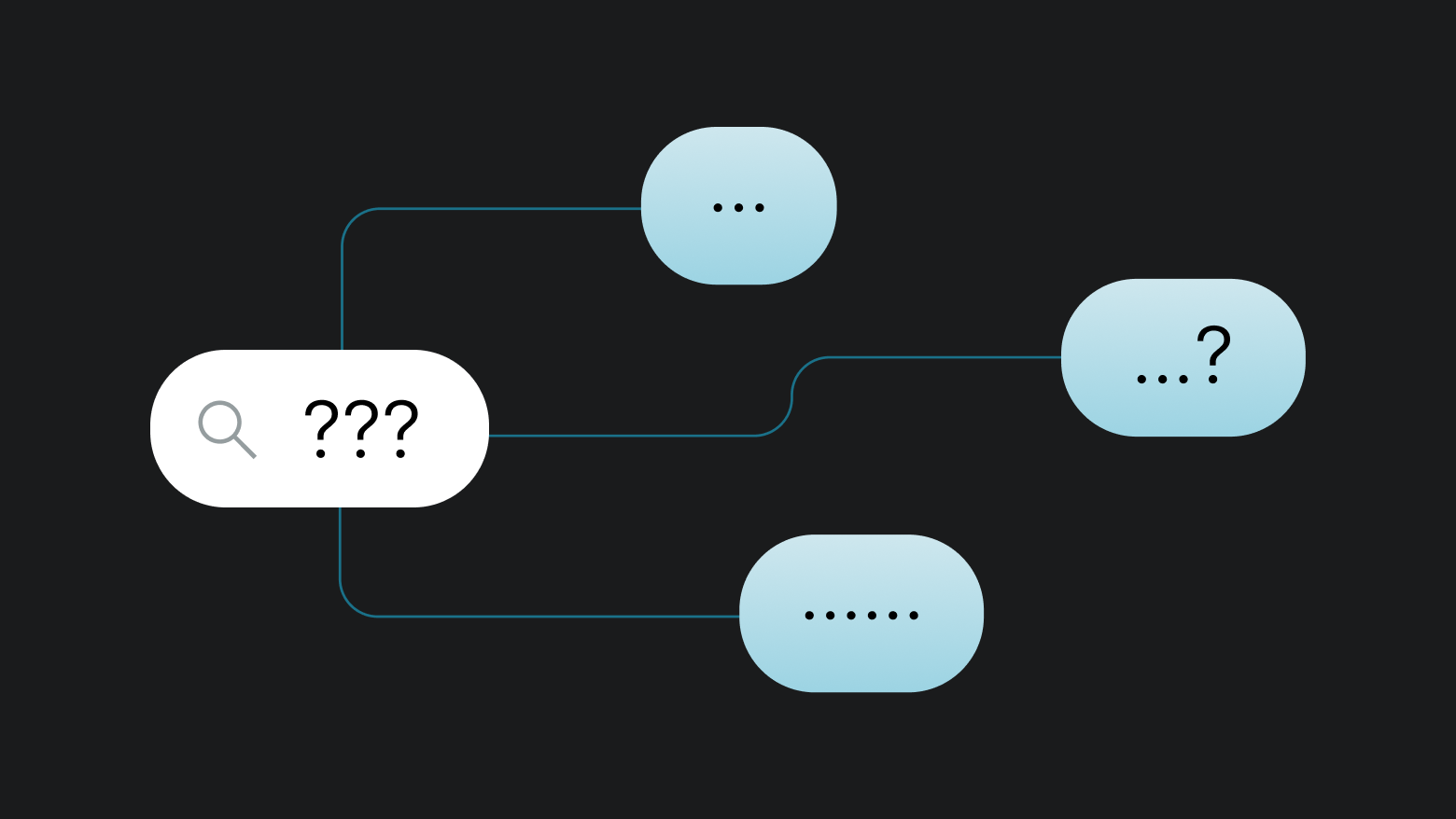
This is called a multi-fanned query. Simply put, a multi-fanned query starts with one question and expands (or fans) into multiple, intent-rich directions. It's a defining pattern in multi-turn, conversational AI search queries and a major part of today's AI search customer journey.
If your brand's data is only optimized for a customer's first question, you're going to miss out on high-intent moments and lose visibility when customers are making decisions.
The difference between AI search and traditional search
To understand why brands disappear on AI search, you need to understand the differences between answer engines and search engines.
Traditional search engines (like Google, Bing, and DuckDuckGo) were built around ranked results. You type a query, and the engine returns a list of links ordered by relevance and authority. Here, visibility is measurable: you can track your position and optimize for keywords accordingly.
Answer engines (like ChatGPT, Gemini, and Claude) work differently. Instead of returning a ranked list, they generate a synthesized response – pulling information from multiple sources, then adapting their answers as the conversation evolves. And if you're still not sure how AI search engines work or how AI generates search answers, the key concept is this: answers are dynamic. Each follow-up reshapes which sources are cited. Visibility isn't about ranking once – it's about staying relevant as criteria tighten.
The shift isn't that ranking disappears entirely. It's that ranking is no longer the end experience. Instead of choosing from links, users increasingly interact with a single, evolving answer.
Why brands disappear in AI search
Right now, many marketing teams are asking:
Why do brands disappear in AI search?
Why is my brand invisible in AI answers?
Why are my competitors visible instead of me?
In many cases, the problem isn't the first question. It's what happens several turns into the conversation.
Let's use the financial services industry as an example. A customer might ask ChatGPT a question, like "Who is the best financial advisor near me?"
When prompted, ChatGPT will provide a list of answers not entirely unlike how Google traditionally did. But then… the conversation continues.
"Which one specializes in retirement planning for women in tech?"
"Do any accept clients with under $500K in assets?"
"What are their fee structures?"
"I need one I can meet with on weekends"
"Which has the best reviews for responsiveness?"
These thorough follow-ups are exactly how today's customers are using AI search to make buying decisions.
If your brand doesn't deliver clear information about specialties, client minimums, fees, availability, and review context — in structured, machine-readable ways that AI can parse and summarize easily — you drop out of the thread. And that drop-off is a major reason brands lose AI search discoverability. (And once you drop, you rarely re-enter.)
What influences AI search answers?
AI models rely on clear, structured facts they can interpret and reuse. They need accurate information about each location's:
Services
Specialities
Availability
Hours
Policies
In conversational search, entities matter more than keyword repetition. Traditional SEO rewards density, but conversational AI rewards completeness.
This is why many multi-location brands have problems managing multi-location visibility. Data lives in different systems, attributes vary by location, and updates don't sync everywhere. And when AI systems encounter gaps, they move on.
Shifting from keywords to conversations
Winning in conversational AI requires a shift in strategy. Instead of optimizing for a single high-volume query, brands need to support the full AI search customer journey. That means:
Modeling multi-fanned queries. Research and understand 1. customer intents and 2. how conversations unfold in your category. What are the common third, fourth, and fifth questions someone might ask? (Tools like SEMRush and Ahrefs, among others, can help with this.)
Prioritizing structured completeness. Comprehensive entities, not just keywords, determine if brands get discovered in AI across follow-up questions. This helps you stay visible as criteria narrow.
Supporting contextual combinations. AI answers layer attributes such as "open late" + "outdoor seating" + "kid-friendly" + "vegan options." Your data needs to support combinations, not isolated traits.
Monitoring where visibility drops. Many teams feel a lack of control in AI search results because they can't see where they fall out of the conversation. Measuring visibility across entire conversations, not singular answers, reveals those gaps.
How Yext supports conversational search behavior
Conversational search behavior raises the bar for brand data. Every follow-up question depends on structured, reliable information.
By using a Knowledge Graph to manage structured data across every location, Yext makes it easier to standardize attributes, publish accurate information everywhere, and maintain the depth AI systems need to support multi-turn AI search queries and evolving conversational search behavior.
But structure alone isn't enough. You also need insight.
Scout shows you how your brand appears across AI search and traditional search, benchmarks you against competitors, and highlights where you're losing visibility in multi-turn AI search queries. Instead of guessing why you dropped out of an answer, you can see the gaps and prioritize what to fix.
If you're ready to understand how your brand shows up across AI search, get your Brand Visibility Score with Scout.