Yext 2026 Consumer Search Behaviours: How UK Consumers Navigate Local Search in the Age of AI
What 600 UK consumers told us about how they find, evaluate, and choose local businesses in 2026.

Yext
Jun 16, 2026

By now, most marketers know their brand should be visible in AI search. But knowing that and understanding exactly how it plays out in a specific market are two different things.
As part of our 2026 global consumer search behaviours study, Yext surveyed 600 UK consumers about their local search habits: which tools they actually use, how much they trust the results, and what drives them to act. The UK data tells a story that is in some ways similar to global trends - and in others, distinctly British.
Three things stand out:
- AI adoption is real and growing, but UK consumers remain somewhat more measured in their uptake than the broader EMEA region.
- Social media plays an outsized role in how UK consumers discover new local businesses.
- Trust in AI is high and climbing - but verifying AI answers using another platform is still a near-universal step before any purchase.
Let’s dive in.
AI adoption is growing in the UK - and it’s not slowing down
36.7% of UK consumers used AI for local search in the past month
75% of AI users are using AI more than a year ago
Check out the interactive report.
UK AI adoption sits at 36.7% - a number that’s meaningfully below the EMEA average of 40.8% and the global figure of 42.7%. That gap is worth noting, but so is the trajectory: 75% of UK AI users say they are using AI for local search more than they were a year ago, with 48% saying "much more."
Among current non-adopters, awareness is high - only 18% say they had no idea AI could be used for local search; the rest are aware but just haven't yet made the leap. In that light, the 36.7% figure looks less like a ceiling and more like an early reading of a trend still building.
ChatGPT leads tool usage among UK AI users, followed by Google Gemini and Microsoft Copilot - which ranks notably higher in the UK than in many other markets, reflecting the stronger footprint of Bing and Microsoft's AI integrations here.
Social media is driving discovery more than Google in the UK
This is one of the most striking findings in the UK data - and one that sets the UK apart from the global picture.
24% of people have tried a new local business because of an AI recommendation, but social media is what’s *really *punching above its weight as a discovery driver.
When asked what led them to try a new local business in the past six months, UK consumers ranked social media second, ahead of both online reviews and Google search results, and behind only a recommendation from family or friends. Globally, Google search ranked second. In the UK, it ranked fourth. For UK brands, this is a signal that social presence is not a supplementary channel. For a meaningful share of consumers, it is the primary channel for brand discovery.
That dynamic shows up in the starting-point data too: when beginning a recommendation search, UK consumers rank social media third - above maps apps and AI tools. For looking up basic business information, social ranks fourth, just behind maps.
Trust in AI is high - and still climbing in the UK. But consumers still verify answers
Among UK AI users, 74% rate their trust in AI local business recommendations at 4 or 5 out of 5, with an average score of 3.84. And the trust trajectory is striking: 74% say trust has grown over the past year, compared to just 4% who say it has declined. That 70-point gap between growing and declining trust is one of the strongest signals in the UK dataset.
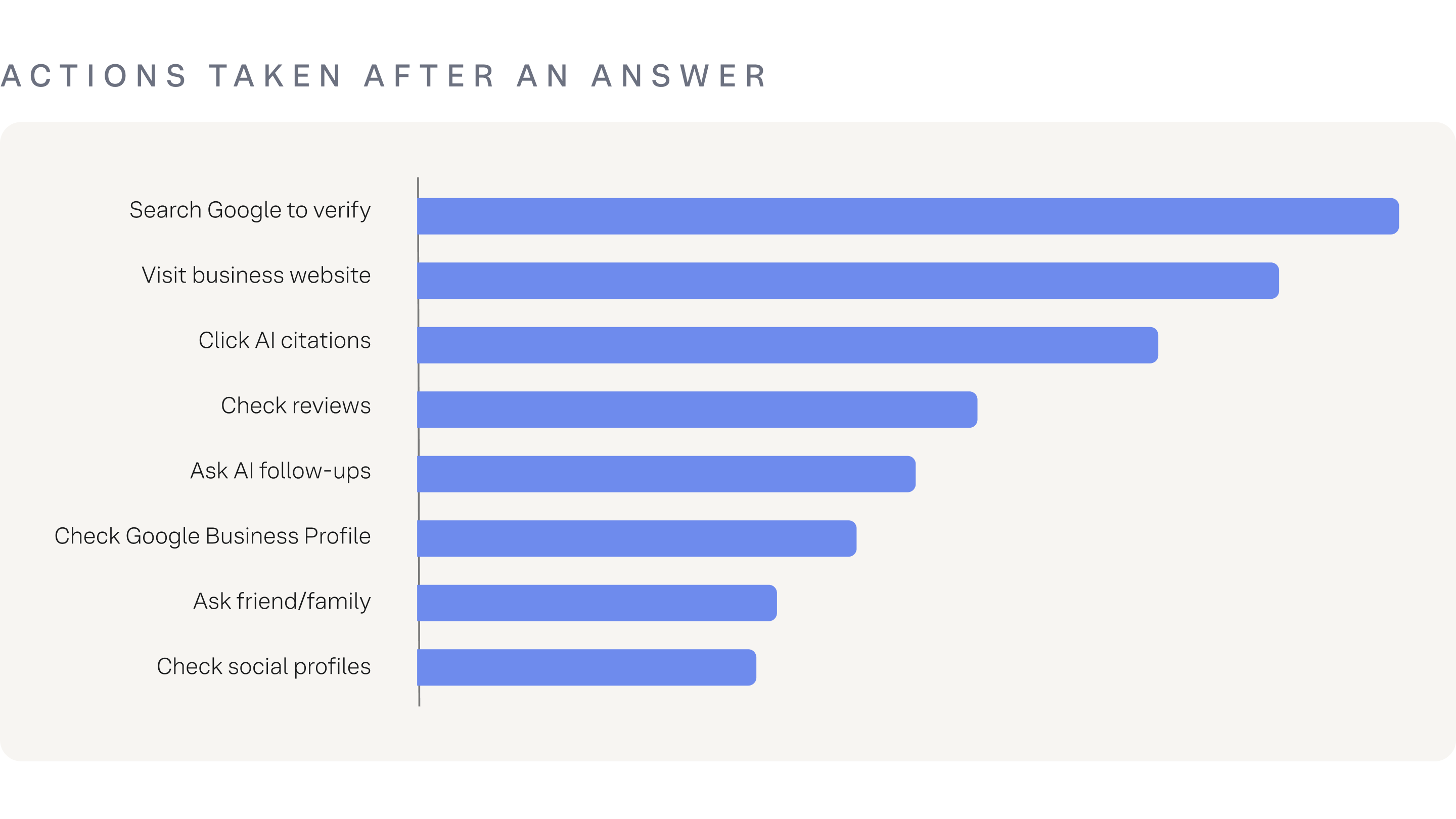
And yet, that trust doesn’t translate immediately into action. Instead, there’s a “verification loop” as people seek more information: after receiving an AI recommendation, about half (49%) of UK consumers search Google or Bing to verify. 43% visit the business's website directly, and 37% click through to the sources or citations the AI provided. Looking for reviews on Google, Yelp, or similar platforms is the fourth most common next step.
Every top post-recommendation action is a verification step. The trust is real - but it does not shortcut the research process. For brands, that means showing up in the AI answer set is only the beginning. Your website, your reviews, your Google Business Profiles… all of it will be scrutinised, and brands who don’t show up accurately and consistently across every touchpoint will drop out of the consideration set.
What this means for UK brands
The picture from the UK data is clear, even if the path to action isn't simple.
AI search is growing, and the UK consumers who have adopted it are accelerating their use. Social media is not just a brand awareness play; it is where a large share of UK consumers begin their journey toward a new local business. And while AI trust is high and rising, the verification steps consumers take before acting touch every channel a brand manages: traditional search, website, reviews, and social.
UK brands that show up consistently across all of these sources - with accurate information, strong reviews, and an active social presence - are the ones positioned to be cited in AI answers *and *able to capture customers at every point in that journey.
Click here to dive into the full data with our global report.
Data from Yext's 2026 Consumer Search Behaviours Study. UK findings based on n=600 respondents. Full global findings available at yext.com/resources/consumer-search-behaviours-findings.