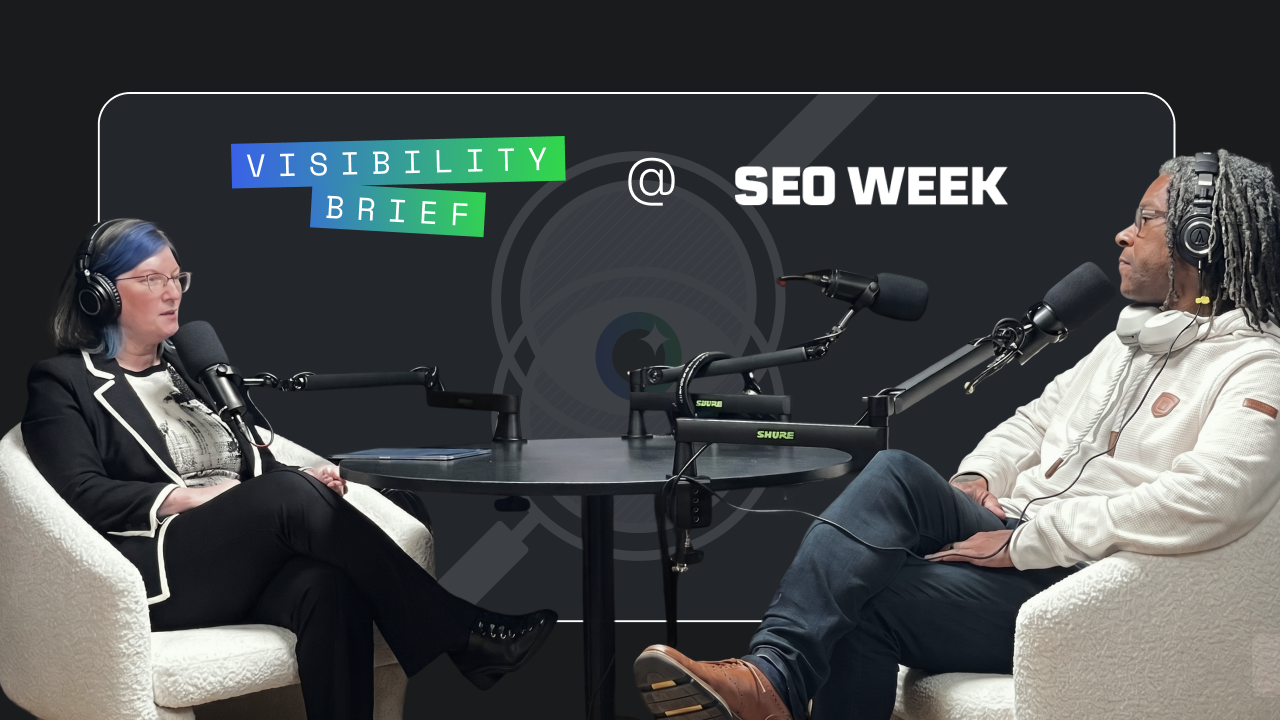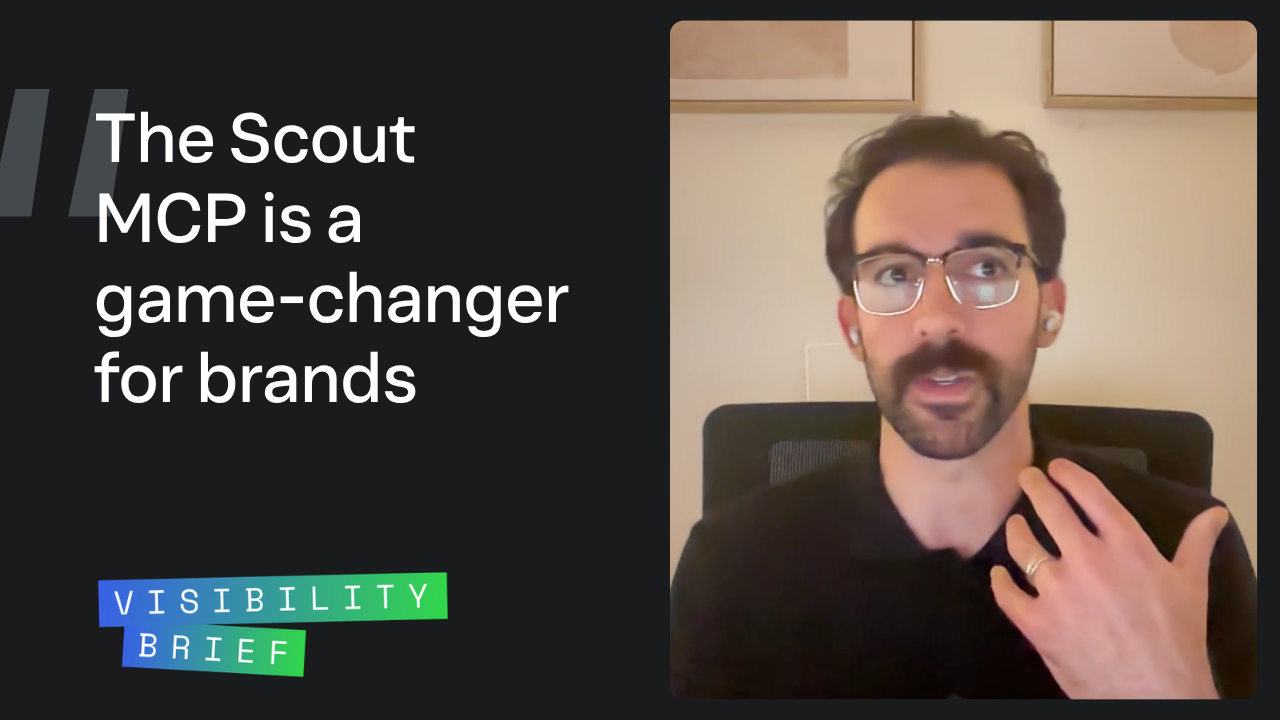
In this special edition episode of The Visibility Brief, Yext SVP of Marketing Rebecca Colwell is joined by Sam Rahimi, VP of Earned & Owned Media at AdCelerant, to discuss how AI is solving one of the hardest problems in marketing: turning data into concrete action.
Marketers have never had a shortage of dashboards, reports, or performance metrics. The challenge has always been knowing what to do next. Which locations need attention? Which competitors are gaining ground? Where should teams really invest their time, budget, and resources?
That's where a new generation of AI-powered intelligence tools is changing the game.
Drawing on his experience helping agencies and publishers support thousands of local businesses, Sam shares how AdCelerant is using Scout MCP to surface competitive insights, prioritize the right opportunities, and make faster, more informed decisions for clients at scale.
The episode breaks down:
How marketers can shift from collecting data to generating actionable recommendations
How AI helps with prioritization and resourcing
Why combining performance data, competitive insights, and AI-powered analysis creates a new operating model for marketers
How Scout MCP changes the marketer's workflow
The future of marketing isn't about having more data. It's about having the right intelligence at the right moment — and being able to act on it immediately.
If you're a marketing leader, agency, publisher, or local business strategist looking to move beyond reporting and toward real-time decision-making, this episode offers a practical look at how AI and competitive intelligence are changing the way visibility is managed.
Episode Links
Transcript
00:00:00.000 — 00:00:38.640 Generative AI is disrupting the business model for digital agencies in a major way. Services that they use the bill for by the hour can now be generated in minutes by Llms, and this leaves agencies with an existential question if value isn't built around generating content, what do they do instead? Sam Rahimi is the VP of earned and owned media at Accelerant, a major UX partner and a global white label digital marketing agency. In his role, Sam has a front row seat to this disruption, and he and his team are taking aggressive steps to deliver value in a new way. Let's get into it. 00:00:46.240 — 00:04:57.680 Hi, Sam, welcome to The Visibility Brief. Thanks, Rebecca. Appreciate having me. Before we dive in to all of the really exciting conversations we have queued up for today. Um, I would love for you to tell us and our listeners a bit more about Accelerate. Um, yeah. For sure. So. So accelerate is a Denver based, uh, advertising suite. We have many functions of the business, but the primary role is that we kind of work in a white label capacity for, like, sales enablement and fulfillment. We've been around for 13, 14 years now. And over that time, you know, we've definitely evolved. We've expanded out of the United States. Now we're in the UK and Canada. It's a new feat for us. It's been fun, exciting and challenging. But our primary role is to to, again, kind of be that that fulfillment arm for a number of different styles of businesses. Um, we came out of the publication space, so like TV, radio, newspaper, advertising type, type space, uh, if you, if you kind of dig into, you know, our founders, uh, and kind of where they came from, you know, ultimately it was to kind of enable these kinds of businesses that over recent history, have seen a little bit of a decline, kind of enable them with with digital solutions and ads on. It really fills that, that void for them. Well, you've been a trusted partner for such a long time. I really appreciate that you're here chatting with us today. Tell me a bit about your role inside the organization. Yeah. So I've been with that seller for, um, eight years, my eighth year now, which is like, crazy to say. I don't think I've. I don't think I've done anything for eight years, but I've been an ad seller for eight years. Um, but I was, uh, I was brought on to stand up our, effectively our SEO department. I oversee all earned and owned media, but, um, I came from the agency side. I worked for a number of different agencies around the country. Um, uh, you know, being kind of a practitioner of SEO. Uh, and I just truly came to love that topic. I mean, I think it was I remember in my college days seeing somebody present to me, like how a search engine functioned. And I was like, I never thought about the intricacies of how this works. Um, and, uh, and that's, you know, it just became such a such interest to me. And then accelerant came along and they had, you know, they were they were very unique because they worked with these large publications. But those larger publications work with the, the, the Main Street businesses. You know, they work with the local guys, the small, the medium size, primarily the small in many cases. Whereas I was working with like fortune 500 companies and like large international brands, and while that was all well and good and very interesting and a great learning experience, um, I grew up in the back of a restaurant, so it was like, it was like very like near and dear. And I just, I love like those, you know, those small businesses are filled with people that obsess over something and turned it into a business. But maybe it didn't have the business acumen. And I think that this is a great way of kind of giving back to that part of the the economy, if you will. That's incredible. So did your folks have a restaurant or family member? Yeah, my dad was a he was a he was a he was a full time restaurant guy. He had two restaurants. He started with a bagel shop. He he was Iranian. He got some he had a Persian food restaurant for for a long time there. So yeah, my bus stop was right off from the restaurant, I love that. My parents had business too when I was in high school, and it was just like a mini storage business, and I loved working there, just kind of getting in, like balancing the book shipping. And there's really something, um, special about the small business and entrepreneur experience. And I think you just bring a lot of grit, you know, resilience. Yeah. That's great. That's great, I love that. So you've got a passion for supporting small business. Um, and I'm, I would also think that, you know, because you work with so many digital agencies and things like that, you've got this macro level view into all of the things that are impacting them right now. And we know that AI is having this massive disruption, um, both for businesses out there as well as agencies that serve them. But there's also a big opportunity, um, that it's created. So I'd be curious, what are you seeing from your perspective? 00:04:59.360 — 00:06:15.830 Um, you know, I mean, right now it's it is a lot of a lot of confusion, a lot of, like, flustered kind of feelings, a lot of noise. I mean, if, like, even if I just think to like the SEO industry specifically, if you look back the last like 15, 20, 25 years, I've only been in the industry like 15, but you have to study a little bit beyond that every like 3 to 5 years, there's like some new acronym that pops up, right? Some new like like landmine, like paradigm shift, whatever you like to call it. Like like that. That comes along and it creates a lot of buzz and talk. And oftentimes there's, you know, there's a necessity to kind of change. Right. And the way that I've ultimately deemed this is like the like the advanced tactics of yesterday are now just standardized tactics of today. Right. There's like this natural advancement in evolution. And I think that that's Ultimately what's happening here now? AI is, you know, we can't deny, like, the speed at which the data is changing. Like it's fast. Unquestionably. Um, but I think that right now we're in that early stage noise phase. And I think that it's important for like, agencies and businesses just like to, to, 00:06:16.910 — 00:07:44.340 to, to try to kind of recognize that there is no silver bullet, there will not be a silver bullet. And frankly, we're still learning what the heck these things are, how they function, how they absorb information, and how they kind of like, parse it and deliver it back into the world. So, you know, as far as like as far as what we're seeing, I like that. I mean, it really varies. And I think that Celeron is unique is because we get such a broad spectrum and we work with like, multinational publications all the way down to one man, one woman agencies. And obviously their clientele spans a large spectrum. So we tend to run the gamut in terms of how people are using AI and where the disruption is. And right now, I'd say most even the larger, more advanced agencies are, um, are still just trying to figure it all out. You know, they obviously get into Claude or they get into Gemini, or they get into ChatGPT and they kind of are using as their local therapist, or they're using it as like some kind of like trip trip planner for them. But also people are now getting into building unique agents. And, um, you know, obviously MCP is a is a good kind of add on, really applicable add on to many different scenarios. But I think the learning curve is still so steep. Um, even for us, I mean, we've got a fully AI department, but but um, but as far as like where we're going to land in a year and three years and five years, um, you know, it's still very much undefined. Um, but I think the main thing that I take away from AI is, um, 00:07:45.660 — 00:07:47.619 its ability to 00:07:48.980 — 00:07:50.459 more easily 00:07:51.620 — 00:09:43.330 standardize certain Advertising marketing methodology. Since the dawn of marketing. Since the Don Draper days, we're talking about like, the holistic approach to. Advertising and marketing is going to be more impactful. Okay, yes, we all agree with that. Now, since AI comes along, I think that it enables us to be a little bit more holistic. And to my earlier point, if yesterday's advanced is now today's standardized, well, that's exactly what we're talking about. We're advancing in a more seamless way. Right. You know, it's interesting when I think about the clients that you serve and the clients that they serve. A lot of small businesses and entrepreneurs, I imagine, are experimenting with AI and LMS to to generate content and to do jobs that maybe they were turning to the agencies to do on their behalf. So now they're feeling empowered. I can create a month's worth of social media content in an afternoon. Or I can, to your point, create all this, all of these resources that are consistent and and they seem to be on brand. Um, so I imagine that's really disruptive to your experience in a world like that. What what does the agency's role become? What do they do instead if it's not about generating content? Well, I mean, that's the I think that there's a few ways to kind of peel that back. I mean, AI is as good as the prompt that's inputted into it, right? Like, and I'm sure that's going to evolve and I'll be eating my words in a year. But so I think that I think that a savvier agency needs to be kind of cognizant of the fact that, like an elevated level of thinking, some strategic oversight, um, insight into an avenue or an opportunity that a business owner themselves couldn't come to a connecting of the dots between all of the 00:09:44.730 — 00:10:46.920 characteristics of a business market level opportunity and available technology, like a connecting of the dots between these these components is where an agency still has to lie. And I really I feel like it's always been the case. But as far as like how that's been, you know, conducted, obviously it runs again across the spectrum. You know, you're going to see a lot of businesses take things like, um, like social, organic, social, uh, in-house content creation, perhaps in-house. Um, I think that that businesses should definitely be focused on like, like internal efficacy, like internal processes and streamlining and these kinds of things looking at data, data analysis. But I still think that that the agency's role is it exists. It's just that it's just now elevated. So so if you're if we're looking at kind of the products and services that we've offered in the last five years and, and, and, and continuing to or expecting rather that we're going to continue to execute those over the next five years. 00:10:48.440 — 00:13:43.969 That is obviously the wrong outlook. I think that that there needs to be elevated and elevated version of each of those kind of kind of going forward. The other thing that I would add to that is, um, is kind of the early stage kind of sales and discovery conversations, particularly as an agency, um, you know, the availability of AI in order to kind of intimately understand a business and then therefore have have a, I call it the come around the table approach. I forget who actually came up with that concept, but there is a concept called come around the table. I'll have to look that one up. Um, and just basically see things from their perspective much more deeply, much more at a level that they understand and resonates with them, I think is where we need to be focused. Well, what I'm hearing you say is it's less about the execution of the strategy and more about the idea. Should we be executing that strategy? What do we know about your business? Um, that would make this particular strategy or tactic effective for you. And I think that that's great. Um, which I think leads us to this idea of intelligence and insights and judgment. So, um, you mentioned the best agencies are acting from this place of intelligence. Where does that come from? How are you? Maybe. Let's take a step back. First of all, what kind of intelligence do you want to bring to your clients to give them the best guidance possible? Oh, man. Um, it depends on the client. Depends on their. Depends on the client. Depends on their business structure. Um, I mean, obviously it's going to depend on, uh, like the, the typical things, their average order value or contract value, their close rates, their margins. Um, you know, you always want to back out from, from those, you know, those, those areas. Um, but as far as the intelligence goes, I mean, like what I if you look at, if you look at SEO services, I mean, you could have five different SEOs work on the same account and they would have five different strategies. You know, there would be a lot of overlap between how they approach those strategies, but I think that AI allows you to add some objectivity to what should be step one. What should be step two? What should be step three? Because otherwise, I think is just subjective, based on like the experience of the campaign manager, you know, and that's, you know, that's not always in the best interest of the of the actual client, the advertiser. So, um, intelligence wise, I would, I would start by like data analysis and prioritization of time and resources. You mentioned a lot of your clients are serving local businesses like the restaurant that that your, your father owns. Um, how important is local information, local uh, level insights or guidance strategy? This is an area and this is in fact an area where I think Yext has actually helped us out a lot, like the 00:13:45.970 — 00:16:15.630 the availability of, of hyper local data, uh, is is definitely a gap, I would say just in the industry overall. I mean, in order to get, uh. And I would love to hear somebody tell me how to do this. If they've got insight, I'm sure. I'm sure great people do. But, um, you know, in order to get like, a hyper local, um, competitive analysis, um, and then kind of use that to kind of inform very specific action and do that very quickly. Like, that has always been I mean, we talk about competitive analysis and we have talked about them for years. And they are they can be lengthy and arduous and and extremely time and therefore budget consuming. And then the action that comes of them is, uh, you, you know, it is it is it has to be kind of prioritized against all of the other analysis and data and what we've already defined as priorities. And I think that when you're thinking from, from like a search perspective, when you think from, like whether we're talking about AI or we're talking about traditional search engines, It's kind of the only thing like your competition, you know? Like, I've, I've told my clients this for years. If you were to take you and your top five competitors out of the ether, you do not exist. Google's putting somebody in the results. Right. ChatGPT is putting somebody in the results. Like there is always competition out there. So having an intimate understanding of what the other guys are doing is wildly powerful. And again, like when you talk about the Main Street businesses, that's extremely challenging because a lot of the data sets that are available today, you know, many larger brands that have larger visibility can thrive off of that. There's a lot more competitive insight. But I don't know what how Joe Schmo Pizza Shop has got a line out the door every day. You know, apart from the fact that, you know, diners, Drive-Ins and dives did a show on them at some point in time. Right. Like, so how do I compete with that at a very, very specific level. And again, I think Yext and I don't know if we want to talk about Scout at all, but Scout is pretty darn cool in that context. Um, it's very insightful. And I also would add to that, um, again, it is one component of a much, much larger strategy. So my ability to capture that data, analyze that data, and then create actionable intent, some type of some type of output that's, that's going to support me, um, needs to be swift. Absolutely. Well, let's geek out about Scout for a second. Since you brought it up, I'd like to do this right. 00:16:17.270 — 00:16:20.390 Um, but no paid, paid promotion involved here, by the way. 00:16:21.430 — 00:18:55.960 Yes. Um, so Scout is, uh, data intelligence, uh, competitive data intelligence agent. It goes out. Um, it analyzes business's performance stack, ranked against 19 of its competitors in the hyper local market. Um, and then it provides insights and recommendations for what to do. Um, so I'd be really curious to hear, how are you using this data? Like what what kind of insights are resonating with you and your clients from that. And how are you acting on it? You know, admittedly, like when we first heard from Yext about Scout, um, you know, I was kind of envisioning that as being like a reporting enhancement. Like, this would just be like one of the because we have obviously, our own system incorporates all sorts of reporting metrics. And my thought was, okay, this is great reporting. Um, which I would say it absolutely is like there's no question there, but where we have seen and where I should say, our partners have seen a lot of value from, it is actually in like a prospecting, like a sales discussion. Um, because it, it, it provides data again at such a granular level. And if people that are listening are not familiar with Scout, I mean, I can see to what you just mentioned. I can see my 19 top competitors based on my business category at a very specific location, like a local level, and that level of insight to come in to a sales discussion and say, hey, you've got 75 locations, 25 of them are best in class, and you've got another 50 or so that, you know, that could use work. And then you have 15 to 20 that basically have no visibility whatsoever. That level of insight is, is, is at the level that the business is looking at it. Right. Like especially like a franchise. Um, so and in fact, I was actually talking to a franchise and he's so devoted to supporting his franchisees, but he doesn't have that location level granularity in his data that he provides back to them. Will Scout was an absolute game changer in that context. So it allowed him to more effectively support with budget marketing resources that allowed him to more effectively prioritize. It obviously allows my operations team to more effectively prioritize. And that was again, that was primarily in a presale setting. But but we use it also now to maintain campaigns and make our team more efficient. Yeah. It's amazing. So, Sam, when you're looking at that data and you're seeing 15 locations that are doing a fantastic job, do you take action on that in some way, 00:18:57.080 — 00:22:47.770 like let everything run or you're like, I'm not doing page spend here. Like tell me what you've learned from the top performing locations, like the top performing locations. Um, you know, sometimes we find it's a certain level of activity tied to that location. It's like a certain, uh, a level of management. Or maybe it is, um, in certain scenarios, we found that like, a, like a regional manager is a little bit more involved and dedicated to certain activities than, than others. So that kind of reveals like, maybe like a personal, um, kind of kind of challenge, uh, obviously that alludes to like certain certain levels of activity digitally, which, which plays a big role in obviously driving some kind of presence. Um, but then it also it also kind of reveals for us like the, like the market penetration, like the availability of new opportunity. Um, you know, we might find that we're performing extremely well in certain markets that are more competitive or less competitive. Right. And then you get to look at those very specifically and say, well, if I'm in a more competitive market and I'm performing down well, maybe there's some obvious answers there. If I'm in a more competitive market, I'm performing above the rest of the guys. Well, there's absolutely something I need to learn. Um, so again, it just it kind of it's a little bit of a directive and it puts you, kind of puts you down the path of where to pull more insight. And then when you kind of layer on the simplicity of being able to kind of, um, kind of query that data again, it gets into the, you know, how creative is your thinking around just like prompting that, that, that information. So you can you can reapply that in a number of different ways. Hopefully that answers your question. Yeah. But it ultimately comes back to the defense. Yeah. And marketing and always depends. Uh, and I'm a data oriented person as well. I want to geek out a little bit to about how you're accessing these inputs. So there are a lot of tools that will give you, uh, a corpus of data. But, you know, making sense of it can be really challenging. So one of the things about the Axon Scout, we make it available through the UI. So you can do dashboards and reports. We've got the API if you want to plug into your existing systems. And we just made the big announcement around MCP access to Scout. Um, so you were one of the early adopters of the MCP, and first of all, love for anyone that is not familiar, how would you explain an MCP to our listeners that maybe haven't experienced it? I mean, I, like an MCP, is having a coach that you can access at any point in time, like like I can ask questions about a certain it is a specialist that is specialized in a very specific topic I'm using. But it is, you know, I think being able to have somebody that is effectively at your beck and call and is ready is ready with with the deepest level of insight into some some kind of data. I mean, the UI is is is pretty solid in of itself. The API is great, but, you know, you go to any development engineering team and you talk about API. And then the next question is like what the spring schedule looks like. So the MCP is is absolutely game changing in that it's just I mean like it's just there now. I mean, it's just available to us. So so yeah, it was kind of alluding to it before. But you know, being able to again quickly understand who are my top performers, who are my bottom performers, what's the competitive density look like? What are the major gaps in terms of how people are managing their Google business profiles or their listings? And then also like who out of that competitive list could be my next prospect, right? Like all of these different types of insights are extremely available for me. So it takes that Morton Coffee view of data and it just takes it to the absolute next level. I think this goes this is like thematically the AI discussion. Right? Just just simplifying the ability to capture and analyze and parse through data. 00:22:48.890 — 00:24:04.360 Um, that's that's where the MCP has been, uh, has been such a significant, uh, game changer for us. I mean, the the one thing that I would add to that, and this is where our seller is planning to go with this. We have our own AI built into our own system. And that AI has been trained. Uh, with 14 years of campaign data, millions and millions of data points and, and it's and it's across we have 160 or 5 ish different advertising products. So when you think about the level of data and how it can be broken down by industry, market budget, uh, advertising type, various regulations and compliances, seasonality, whatever, whatever we really want to if we can marry that paid data, which is primarily paid, not exclusively pay data. Up with, you know, something like we see at such a granular, hyperlocal level like Scout. I mean, we just we kind of take it to, to, um, you know, to, to a level that, that is there's just mutually beneficial. Right? Because it makes sure that we're making the right recommendations. You know, we especially we work with a lot of like legacy partners, like legacy media partners, rather. And, 00:24:05.480 — 00:25:21.550 you know, these are people that have probably been selling print or TV spots or radio spots for maybe like 25, 35 years, you know, so some, you know, Joe Schmo off the street coming in and say, hey, you should sell SEO or AIO or whatever you want to call it. They're like, I don't know where to start. Well, we can make a much, much more informed decision. We can educate them properly, uh, and we can make that recommendation based off of the data that we've gathered from, again, years of insight and understanding of their industry, Traditional CCNa and discovery information, and just marry that up into a way that that you wouldn't be able to poke many holes through. You know, it's really kind of magical to think that for the first time, you can take these incredibly deep insights that you've amassed over 14 years, marry them with insights from a platform like Scout and all of these other things. Put them into one, you know, accessible place for you. Then, as you said, sit down with your cup of coffee and ask a question. Um, so I'm curious, are the possible like, do you have a favorite prompt or query that you ask when you pop in, or that you would like to ask something you've never been able to get an answer to before? 00:25:23.710 — 00:26:38.740 Oh, man. Um, I gotta look through my prompt history here. I'm sure that I have asked some Zorro questions. I don't know, that's actually a really good question. Rebecca. What? You know, what I will say is, um, the one that's that's kind of on my radar right now. I'm a big screaming frog guy for all of my SEO nerds in the room. I love Screaming Frog. I've been using it for forever. That platform is quite complex, and it has been, um, you know, it really contests like the, the, the level of understanding of that software and how to apply it. But the best way of using it was to like run your crawl, export the data, and then kind of use be an Excel user or Google Sheets user and just kind of like get through the data that way and then come with recommendations. Um, well, now it has like an MCP directly in Claud. Right. So, so like that's kind of been my as of the last. I think they launched that not even like a week ago. Two weeks ago. Um, has been where I'm nerding out, but but it's it's again, it's not uh, it's not so much like the questions that are prompts that I'm putting in are so, like, unique. I suppose they're standard more or less for an SEO, but they're um, it's this ability to streamline is absolutely insane. It's incredible. What are you doing with all that time that you're saving? 00:26:40.540 — 00:27:26.020 Hanging out with my twin boys or I don't know. I'm working on my car in my garage. Something like that. That's that's great. Christian and I often joke that, uh, we're getting time back and that just plugging it right back in to learn and grow, you know? Like the curiosity never ends. Um, Sam, this has been awesome. I want to move into our final segment, which is the, um, start, stop, um, and rethink component. And I want to ask you this to two levels, because you do operate at two levels. So for the first one, um, what advice would you give to the publishers and digital agencies that you support? Um, what should they stop doing, start doing and rethink entirely? I would stop 00:27:27.620 — 00:27:30.100 sending so much time on. 00:27:32.220 — 00:28:18.449 What to recommend this customer and how to, um, How? How to make an informed recommendation. I think I would start I would start using things like AI to to assist with that. Rather like I would obviously not do that. You should make an informed decision. But like I use agents, for instance, as like like brand guys. Like if I have a, you know, a prospect that I'm working with, I'll build a GM Gemini and I will feed that my CNA, like my customer needs analysis, my my discovery information, history on who they've worked with previously like that. That is my my source of truth, so to speak, so that at any point in time, in the future, I want to make a recommendation. Well, it's assisted effectively. So I would I would make sure that AI is there to, to kind of 00:28:19.650 — 00:28:37.530 gather that, that kind of insight. And then obviously when you get into more detailed analysis, like I look at a lot of, again, like my legacy sellers and some of the ones that are a bit more eager, going to kind of lean on a resource like that to, um. 00:28:38.840 — 00:31:01.739 you know, to gather more insight, to articulate the value of the campaigns that we're running for them, to kind of evaluate feedback and to make an informed kind of response, those kinds of things. Also building decks like built like pulling together resources and creative and things like that. It's amazing. Like, we shouldn't be spending so much time on making something pretty. I have stopped, I have stopped creating all internal docs on my own. We just had a big marketing goal hands this morning, and I worked with claw to refine all my thoughts, worked on the torque trap and they has the brand guidelines and I created all the slides and it saved me so much time and headache. I hate creating slides. My least favorite thing is, you know, I used to enjoy it, which is hilarious because now anytime I have to create slides, I'm like, how can I delegate this to. Yeah, exactly. There's Claude or there's Gemini or there's ChatGPT, but but yeah, I mean, I think that's a major piece. And to something to start, I would just like if they're not doing it already, I mean, start messing around with agents and MCC and, um. Thinking about all the time consuming things or the, you know, the, the, the thought, um, consuming things that, that maybe can be, you know, more, more efficient. Sam, do you think someone needs to be technical to use an MCP? Uh, I don't think somebody needs to be technical. I think somebody needs to be thoughtful, like. Like the trouble that I see with, like, the agency model, mostly in the States is we ask the question like, are you doing this marketing tactic yes or no? And if no, well, you should go do it right. Whereas like the question really needs to be, have you tried this marketing tactic and did it work out for you? Like I think we we we too often get into this thought process of of of we have to do everything all the time. And I think that that's where like, um, You don't have to be so technical, obviously, to use an MCP, but you do have to be kind of thinking about the prompt in this context. Obviously, like marketing advertising solutions in the context of how is this going to support the business and how is this ultimately going to lead to the objective that they are here for me for? Right. Um, so no, I don't think somebody has to be technical, but I think you have to kind of deepen the layer of thinking. Okay. Excellent. Oh, and then final, um, from the 00:31:03.020 — 00:33:37.880 what's the final stop? Start and reset from the perspective of the clients that your clients are serving. Well, the thing that I've been getting more recently, um, which I love, is that sarcasm, by the way, um, is when somebody comes to me and says, oh, I went to ChatGPT and they told me I should be doing X and your your SEO strategy or what have you is doing Y. Okay. That's fair enough. I think that it's there's probably like an overreliance on AI in some cases. Um, until, you know, AI ultimately gets to a point where it's fully integrated with, like your CRM, your any kind of competitive metrics, all of your onsite analytics, your your inventory system, your your general interest in sentiment, your historical marketing, advertising initiatives, you're going to get some, perhaps some misleading recommendations. Um, well, that's not to say when somebody. Oh, sorry. The LM always seems so confident when it's giving a recommendation, right. Even if it's grounded in nothing. It's just like, yeah, this is absolutely what you should do. And if a small business owner doesn't know that, you know that that's not the right strategy. They might just do it. Well, it strokes your ego way too often. You have to like we were talking about that before. It's like ChatGPT is like way to you know, it's everything's oh my gosh, what a great thought. Well, that's not always the case, right. We can we can be challenged still. So I think that's probably yeah I think that's the main thing is like don't don't take it all as gold. But but definitely get creative with it, you know. Use it in unique ways. And you know, as far as like the start thing goes again, like start to think about AI as what are those things that I maybe have put off over the last year or years that I wasn't able to efficiently scale because of resources, because of time, because of budget, what have you, because really we need to if we look at our digital presence, there is no silver bullet. We need to kind of broaden that that presence and be able to evaluate data very effectively from each of those and understand which ones work best for me at this time. And then I can lean in a little bit further and broaden and lean in further and broaden. So I actually go back to grade school when we learned about like the scientific method where you like build a hypothesis, you test your hypothesis, you evaluate your results, you go back and hypothesize like that's SEO, that's that's advertising, that's marketing. Like, you got to do those things if you're not doing those things, use AI to facilitate that. That's probably where I'd take it. Well done. Remembering the scientific method. I don't. 00:33:39.960 — 00:34:32.840 Know, but it's spot on. It is, you know. Marketing and SEO are, you know, like it's a science in a lot of ways. Um, so that's fantastic. Um, Sam, this was so great to have you on the visibility, helping people connect with you to stay in touch and learn more. Yeah. You can find me on LinkedIn. Samad Rahimi, some ads, my full name. I'm Persian if I didn't say that already. But people call me Sam. Um, you can find us at, uh, accelerant, comm, aDSL and com. Um, but, uh. Yeah. Yeah. Thank you so much for joining and sharing your insights. Um, and we'll have you back in the fall to talk about. Oh. What else? What what else do you uncover at the MCP? Um, have a great rest of your day. Thanks, Rebecca, I appreciate it. That's a wrap on this episode of The Visibility Brief. If you found this useful, subscribe, leave us a review or send this to a colleague who needs to hear it. We'll see you next time.