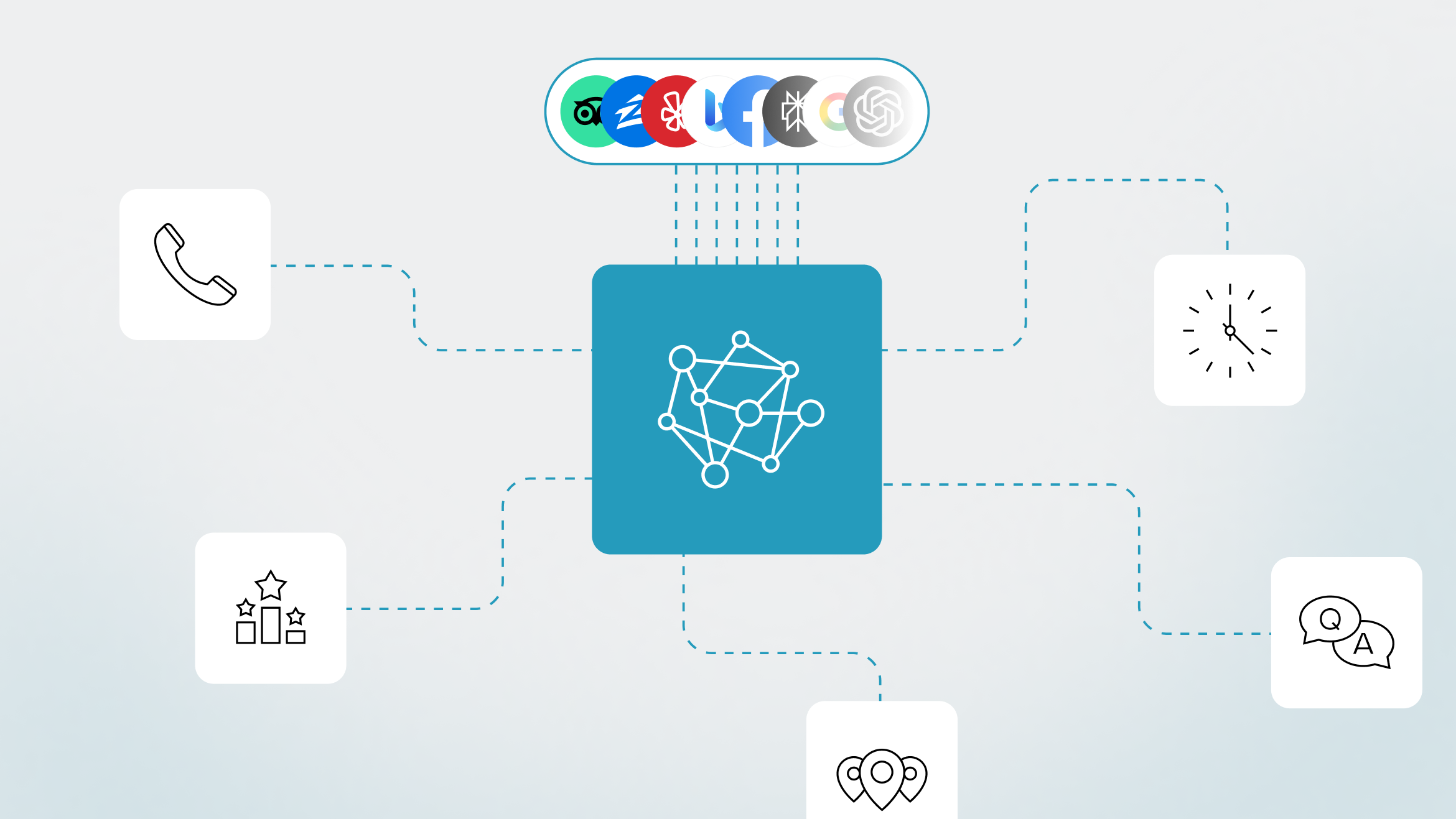
TL;DR: Did you know that AI engines reward brands that speak their language? That means having structured, centralized, relational data. A Knowledge Graph is the foundation for visibility in the AI era — and it's how Yext helps you control the facts that matter most.
ICYMI: AI discovery is changing the way customers find and choose brands every day. But most companies are stuck trying to compete with data that's still scattered across dozens of systems: CMSs, CRMs, PIMs, spreadsheets, and even local drives. That fragmentation makes it hard for humans to stay aligned — and nearly impossible for AI to understand, cite, or accurately describe your brand.
The solution? Structure.
A knowledge graph turns disconnected facts into a consistent, AI-ready foundation, making your brand more visible and more trusted across every channel that matters.
Let's break it down.
What is a knowledge graph?
Broadly speaking, a knowledge graph is a structured way of organizing information in a form that both people and machines can easily understand and use. It's centralized, contextual, and designed to make sense of data from internal and external sources. Basically, it works like a living, breathing map of your brand.
At the heart of a Knowledge Graph are entities — the real-world "things" your business wants AI to understand, such as locations, products, services, providers, or promotions. Each entity contains:
Attributes: hours, address, insurance accepted, menus, inventory
Relationships: which providers work at which locations, which products are available where, which promotions apply to which services
And unlike static spreadsheets or rigid databases, a knowledge graph doesn't just store facts – it connects them with relationships and context, so AI systems can understand not just what your brand offers but how everything fits together.
For example, say you're a national restaurant brand. Here are a few things your knowledge graph might include:
Each restaurant location, with addresses, hours, and menus
Detailed menu items, with ingredients, dietary tags, and prices
Promotions tied to specific dates or locations
Structured in a knowledge graph, all of these entities — and the relationships between them – become centrally located and machine-readable, and ready for the AI engines that now shape customer discovery.
Why a knowledge graph is the new SEO foundation
Traditional SEO focused on optimizing for ranking in a list of links on a SERP. But AI-driven platforms — from chat assistants to platforms like ChatGPT — don't rely on keywords alone, and they don't rank websites. To generate their detailed, conversational answers, they need to understand entities (your locations, providers, services, and products) and how they relate to one another.
They try to interpret:
What your brand is
What it offers
Where it operates
How your entities relate
Whether your facts are trustworthy enough to cite
That shift requires data that your legacy systems were never built to deliver. A Knowledge Graph meets this need in three major ways:
1. AI cares about facts, not pages
AI engines don't decide visibility based on how your pages look — they decide it based on whether they can clearly understand the facts about your brand. A knowledge graph organizes those facts (like hours, services, providers, products) in a way AI can easily use.
2. Relationships provide the missing context
It's not enough to list your facts. AI needs to know how those facts connect — which services belong to which locations, which providers offer which specialties, which products are available where. A knowledge graph builds that context automatically.
3. Schema becomes scalable
Schema markup is only useful if it's consistent everywhere. When your data lives in a knowledge graph, schema isn't something you manage page by page — it's applied automatically across all your pages and listings.
With a Knowledge Graph, structure isn't something you add later — it's baked into how your brand operates.
86% of AI citations come from brand-managed sources
If you want to understand why a knowledge graph matters, look at where AI engines actually pull information from.
Recent Yext research shows that 86% of citations in AI responses come directly from brand-managed sources, like your website, listings, and local pages.
That's the good news.
But the challenge is that most brands manage those sources separately. When details drift — hours don't match, services differ by location, product availability isn't updated — AI engines lose trust and skip you for a competitor. A knowledge graph fixes this at the root:
One source of truth: All your locations, providers, products, and services live in one place.
Automatic distribution: Update a fact once, and apply it everywhere your data lives.
Less drift: Corporate and local teams stay aligned because all updates flow through the same system.
Clearer signals to AI: Consistent facts across all surfaces make your brand easier to cite.
For example: if you're a retail chain, and your holiday hours change for certain stores, updating them once in your knowledge graph can update every surface: across listings, websites, social pages…. everywhere AI engines "look" in order to generate their answers.
Or, let's say you're a healthcare provider with hundreds of clinics. With a knowledge graph, each provider can be an entity, with rich attributes like their specialties, certifications, accepted insurances, and location information correctly associated with each.
With a knowledge graph, you keep control, and AI gets clarity.
How the Yext Knowledge Graph + Yext Scout work together to drive AI visibility
Driving AI search visibility will be a goal for every brand in 2026. Yext has multiple solutions to help you get there.
The Yext Knowledge Graph: structure and distribute your data
The Knowledge Graph is your system of record for every brand fact — locations, providers, products, services, hours, attributes, and more. This is the foundation AI engines rely on to interpret and trust your brand.
Yext Scout: measure your brand visibility and gain actionable insights
Yext Scout, your AI search and competitive intelligence agent, continuously monitors how your brand is appearing (or not appearing) in traditional and AI search. It helps you:
See where and how you're being cited in AI answers
Identify data gaps and inconsistencies
Spot competitors showing up in your place
Get tailored recommendations (stack-ranked in order of impact) to strengthen your visibility
Together, they create a closed loop. With the Yext Knowledge Graph, your brand data gets structured, distributed, and cited. And with Scout, you get continual, real-time insight into how you're performing and what actions you can take — in the Knowledge Graph and with the full Yext platform — in order to improve.
This combined system takes brands from reactive ("why aren't we showing up?") to proactive ("we know exactly what to fix to win visibility before competitors do") — no matter how AI evolves.
Click here to get your visibility report, and see what gaps you could solve with a knowledge graph.