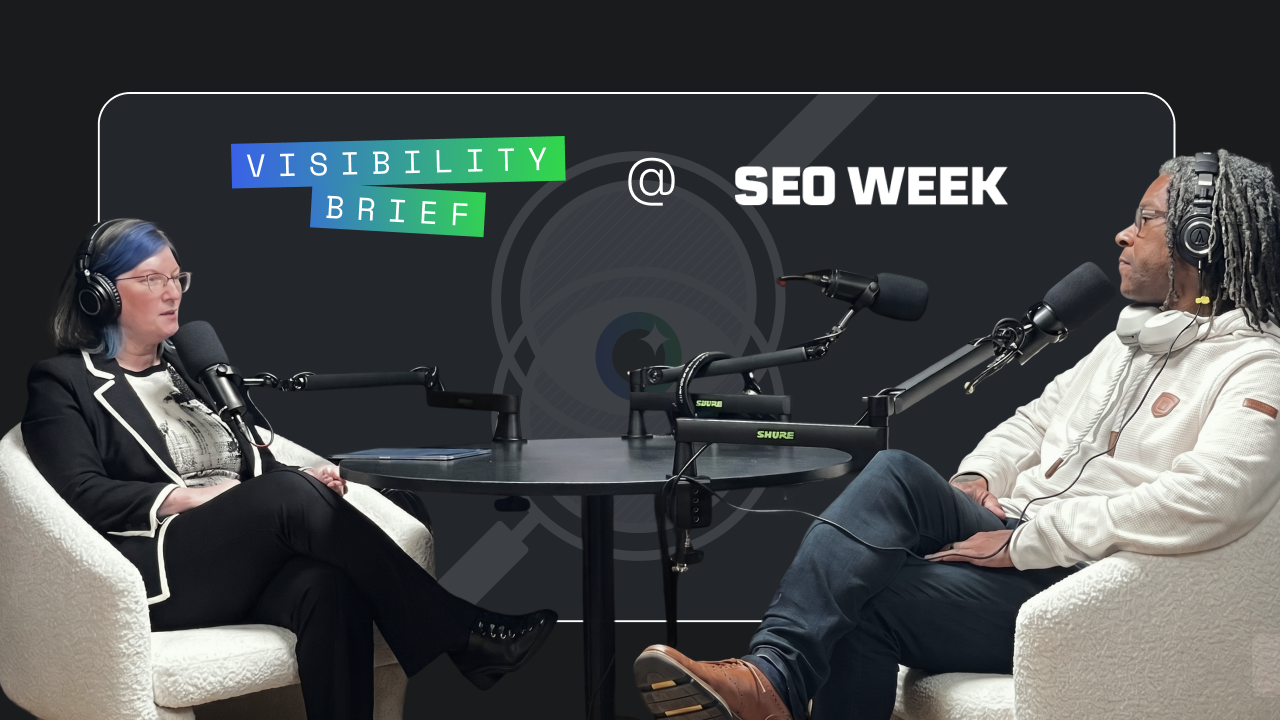
In this episode of The Visibility Brief, Yext SVP of Marketing Rebecca Colwell sits down with Paul McHardy, Leader of Global Search Intelligence for The Church of Jesus Christ of Latter-day Saints, to explore one of the most important questions facing marketers today:
What happens when your brand is no longer the primary author of its own story?
AI search now gives direct answers synthesized from review sites, third-party publishers, and creator communities — meaning that customers form an impression of a brand before ever visiting a website. This shift creates a new challenge: visibility is important, but accurate representation across every source that shapes that impression matters more.
For Paul, that challenge plays out at a global scale. The Church of Jesus Christ of Latter-day Saints operates in more than 100 countries and dozens of languages, serving members while also helping curious audiences understand its beliefs, history, and identity. His team's job isn't simply to be found; it's to make sure people receive accurate and trustworthy information.
The episode breaks down:
Why AI is changing the role of search teams
What happens when AI controls your first impression
How brands can bridge the gap between internal language and the words real people actually use when searching.
Why data accuracy is foundational to visibility
Why AI visibility isn't just about your website
The future of visibility isn't just about being discovered. It's about being understood.
If you're a marketing leader trying to understand how AI is changing discovery, reputation, and brand representation, this episode offers a unique perspective from an organization navigating those challenges at scale.
Episode Links
Listen on Spotify
Listen on Apple Podcasts
Listen on YouTube
Transcript
00:00:00.200 — 00:00:40.680 When most marketing leaders talk about brand visibility, the conversation comes pretty quickly back to pipeline or customer acquisition. But what happens when you strip all of that away? When the goal isn't to get chosen, it's to be understood and understood accurately. That's the situation that Paul McCartney lives in. Every day, he heads up Global search intelligence for The Church of Jesus Christ of Latter day Saints, one of the most searched for religious organizations in the world, operating in 100 countries with 100 different languages. Paul has some very unique challenges and is here today to share his pearls of wisdom. Let's get into it. 00:00:48.760 — 00:09:00.930 Hi, Paul, welcome to the Visibility Brief. Hi, Rebecca. Thanks for having me. I am so excited to have you here today. Um, you have a fascinating background in broadcast journalism, radio in particular, so I am confident this is going to be a great episode. But I am curious, before we dive into to all of the fun stuff we're talking about today. How did you make the pivot from radio and journalism into search? Well, the short answer is I wanted to make money in my career. Um, the longer the longer answer, it's just really competitive. Um, so maybe I wasn't good enough, or maybe I wasn't patient enough, but, uh, you know, I spent, um. Gosh, what, six, six ish years in radio broadcasting? Um, had the dream of becoming the voice of maybe the BYU Cougars. Um, got to work with, uh, the current voice of and and got to do a lot of fun stuff. Um, I was on a talk show for a couple of years. Um, did the sports broadcasts on the side at the same station? Um, it was when I moved into the newsroom as our talk show was, was phased out. Uh, that I realized this is this is hard work. Waking up at 4:00 in the morning. And so I just realized, like, there was a side of it I really loved. There was another side of it I didn't love so much. And, uh, you know, I just kind of looking into the future, decided I wanted to explore other options. Kind of fell into, uh, sort of a startup e-commerce company. Um, a deal of the day type of site and worked. Wore many hats there. And, um, was starting to sort of lean towards the logistics side of it is the role I was doing the most there and didn't like that either. And, uh, so I went back to my communications roots, went back to school for a little bit, um, and just, you know, with that connection to e-commerce got me thinking a lot about the web and, uh, fell into marketing after after my master's program, um, did it did like full product marketing go, you know, go to market plan, uh, and then had the opportunity to, to start focusing on the web, where I was a digital marketing director for some time, um, doing mostly affiliate marketing for, for a large, uh, uh, telecommunications brands primarily, you know. So. So I really liked it. And I touched all the pieces that go into digital marketing, um, from, you know, paid search to, you know, other affiliates and, and everything else. But it all kind of came back to I always had a love for that. The content side, the, you know, speaking to an audience, which, you know, the broadcasting background, uh, kind of kind of leans to and I, and I like the art of, um, tailoring messages to connect with people. And even as I was, you know, doing the product marketing, being able to take a product and figuring out who is, who is the audience, who are the consumers for this product, and how do I connect with them and help them understand the value and benefit? Marketing one on one stuff. And I'm over time, eventually, the opportunity to really focus into SEO and SEO is kind of a good mixture of the the technical and then the artistry of, uh, online discovery, the opportunity to, to work for, uh, the church, um, which, uh, I've been a lifelong member of, uh, never thought I would join their. Their full time workforce. Um, but but always been involved on a volunteer basis with the church. So to be able to actually apply this skill that I had sort of fallen into and grown to love with an aspect of my life that is very important to me and is core to who I am, is just like this really nice marriage of of of two loves that make me really excited to do what I do every day, because it gives me a lot more meaning than just, you know, punch in the 9 to 5. It's such a gift. Um, when you have a talent to do something and you get to apply it to something that you're passionate about, it's something that most people you know dream about but don't, don't get to experience. So that's incredible. Well, I love your background. I also have a product marketing background. So in storytelling piece you're speaking directly to me here. So in your role, um, so you manage the global search intelligence function for The Church of Jesus Christ of Latter day Saints. Other people might call that an SEO team. So tell me a bit why you frame it as global search intelligence versus SEO? Yeah. So I mean, it's a recent change. It's actually in the last 12 months. Um, and I mean, let's be honest, it's AI, right? Like the only, the only reason we made a change was to account for the way the industry is evolving. And to be perfectly frank, I hate the other acronyms I've seen out there. I don't, you know, GMO is a loaded acronym, like, so what are you, a geographer or, you know, whatever. But so so we we kind of hung on to the SEO, uh, moniker for a while, but it, you know, it was honestly mostly perception. So as executives are, you know, reading the tea leaves and trying to see where the future is leading, when you when we were coming in the door and talking about SEO, there was a lot of presumption that, oh, you're stuck in the past. Like, you know, that stuff doesn't matter anymore because AI and you know, Yeah. Yeah. Yeah. And as much as we would say, you know, we're looking at this new space and we're looking at these, you know, AI driven search tools, etc., bringing that baggage, I guess you could say to the table of calling ourselves an SEO team. Uh, it just wasn't really landing. Now, we still say SEO all the time, but we try to make sure it's clear that we're talking about, you know, traditional SEO best practices and then also, you know, tying it into the future, essentially. Yeah. And that's not to say that I guess the clarification. So it gives us another term and another way to position ourselves that accounts for the the foundation principles of SEO and the future of AI. Um, but really, it's it's all just like a prioritization of a lot of the same stuff with some, you know, some sophistication on top of it. And, and then acknowledging that we're also keeping our pulse on. You know, when you and I first met several months ago. Even then, it was so different than it is today because we're learning so much and things are evolving and changing literally daily. So again, it's a little bit of internal PR, but but there is some foundational like there's some strength behind it. One of the things I really enjoyed about our early conversation was how innovative you and your team are, and you're really forward looking. And the first question I had for you, you know, what I think about the goals of the church and your organization are not commercial, right? You're not trying to get someone to come in and buy a product or, you know, get found. So you can you can hit your pipeline number. So I'm very curious when you think about visibility and getting found, what is the primary job to be done for for your team. Yeah. So I I've, I've not worked at the church for five years. And it's interesting how your typical marketing terminology like it's still relevant. But when you talk about a sales conversion versus a conversion. Conversion. It's a bit, you know, the words the same, but the you know, the way behind it maybe is a little more significant. Um, so it is interesting and it's taken some understanding again, getting to learn and understand both the space you're working in and the audience that you're, you're working with, um, is so important. Um, every time you kind of jump into a different vertical. So in this space, for better or worse, you're right. We don't really, like, have that full funnel attribution model that that you typically see elsewhere. It doesn't mean that those aren't there. Right? Like we still do as an organization, run paid advertising. And there are metrics associated with that. But then the KPIs down the line are of course different. So so for us on the search intelligence team, we are you know, there's a lot of interest in our faith. There's a lot of interest in faith generally, especially in the past couple of years. Um, and when it comes specific to our faith, there's a lot of misinformation, disinformation and just, you know, competing ideas, which is fine. But we just want to make sure that as people are, 00:09:02.330 — 00:14:27.949 uh, making considerations that are pretty consequential to their lives, that if they find themselves interested in what do what what do members of The Church of Jesus Christ of Latter day Saints believe that they're getting a fair representation, right? Um, and so that that is kind of number one for us is just are we being represented fairly and, and, um, accurately. And then, you know, from that point, then there's, you know, the, the, the conversion journey, the user journey is pretty long, uh, for somebody who maybe would eventually take the step to converting to a new faith. Um, but as long as we know that they are finding the information that they need from the reliable source along that path, that's where we say, okay, we've done our job and then we we allow God to do the rest. And really, really God's doing all of it in our view. But, you know, he uses us imperfect people to accomplish his work. And, um, and so we're just trying to make sure that, that the tools that we have at our disposal are used in a way that, that allow him to do what he needs to do. As a marketer, your role right now has changed a lot. Right. So perhaps 5 to 10 years ago, your job was to influence the individual. Now you're trying to influence the individual and the machine, the LM, who is describing the church on your behalf? Right. So I'm just thinking about all this information that you're trying to get out into the world, um, to ensure that the answers are are accurate or there's a, there's a fair representation of, um, all sorts of things. So I think there are three general categories of content. I think we had discussed, uh, right. So pure facts. Right. Uh, where is there a location near me where I can attend a service, and what time does that start and what services do you offer? You know, those sorts of like general facts. But walk me through a little bit more about how you think about the types of content and questions that you are answering for existing members and perspective. Yeah. So I'll kind of start, you know, bottom the funnel with people who are members of our faith already. So obviously we want to make sure that as they are coming to the resources that the church has made available to them, that it's easy to find it. And and our website is pretty big. We have I don't believe we've completed a full crawl of the site to actually know how many pages there are as well. You know, there's there's just the content and then the translated content. But, you know, obviously we want to make sure that that it's findable, but it's a captive audience, right. Like they're going to come to us because they're looking for the information the church provides. So there's a little bit of, we can get to get away with the, Uh, neglect or I don't know what the right word is, but, um, you know, they'll slog through it. It's when you step that next level up, uh, that that it becomes all the more essential. And, and, uh, I call this kind of the, the church curious audience. These are people who are, uh, who are who are people of faith or they're they're curious. They already know of, uh, the church or they've heard of Mormons or, you know, whatever. Something's come up in their life. They've watched a TV show where the where the church is mentioned and they're like, dude, you know, they really believe that. And so meeting those people where they're at in their awareness of our organization and of our faith, um, and so one of the keys to to that part is that we have to use the language that they're using and that they're familiar with. We every organization has kind of its internal vernacular, its slang, its, uh, you know, the colloquialisms. We have a lot of that. We love our acronyms. We love our, you know, special terminology for things. Kind of like when we walk around saying, oh, I'm an SEO. You're right. What? Right. Right. It's very it's take that, you know, 108. Yeah. We do it in tech as well. Right. We have all these shortcuts for for how we talk about things. And then we get to our customers and like, what are you talking about? And when you're talking shop, you can throw those those acronyms around all the time. Right. But when but when you're then you know, when I come home and I'm talking to my wife about my job, I have to translate it in my head to make sure, as much as I've talked about it, she knows a lot more than she used to. But man, if I if I just kind of ramble, she'll be like, okay, honey, that's that's cute. I'm glad you like your job. Um, so so so using that language is super duper important. And we have a the the origins and the foundations of the church's web presence is, has been, um, primarily to serve our membership, which is understandable, but there's an element of it that needs to create that external connection. And that's a place where where my team has been focused a lot over the last few years, is trying to draw those connections and help answer and acknowledge the question that's being asked, and then open doors to further discovery. Again, basic marketing, but it's when you apply it in a space like ours, it it can kind of get lost. You can get lost a little bit, I think. Yeah. And I just been thinking that the, the brands challenge as well, if you change vernacular, trying to meet people who might be searching for old 00:14:29.390 — 00:20:46.160 ways of, you know, describing your faith versus how you're describing it today, that's a big one. Yeah, that's a that's a big one. And, um, you know, it was, uh, a known challenge when I took this job of, uh, trying to meet a, um, a change in. You know, we don't like to call it branding, but, you know, branding or the way we acknowledge ourselves while also recognizing that, um, we're not going to be able to control how everybody knows us as we can do our best to influence. But ultimately, people still know us as the Mormon church, you know, as we've. So. So in 2018, our prophet, our president of the church asked us as members and as now, you know, content creators of church content, to move away from using Mormon church terminology to focus on the full name of the church, which includes the name of Jesus Christ. And we felt and he felt inspired that by by having by referencing ourselves as the Mormon Church, we're removing the name of Jesus Christ, which is the most important piece of our faith and the central figure of our faith. So in order to accomplish that, we needed to kind of correct ourselves and make sure we're Representing ourselves doesn't mean we don't ever use the word Mormon. It's just that, you know, we primarily prefer it this way. Um, and as we experience, uh, others who are who are familiar with us as the Mormon church, we can talk about it and then also help them understand this is our preferred way of talking about the church. But, you know, it's okay. It's fine. Um, it's so we do, I love it. Yeah. Please go through the a similar challenge. So, uh, as you know, lead marketing at Yext. Historically, people think of Yext as a listings management platform. And we are an a genetic enterprise AI platform. Like, we are trying to help people think about us differently of all these different things that we can do in the framing. It is such a hard challenge. But I imagine like we're starting internally, getting our our teams to understand this, our customers to understand this and then the broader worlds. Um, but I'm there with you. It's the tough It's a tough pivot. Um, yeah. And, and and we've, you know, we've done it through a pretty aggressive pendulum swing. Like, we we very aggressively, you know, sort of did a, you know, scrub of those terms from our digital presence, from our social media, from our you'll still find video content out there from years ago that still has it. But overall, you know, we went pretty aggressive with we're going to shift away from this. And then we had to measure and say, okay, what was the impact? We're going to do this now we have to figure out how do we calibrate and and still create the connection. And I I've conducted several studies over the years looking at, um, you know, generally does have did Google recognize the shift? Does it understand that The Church of Jesus Christ of Latter day Saints equals Mormon church? And generally speaking, yes. And then I've also done, you know, extensive, uh, deep dives into okay, well, what's the ecosystem look like out there? Are people still searching for Mormon since we're not using it, does that mean that searches are decreasing and, you know, latter day Saints or other terminologies that are increasing? Short answer is no. In fact, there's more searches than there ever have been using Mormon terminology. So in reality, as as we as a church have made this shift, we have to acknowledge that even though we're not using it broadly, it is still the primary way in which people understand what are you even talking about? And so how do we meet? How do we meet that middle? How do we swing the pendulum back to recognize, hey, we've done our internal correction. And now as we try to do that awareness campaign externally with others, how do we acknowledge and then educate and bring people to understand? Yeah, that's where we were. And this is where we are now. And it's still the same, you know, for you it's still Yext. But we're, we're more and and you know yes. Mormon is a part of our history and Mormon pioneers and all of the things that go into the history of our faith. And now, you know, in fact, the name of the church has been the name of the church since 1838. This is just the nickname that's existed. Well, hey, we'd prefer you not call us that. It's okay. But just, you know, know that as we build a relationship of trust together, here's how we would prefer to be treated. So, you know, it's it's a process, and it's, um, it does take time. You know, we're we are eight, seven, eight years into this and Mormon searches are still going up. So how do we continue to influence knowing that you can't control everything? I'm curious. You mentioned there are a lot of different people out there creating content. Um, probably attempting to answer questions that people might have about the church if they're using terms that people are more likely to search. How do you bridge that gap? And I guess, um, I'm also curious, Do you find yourself creating content today that you maybe wouldn't have created 5 or 10 years ago? Mm. Those are good questions. Um, as far as other creators. So. So if they are, uh, creators who are members of our faith, they've actually all, you know, tried to very faithfully follow this prophetic counsel and direction. But still we do hear it, right. Like we are there are some of these creators that we have informal, you know, relationships with. Or I just happen to know, um, just through other connections and things. And it's honestly the number one question I get when they're like, oh, you're over search. Well, tell me about this whole Mormon change. Um, which is a big catalyst for me doing all those deep dive, uh, research projects. But, you know, they're going to do what they're going to do. And, um, it's just all we're trying to do is just connect with the interest that exists. And? 00:20:48.520 — 00:32:01.619 Ultimately it's not. It's not a problem. Right? Like, we're not like, we're not out there slapping wrist and saying, how dare you? Or whatever. Um, you know, it is what it is and it's beneficial. And honestly, even if they're, you know, whether they're for or against or just inquisitive or whatever, it's it's that, uh, all, all press is good press. Right? Like, if people are talking, you're relevant and and that's great. So we don't overly concern ourselves with it or try to police it or whatever. We just want to have opportunities to, to to share this. One of the biggest challenges, honestly, is instead of talking about us, why don't you talk to us? Uh, and, and then let's have a conversation of connection rather than, like, think. I think this is how they are instead of. Well, let me actually ask someone who might really know. Well, speaking of connection, let's talk about how you enable your members to find you in real life in the wild, right? So. So you've got visibility across 100 countries. Um, with a team of six. Right. So tell me a bit more about. Um, so obviously we're crushing it, right? We're doing everything we can do. All the things. We're checking all the boxes. Right? Really, really impressive. What did I hear? 19,000 congregations or so. Uh, so 19,000 physical buildings with 40,000 plus congregations. You know, some are shared buildings, but. Yeah. Okay, so that's a lot of physical location data to manage details. Tell me a bit about the types of information, like details for those physical locations and why that's so important for your members. Yeah. So we within our own ecosystem, uh, over the years, the church has developed, you know, internal finding tools. Um, you know, obviously there's databases that house the information for these physical buildings that we have to, you know, upkeep and and do repairs on and pay taxes on and all that, all that stuff. So all the data is there. Um, which is what they use to build that, you know, on site ecosystem, homegrown, you know, put it together ourselves sort of map and look up and finding tool. But up until recently, we just weren't really acknowledging that. I mean, even even with our top leadership, when they, they travel all over the world all the time, and when they land in another country and they're mapping to go to the chapel that they're, you know, scheduled to speak at, are they going to the church's website or are they pulling up Google Maps? Well, we all know what the answer to that is right there. Going to Google Maps, uh, or they're putting in the navigation in their car. Right. And uh, man, if I, if I had a dime for every time I had heard, like, Oz trying to find the building and I couldn't find it like it was the pin was in the wrong place or it wasn't even there or whatever. So there's this acknowledgment of, you know, again, talking about those different levels, like you've got your members, your church curious, and then you're the one. The third one is just, you know, general faith or religious interested folks, regardless of where they are, if they're wanting to go somewhere, they're wanting to take that action, which is like, you know, that marketing gold of, you know, the golden prospect, they're going to buy something or they're going to take an action. That's the action, like get in the car, drive there. So, you know, there's this like find ability as well as then the reputation piece of, well, we've got these buildings and and our online presence is unmanaged. We don't know how each of these buildings is being represented. We got to do something about that. So so that's where our connection with the XT came in, was recognizing that we need some way to do this at scale. And then as we've gone through this process, how do we utilize all of this information? We already have to make it easy for, you know, you said I have a team of six. In reality, for this portion of our work, it's me and one other person. So um, and then a much larger but volunteer level support system in each of the, you know, each of these parts of the world where, you know, a member of the church in, uh, in Portugal volunteers their time. We give them some steps and some guidance and give them, you know, a, a local, uh, admin access to say, hey, make sure that your building is being represented properly. I have no way of knowing if where this address is showing up on the map is actually where you're building is. I'm sitting in the United States, right. Um, so we have to have that piece. But we also recognize these are volunteers. They're doing it in their spare time. So how can we make it as simple as possible? So tying all those pieces together has been an interesting challenge. I've gotten involved in a lot more things internally at the church that I never thought I would. Um, learning about telephony systems and and how all that works in every country. And you know, how how to format an address properly so that it'll actually be accepted by the Listing Service. And it's literally different in every country. So it's been really interesting. Um, but but ultimately, like acknowledging that our systems were homegrown and built the way they were, but they're super valuable because we can't like to just literally click on 19,000 locations alone would take weeks, much less actually think about each one. So yeah, it's definitely been an interesting time trying to tie those two together and then also recognize maybe the way our data is stored won't work in. Is that like, you know, we're storing our addresses and we don't have any sort of validation on them. So they could. You could type anything in that field that's not going to work for for a listing service. So it's interesting our data, we've done some recent research around what it takes to show up in an LLM search. So you mentioned people are going to Google to find an address for local congregation. But it's possible that they're just asking ChatGPT. Right. Yeah. And what we're finding is, you know, ChatGPT is referencing potentially Google, but it also might be looking at MapQuest or any one of these other directories that exist out there. So it's more important than ever to have that accurate information distributed to all those sites where people and machines might look, and it feels like part of the plumbing of the marketing department sometimes, or you're just like, I have to format this address correctly, and it seems like it's not important, but it's those little details, actually, that really can impact the experience for the constituents that you serve. Right. Yes. it's super none. Flashy work which no marketer likes. We all want to be out there doing the fun, like creative stuff and and, and and, uh, you know, see the things that like really just boom, bring this big spike in your analytics or whatever. Um, but, you know, it's that it's that steady eddy foundation. You gotta you have to have that to be able to do the fun stuff. That's right. And, uh, and so you really, you got to dedicate the time to be able to do the, the play. So. Absolutely. Well, um, Paul, one of the other things that I thought was interesting is that you sit within the reputation management group. So how do you think about reputation management for an organization like yours? I mean, fortunately, I'm not I'm only one piece of that bigger puzzle. And that is a very challenging, um, role, uh, for a, for global church and for one that, uh, you know, is often gets a lot of, um, visibility in the media or otherwise. But, but ultimately it kind of comes back to that, uh, that, um, when people are asking questions that they're getting reliable information. That's what that's where it's a little unorthodox for, for an SEO now search intelligence team to sit in a reputation division, um, and not, you know, typically you're in a marketing team or you're part of of that whole whole ecosystem, and we are dotted line. Um, but the recognition was so, so much information. So 70 plus percent of the, the queries that our faith, uh, shows up for in search are informational queries. So they're not transactional. They're not, you know, they're of all those categories they sit in the one where people are just like, I had this question about this thing, and I just want a quick answer. And AI is eating our lunch on that. Like, no, not only is nobody clicking to websites as much as they were before broadly everywhere, but when you're indexing really high in informational queries and 75% plus of informational queries are being answered by AI, and then they never come to your website like, it's really significant and so important that AI is using your information to answer those questions. And you know, you alluded to not even AI is not just using Google anymore. Sometimes you'll see, like, I don't know, sites you've never you've never heard of or um, or you haven't heard of in 20 years. Oh, that's still a thing, but AI is referencing it. So you have to you have to touch all the things now. And so to be able to, to ensure that, um, you know, like you were saying, we're not just influencing an individual anymore. We're influencing an entire ecosystem of AI search. Um, you have to make it as easy as possible and as clean as possible. Again, all these are foundational SEO things, but it's just like to the nth degree now where you have to be so clean with it, um, and so clear that if if you are not, There's plenty of other options out there and and, and and people will take the answer they're given as the gospel truth, regardless of the source. They won't even know the source half the time right now. Um, so so you have to be you have to be there or forget about it. Exactly. Yeah. If you don't answer the question, someone else is going to answer it for you. Yeah. And, you know, you're crossing your fingers at that point if it's an accurate answer. So, yeah, it kind of comes back to this idea of how much content are we creating today that we weren't creating years ago. Um, you know, I think your story is so relatable. Um, specifically for organizations that are trying to manage visibility in spaces where there's a lot of competing information. Um, there are a lot of brands out there that, you know, people are passionately writing about, um, for one reason or another. So, um, as we wrap today from where you said, what would you recommend those organizations do in terms of what should they stop? What should they start and what should they rethink about their strategy today? Yeah, I mean, the stop is probably the most obvious to me. Um, but it's kind of a bummer, especially for me. So, so, you know, we have for, for our organization to be able to kind of make changes and make waves. We have to do a lot of education about the digital space, with 00:32:02.620 — 00:36:29.330 a lot of times people who have absolutely no exposure other than they have a phone in their pocket. So understanding how that works can, you know, it's not like I'm going to a chief marketing officer who understands to some degree the digital space. It's very, very, you know, newbies to the space. And, you know, over the last several years, we did. We've finally gotten to the point we felt like we had a good understanding of what the standard KPI KPIs are in digital marketing. Your your impressions, your clicks, your, your, your visits to the site, etc. and now that's gone, right? Like, you just you can't talk about that stuff anymore. Because if you if you are, the only thing you're going to be able to report is, oh, traffic's down again because traffic's going to keep going down. Um, so, so finding what those new metrics are, what those new KPIs are, is super valuable and then learning how to communicate them. It's always there's always that, uh, communicating to executives like if there's there's master's level courses on this. Right. Uh, they don't want the, the minutia, but they still need to understand enough to be, uh, you know, to be really strategic and make good decisions. So in our roles, we have to learn how to translate that. And in, in a space where the KPIs are, uh, I kind of equate it to like your old school Google impressions number that honestly, in my career, I never gave a lot of credence to because it was it's hard to rely on it for anything. Like, okay, well, what do I get out of that? It's kind of where we're at now. You know, your citations in AI are kind of like Google impressions, where it's like, okay, great. But like, now what? Like, did they do anything with it? Well, we don't know. You never want to say that in a meeting like that. You want to say, oh, we don't know what the actual impact of it. We just know that we were cited. And what I will say is, I don't have the answers to that. I don't know that anybody does yet. I think we're all in a space of discovery. So it's super important to acknowledge that there's a change point towards the indicating, uh, you know, the few what we think the future is. But always say, you know, this is a changing space. I'm coming to you acknowledging, I know it's a changing space. So. But I am working my tail off to figure it out with everybody else. And and then when we finally understand this crazy new world we're in, we'll be right there, ready to tell you what it is. And I think for me, in my career, I've always found that that level of honesty and transparency goes a long way, then trying to like, you know, like, spread some icing on top of this weird cake underneath the like a fruit cake underneath it. It's not going to work. Eventually you're going to be exposed. They're going to eat the fruit cake, and everybody's going to hate it. So the more you can just say, listen, I know this is weird and but trust me, we're like on the pulse. And when we know along with everybody else out there, you will know. Um, so that would be my just acknowledge that. Stop trying to hang on to the past. Acknowledge that the future's here and acknowledge that there's a lot that we don't know. And I guess that leads to what I would say that the the start is similar to answering honestly to your leadership on, you know, what you're seeing in your analytics is, again, you have to make it as easy as possible for AI to want to to look at you, to want to reference you so you you can't leave it up to chance for it to interpret what you're trying to say. We we talked a lot today about using certain terminology that the general public uses versus what we prefer them to use. And it's been a big challenge for us organizationally to figure out where that middle ground is. But ultimately, when it comes down to it, you have to meet people where they are. Where are they in their journey? Go to them. Don't wait for them to come to you because they won't. And and the barriers to them coming to you are getting wider and wider. So you have to make extra effort to say, okay, maybe they're asking questions that I'm not super comfortable acknowledging or even questions people have about this, but they're asking them. And if you're not willing to answer it, there's plenty of people who are so like, just lean into that. So that, again, especially when we're not fully sure how to measure the success yet, you can at least say, well, I've done absolutely everything I can to go to that audience. Talk to them in the language they use. Guide them towards what we would you know, where we would like them to end up. Um, I think the rethinking. 00:36:31.310 — 00:36:37.070 Gosh, there's so much to rethink. And I was thinking a little more about this this morning. I think 00:36:38.750 — 00:36:42.750 this has come up a lot in the last few weeks and some conversations that I have. So so I think 00:36:43.910 — 00:36:45.390 it may fit this mold, 00:36:46.670 — 00:39:07.070 but in in digital marketing, especially in SEO, there is if you ever spent any time on LinkedIn, you'll see everybody's got the answers right. Everybody's got this new whiz bang, fancy new thing they're doing that's gonna just crush your your your search visibility. Listen, I'm going to tell you, those people are there to burn you. They're there to use you for their benefit. Uh, they they will come up with something that is going to take you down this path of chasing the fanciest, new, amazing thing that's going to solve all your problems. It's not going to do it. And and you know what? One example that's that's been really big lately. It's been, you know, the AI creation of content. Oh, I've got this brand new tool that's going to create new content in bulk that is optimized that that will just crush in an AI visibility. They're going to eat it up, and then they'll post some analytics thing of this giant up into the right spike. But what they don't show you is that week later when you know, AI finally catches on to the game they're playing and they basically get completely shut down. Um, and that's nothing new again. I've seen this over the course of 15 plus years. There's always something like that coming up. It's the people who stay right here in the middle, the steady eddies, as people are chasing all the fancy new stuff. It's the people right in the middle that have the long term success. It's going to be really hard to resist wanting to do these fancy new things. I get developers coming all the time. We don't even need to build our website anymore. Let's just build a code based foundation of all of our content for AI to consume. Humans don't need to see it. It doesn't need to look good. It doesn't need to look amazing. We don't need to spend millions of dollars with this fancy, you know, design. But there still are humans coming to websites. And the principles that all of this are built off of is serving the user, whether that user is AI or whether it's a human. It's all built on that foundation. If you just stay the course and make those small course corrections along the way, you're going to be fine. And don't get caught up in the in the crazy. So so yes, the world's changed and things are crazy, but there's a lot to figure out. And as the dust settles, 00:39:08.230 — 00:39:20.710 those people will still be chasing the crazy. And you're going to be you're going to be just like, boom! And people are going to look to you as okay, where there's chaos. That's the person I can look to to help me, like, feel. 00:39:22.110 — 00:40:27.450 I can handle this. You're spot on. You're absolutely spot on that, like Chasing the latest trends are really. It's really only going to have a detrimental impact on the long term. And, um, this was such a wonderful conversation. Um, Paul, where can people connect with you if they wanted to ask follow up questions or just stay on top of what you're up, what you're doing? Yeah. LinkedIn is a great place. I'm not super active on any other social media. I've kind of decided I don't want that in my life too much with the headaches, I. I lurk, but I don't interact. But feel free to hit me up in LinkedIn. Um, that that would be the best way to reach me. Obviously. You know, Church of Jesus Christ. Org has all the information about our organization. Um, and, and I'm always, always happy to have conversations when for anybody that reaches out wants to connect. Well, thank you so much for being here. I truly enjoyed our conversation. And, uh, have a wonderful day. You too. Thank you. That's a wrap on this episode of The Visibility Brief. If you found this useful, subscribe, leave us a review or send us to a colleague who needs to hear it. We'll see you next time.