Customers aren't just searching for brands by name anymore. Instead, they're asking highly specific questions about products, services, locations, and experiences. Whether they're looking for "restaurants near Yankee Stadium" or "catering for a 50-person office lunch," AI models cite and surface brands that have built content around real customer intent.
So, how do marketers create local experiences that satisfy both customers and LLMs? And what separates a high-performing local page from one that's nothing more than a store locator?
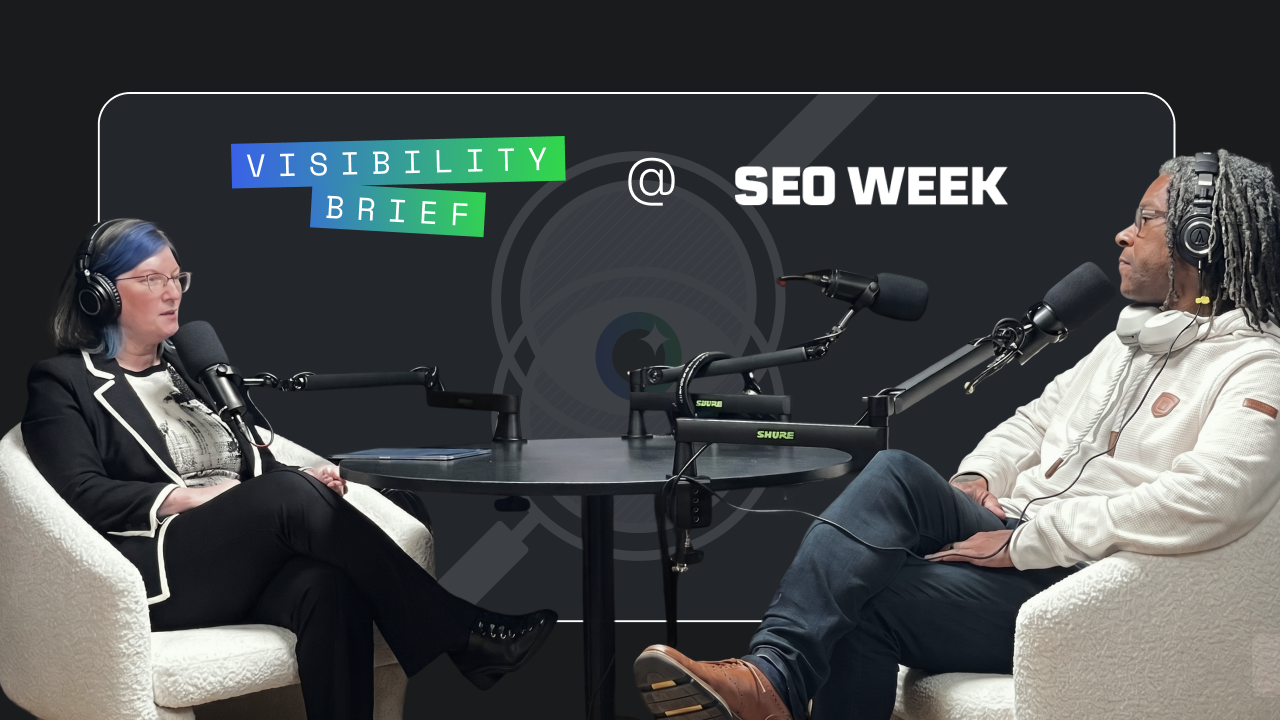
In this episode of The Visibility Brief, Yext SVP of Marketing Rebecca Colwell sits down with Steve Wiideman, President and CEO of Wiideman Consulting Group, to explore why local pages have become one of the most important assets in an AI-first search strategy.
Drawing on nearly 30 years of SEO experience and work with some of the world's largest restaurant brands, Steve shares why local and intent pages are now a competitive advantage – and how marketers can use them to increase visibility across both traditional and AI search.
The episode breaks down:
Why local pages still matter in an AI-first world
The difference between location pages and intent pages
What the highest-performing local pages have in common
How AI is changing local content strategy
Lessons from restaurant brands that adapted quickly to changing customer behavior
What marketers should stop, start, and rethink when building local content
Whether you're managing hundreds of locations or just getting started with local SEO, you'll learn practical ways to build pages that help customers find exactly what they're looking for, wherever they're searching.
Episode Links
Transcript
00:00:00.120 — 00:00:27.720 As consumers ask more detailed questions. Brands need to provide more detailed answers, and a surprising amount of that information can come from local pages and in ten pages. Our guest today is Steve Wiedemann, CEO of Wiedemann Consulting Group, and he has spent the last 25 years helping brands like IHOP, Applebee's and to Doba reimagine what local pages can do for brand visibility.
Let's get into it.
00:00:35.960 — 00:16:12.110 Hi, Steve, welcome to The Visibility Brief. Hi, Rebecca. Thanks for having me. It's so exciting to connect with you again. You have been an SEO for longer than most people even knew. It was a thing, so I first 30 years. Oh my God. So impressive. What? What pulled you into the field? You know, it's actually funny, I was doing.
I was in love with the internet while I was in the military, and I was playing around with, with websites the way everybody was. We were all like amazed at this cool thing called the web. And I just started goofing around with stuff. I was copying other code from old, from other websites and kind of creating my own.
And a friend of mine who was a DJ, it's like like, hey, you're getting pretty good at this, this website stuff. Can you build me a website? And I'm like, I guess, sure, why not? And so I just kind of fell in love with it. Um, went back to school for e-business management. Um, graduated, picked up a little job at Disney working as the account manager for Disneyland and Adventures by Disney.
And, um, again, just just kind of fell in love with the industry. A lot of the clients that you work with today are in the restaurant industry. So I'm curious, one of the things that you really focus on is helping them improve their visibility in the local pages are a huge component of that. So let's start really simple for people who may not understand what exactly is a local page, and how is that different from just any other page that might be on a brand's website?
So a local page is really just one page for each city that you have a location in to allow for Google Maps, especially in that website field, to send the user directly to the page in their area so they can see the menu, and hours and times and differences that other pages might not have. And it gives you an opportunity to get even more exposure.
Because now if you've got multiple locations in a city, your city page could show up in the web search results below the map. So if you're doing paid ads and you've got a map listing, and you've got a city page that lists the locations you have in a city, you've got a trifecta. You've got this perfect scenario, the perfect storm of visibility and real estate in the search results.
And users are going to see that. And all the studies point to you having more results results in higher click through rates across all of them, because now the user thinks, oh, this must be the best option because they're everywhere, right? So the location page is addressing a need when a user comes in and says, is there this thing near me?
Um, I think with the advent of LMS and people asking much more specific questions. We started to see the rise of deeper intent. Pages. So I'd love for you to talk a bit about the difference between what you call a local page and an intent page, and why they're so valuable for both people and the LLM that might be searching on behalf of a person.
Sure. Well, we take like a let's just take a Mexican food chain. And if you've if, if you've got 900 locations across the country and you've created a location page for each of them, your primary focus keyword might be Mexican restaurant near me, right? That's that's what you do. But you know what? You do a lot of other things too.
And the business has some of their own objectives. Maybe this year our objective is off premises. We want to make sure that we're getting online orders through takeout and delivery and catering. Maybe, maybe our our business objective this year is is really focusing in on our happy hour and our, our drink specials.
Maybe our business objective this year is really pushing this new product, these these tacos that everybody loves. So you take those business objectives and the specific intents that our customers have, and you build out subpages underneath them. The first time we did that was, well, the first significant time we did that was with Meineke Car Care Centers back in 2014, where we took a every intent that a customer might have, such as oil change near me or muffler repair near me.
All of those different specific needs they have related to their their vehicle and every location had its own page. And what was neat about that was when somebody would do a search for oil change near me. You'd see that Meineke page forward slash oil change and dash whatever the city happened to be. And the epiphany of it was, we need to do this for all of our brands.
So these intent pages became a cornerstone, really, of our success because, as you've mentioned with LMS, they're often the citation source. When you do a search for breakfast restaurant with specials near me, it might show an IHOP. And then if you click on sauces and you see the sauces column in ChatGPT.
That first citation source is actually the the special intent page that we created. Or if you're looking for breakfast delivery near me, you might see the Breakfast Delivery intent page showing up as a citation source, almost like the single source of truth. So save you're a very data driven marketer, and I understand you just did some research on what the best, highest performing local pages have in common and what the underperforming pages look like.
So tell me a little bit more about what you learned. The top of the list, of course, is the hyperlocal content more than ever with AI, hyperlocal content is nearby parks and landmarks. If we can take all of those different, those different landmarks and and use them as part of our dynamic local content, we're providing more, more detail and more and solving for more intense.
So when someone's saying, hey, give me ideas for a pick a place to have a picnic and where to stop by to get food for the picnic, which is what they're doing in LMS now, right? They're not just punching in keywords, they're using ask maps and other AI features to ask longer questions. Okay, I need to find a place that to eat that's near the freeway, that's near the five freeway.
I'll be passing through there at three. Okay. Um, hey, can you find me a place to to eat before I go to the concert at such and such venue? Right. Those are the types of questions that people are asking LMS. And the hyperlocal content solves for that. And you will have a 107% competitive advantage if you can put hyperlocal content together for those pages, which is the highest of all of them.
Next is like location images. It's really easy just to slap your logo on every page or a static picture that represents your stores. But if you can actually put in a unique picture that shows the customer what the location's actually going to look like when they get there, there's a trust signal there. There's, you know, there's this feeling of, oh, okay, cool, this is where I'm going to be going to.
And not just a generic image that was chosen by the brand. We also noticed that when you when you include links to some of the specific social profiles, like the respective Facebook page or Yelp page for the brand, the users will use that because they'll want to see what other people are saying in terms of reviews and feedback.
Directions. Link. That's huge. There's nothing more frustrating than getting to a location page and having to press and hold the address, and then go to Google Maps and paste it in. Why can't you just click the directions link and go straight to Google Maps for Apple Maps? Page size being very important.
Most of our users for local 90% or so are on mobile devices, so a slow page could cause the person to go back to Google and choose one of your competitors. Open now. Status. It's great that you have the hours there, but why do I have to study the hours to find where today's data is? Why isn't it just highlighted right away?
Ours listed 360 video coupons or offers and a location video. Every single time we put a location video on a page, it moves up within two weeks. And within three months we see it in the top of the at least the top three search results. Um, pretty exciting to watch. It sounds like we're preemptively anticipating questions that people might have about their experience and then addressing them.
What are mistakes that people are making on their local pages, or areas where they're investing time, where we're not seeing a return? I would say when they're not using that dynamic approach, they're just keeping the text the same across every single location and maybe just swapping out the name of the city, you know, that worked ten years ago and maybe even five years ago, but we're seeing it being as less effective today than what it was previously.
Really trying to get those pages to look as customized as possible. The other thing that that a lot of marketers get confused about is the word hyperlocal. Hey, I need to create local content. So I'm going to talk about schools in the area and the weather. Nobody cares about that. And how does that tie into being relevant to somebody looking for food if you're talking about a restaurant?
So it's really easy to get way off topic when it comes to creating hyperlocal content. I know that you partner with Yext in a lot of cases on the pages that you build out. So I'd love to to dive in a little bit and explore. Why yaks. Like, why is that the platform that you prefer to use? One of the reasons why we like to use X pages is that you've kind of already built a foundation, right?
All we have to do is kind of add our content. There's not there's not a lot in terms of, of instruction that we have to give around things like structured markup. It's already out of the box. Got everything we need for making sure search engines can understand what our page is, where we are, what type of service or business we are.
Because it's all written in the code. It's all in that, that schema. Um, you've already got all that laid out and perfect. And if we integrate our reviews from the system, we can actually get those beautiful star snippets. I've seen that many times on on Jax listing. So I would say, um, from a foundation standpoint, we don't have to go back and say, hey, can you make this an H1 tag and this an H2?
And can you add fields so that we can add a custom title and meta description to the page? All that stuff's already there. We just go in and and add our language and the content that we want. And structurally, from an on page SEO standpoint, everything's already set up for us. And creating content pages is so cookie cutter.
Now, I could literally just make a copy of 1 in 10 page and, and build out the next one without having to open up a request, without having to, um, pay extra money to do that. It's all just, you know, time and effort on our end to make it happen with the features that are already available in the system. So it's very minimal support required.
It's got all the coding we need. It's got all the, uh, the HTML, the, um, you know, the structure of what we need our page to have in terms of titles and headings and so forth. So for me, it's just, um, you know, it's it's just a perfect fit for a lot of our clients. Does this allow you to move faster in responding to changing consumer preferences and needs?
Oh for sure. And you know, that's that's the cool part too in the system. As long as you know, we're we're going in through our listings within the the entity editor I can make a change and it'll it'll publish on the pages instantly. I don't have to wait for, um, you know, staging their dev time or production times if I want to make a change.
Um, hey, we're we're going to be doing a special tomorrow. Can we roll out across our locations with a lot of systems? You have to send an email to somebody, wait 2 or 3 weeks, and then it gets published. Or I can just go right into listings, do a book, edit to a specific number of locations or all locations, and it'll get published in seconds.
So from a, um, expediting change changes across location pages, um, it's instant. I would like to talk about some specific examples. So the speed of change in the market, it just seems to be accelerating. And you've had this fantastic example around Covid when restaurants needed to pivot very, very quickly.
Um, so walk me through what the scenario was and how you were able to help. Uh, sure. Yeah, that was a scary time. I mean, restaurants were shutting down. We were getting notices of, hey, we may have to pause service with you. And I said, whoa. Before you pause service, We lined up some ideas a while ago that might be appropriate for what we're going through right now.
If you can't have people dining in your restaurants, but you can still keep the kitchen open and the chefs can, then the cooks can wear masks. We could do all these delivery and take out pages that we talked about. Years ago we rolled out takeout and delivery pages and and it worked exactly how we we'd hoped it would.
It kept the lights on and we showed up because no one else had done this before. And and it worked exactly how we hoped. Within two weeks, those pages were showing up on page one. You know, by the end of the first month, we were in the top three results for takeout and delivery for both of the restaurant chains.
But one challenge that happened as Covid started to come to an end was now they're doing online orders and people were coming into the restaurant, and worse, some of the people who used to work there said, hey, I'm done. I'm not going back that I don't want to be a, you know, a server or a cook or, you know, I don't want to do it anymore.
So they they had a challenge with, you know, twice as much business thanks to the web and, and the explosion of interest in having people order and find you online. You know, so we ended up saying, hey, let's let's counter this by doing an actual restaurant jobs near me page. And so we did that across 3000 locations, about 1500 for each location for each brand.
And I think we had some 52,000 applicants that helped fill the jobs that they needed to be able to satisfy both dine in and order online customers. So it was a it was a double double win within, you know, a year's time frame. One keep the keep the lights open by, you know, having delivery and takeout and off prem.
And then to fill the gaps on on staffing issues by having people who are looking for restaurant jobs finest at the top of the SERPs. So that was that was a really exciting year, scary year. But, um, because our clients believed in us and they trusted us, it worked. And that and it was the catalyst doing more in ten pages later because they saw how well it worked with the, um, the pandemic.
Absolutely. I mean, I love those examples, and I think it's a testament to the creativity of marketers. You know, when times get tough and how wonderful it is that you were in control and able to execute that so quickly. You know, if you had had to wait weeks or months to, to like custom code that or work with an IT department, it had a very different outcome and it approved by legal, get it approved by brands.
Get it through the the martech backlog. Right. Yeah. Those are those are all the challenges we, we face as, um, enterprise digital marketers, not just I load up a page and doing the mock up, doing the wireframe, doing the Figma file, um, writing the content, rewriting the content to be on brand, you know, getting and approved.
So, yeah, there's a lot of steps and a lot of hands that that particular effort has to pass through. And the fact that we got it expedited so quickly, um, felt like a miracle. But it was it was, like you said, a testament to what we could do for creative enough. Yeah. You were triggering me for a second. There was just all of the steps to get a project over the finish line.
I feel that so acutely in my history and marketing and I just I love having that, um, control and speed. I would love to pivot to our final section, which is the my favorite section is to stop, start and rethink. So if we were to apply your 30 years of expertise, uh, to just helping local marketers and office marketers, so much has changed.
What should we stop doing? What should we start doing, and what do we need to rethink in today's era? Sure. I think the the stop doing part is any loopholes that we've been able to get through. I would say let's let's be strategic. Start doing something that revolves around having a strategy for tech and making sure that our site is accessible to all these new LMS and that they can retrieve our content.
It's not hidden behind JavaScript or things that they can't get access to. I would say it's using AI where we can to ensure that our data is accurate everywhere it needs to be. Whether you're using Scout or
00:16:13.150 — 00:19:13.640 whatever platform you happen to be using to verify your business data and make sure it's accurate and stays accurate. I would say it's looking at AI tools and how we can improve our location pages. We went through a lot of ideas today, but really studying the search results and leveraging AI to study what competing pages are doing on their pages.
What's different? What sets them apart, what entities, what keywords, what topics are mentioned on their pages that we could introduce into our copy? Um, and then of course, leveraging AI for all the cool things we could be doing around reputation, being able to just export all of your reviews from across the web and and studying them to see where there could be operational or product improvements, service improvements, um, or even just specific semantic triples around what we do that's different than the competition.
The next thing I would be doing outside of the not doing list is, is trying to control the narrative a bit with our customers. If our customers know that, they can say something like, Outback has the best steaks in Norwalk, California, right? And we can get them to say things in those kind of phrases by hinting and alluding to it through point of sale or through wallpaper.
We put on the wall, or t shirts that we wear that you know, that give hints about what they could be saying and how they could be saying. It can help with the off page citations and and what the the web thinks of us and and matching in, you know, those those semantic triples to the prompts and questions that they're asking.
Um, you know, all these llms, I think that's going to be a big part. And then leaning on AI for each of those disciplines, like how can how can I use Clod or Perplexity or ChatGPT or Gemini for data accuracy and for data visibility and where our competitors are getting visibility, how we can use AI to improve our reviews and our reputation.
How we can use AI to improve our location pages. So I think just looking at all those, those different opportunities and and and experimenting and testing. I think that's that's really what the next couple of years holds as we, you know, get a grasp on on how we optimize for a new ecosystem of search, uh, with, uh, with all the sell on technology.
Well, it's an exciting time. Um, Steve, thank you so much for sharing your thoughts. Where can people follow follow you find you, see your work? I'm still kind of known as with my peer group is SEO Steve. So it's my handle pretty much everywhere on LinkedIn. I actually have the SEO expert handle, so you could use that.
Um, and then of course our website, if you want to look at that study, just w I'd MAN com and you can see that local study right in the top nav. If you want to dig in a little bit deeper see examples. Thank you so much for sharing your expertise with us and we hope to have you back again soon. Have a great day. Thank you.
I look forward to it. That's a wrap on this episode of The Visibility Brief. If you found this useful, subscribe, leave us a review or send this to a colleague who needs to hear it. We'll see you next time.