For years, technical SEO has powered search performance from behind the scenes. Most business leaders only noticed it when something broke. But now, as AI search becomes mainstream, those same technical foundations are becoming important in a new way.
So, what does that mean for marketers? Is AI creating an entirely new set of technical requirements — or simply rewarding the brands that have been getting the fundamentals right all along?
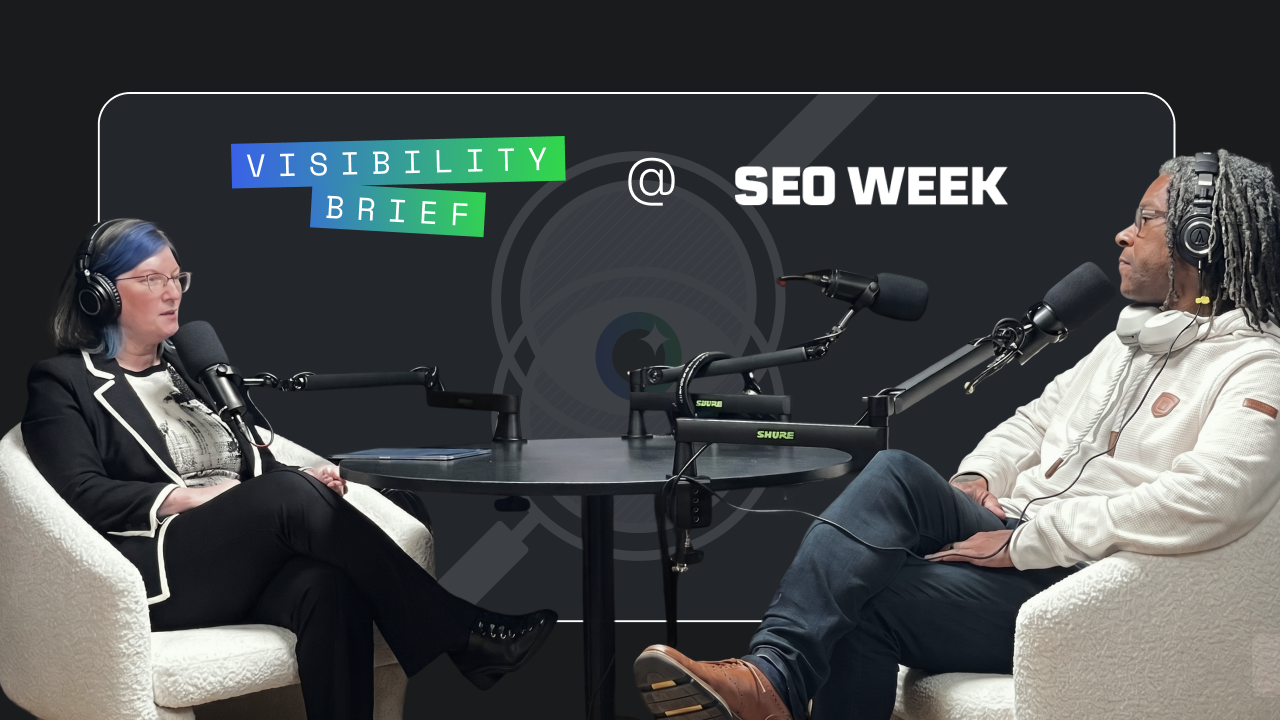
In this episode of The Visibility Brief, Rebecca Colwell (SVP of Marketing, Yext) sits down with Mark Stroud (Global SEO Lead, Specsavers) to explore why one of the most overlooked disciplines in marketing is suddenly getting some overdue attention.
Drawing on more than 20 years of SEO experience and leading global search strategy across 2,000 Specsavers locations, Mark explains why technical SEO is having "a moment," how AI is changing the conversation around visibility and conversion, and why it's time for marketers to double down on the basics.
This episode breaks down:
How AI is improving SEO workflows behind the scenes
Which technical signals matter most right now
Why SEO fundamentals are still the foundation for search and AI engines
The biggest misconceptions about AI optimization
Which SEO metrics marketers should (and shouldn't) measure
If you're a marketer trying to make sense of AI's impact on search, this episode offers a practical perspective on what's actually changing, what's staying the same, and where marketers should focus their attention next.
Episode Links
Transcript
00:00:00.200 — 00:00:28.560 For years, technical SEO has flown under the radar, but AI is changing that really quickly. The same technical signals that help a search engine understand that a website is relevant is increasingly important for AI systems to trust it as well. Today I'm joined by Mark Stroud, global SEO lead at Specsavers, to talk about why technical SEO is having a bit of a moment and what marketers need to understand before they get left behind.
Let's get into it.
00:00:36.480 — 00:21:13.160 Hi, Mark, welcome to the Visibility Brief. Hi. Yeah, hi. Good morning. Yeah, thanks for having me. I feel like it's been a little while coming, and I say we're in a different time zone, but I'm happy to be am if that works for you. Yeah. So we have a global listening base. So, um, thank you so much for taking the time to join us.
I'm very excited for a conversation. The first really interesting thing is that you happen to have been our very first customer in the UK when you were with countryside PLC. Is that right? Yeah. That's correct. So it's not with my current organization. So back in another life, uh, going back to 20, 2014 or so, um, we realized there was a big opportunity around local search and we were doing a lot of the stuff that Yext does super, super manually.
Um, and then the, um, all of a sudden there was this um, company called Yext that, um, came to the UK and we got it because we were trying to do it ourselves, but on scale on mass for 1500 locations and. Yeah, um, we brought you guys on board. Um, and it made our life completely different after that. So. Yeah. So it was kind of like plc a chain of estate agents, I think.
I think, yeah. 2014, that would have been I think, well, you've been in the SEO game for 20 years. Um, and I imagine you have seen so many changes. But before we dive into that, how did you get your start? What what drew you to the field? It's a it's an interesting one. It was, um, a total accident. And I've had conversations with people over the years around how they got started, and it's always seems to be a similar sort of story.
I was working for an e-commerce company that had their own e-commerce platform and point of sale, and, uh, and we were sort of selling it into sort of, uh, up and coming e-commerce businesses back in sort of 2006. But it had no SEO on it at all. It was it was, uh, it was fundamentally terrible to the point where by all the URLs with database strings, there was nothing there.
There was SEO friendly at all. And our clients realized that this was a problem. Um, and we were like, well, we don't know why it's a problem. That's just how the website works. So anyway, long story short, we ended up acquiring a SEO company back at the time and brought them on board, and they started showing us, you know, the world of SEO and how we can make websites and our websites, our customers websites appear, um, more in search and better.
And, uh, I had a really, really good mentor thought, hang on, this is really, really great. Totally embraced the SEO side of the business and the rest is history. And now we're seeing this massive transformation in this space with AI. And I'm really curious. Does it feel similar to what it felt like back then?
Yeah it does. In many ways, I was thinking about this. It's almost like, uh, yeah, an exciting, fresh start. I mean, when I started back then, we were still getting out of what spam and what's what isn't, and it was still sort of figuring out. And Google wasn't really offering any advice on that. I will say we've kind of already gone on a journey.
I remember the Penguin and Panda days, and that was a big learning curve. I was thinking about this as well, actually, you know, with SEOs have been dealing with things like this for a long time when natural language search became a thing from keywords to questions, we had to really adapt to that as well.
So it just feels like a new an evolution, but like an exciting evolution as well. So I think as SEOs, we're kind of used to it, but this is on the next level. It seems like technical SEO is having a moment right now where it's being elevated in the eyes of of the company in the marketing department because of the impact on AI visibility.
Do you think that's the case? Yeah, I really do. And we're we're seeing this within the business. So SEO traditionally has been one of those things that goes on in the background, um, with the SEO teams. Um, and then obviously the metrics of the website gets submitted to the leadership team, and we're only really, um, visible if there's a problem.
Now, the leadership team and the and, you know, and, you know, across the business actually is like, what are we doing about AI? What are we doing about AI? And I think, um, I think the expression was from one of my, uh, from the people in my team. You know, the attention is on us. We're getting the attention that we deserve, and we're almost.
No, I'm not going to say almost. I think we I think we're actually the cool kids at the moment. I feel like, you know, we are getting the attention, our knowledge, our background, the legacy. It's all coming to a point whereby, you know, the business wants to know about what we've done in the past, you know, how are we going to do it?
And you know how we can support them with the future. So yeah, for me, really exciting times. And finally, CEOs are getting the recognition we deserve. All along we've just been propping up websites and so on. Well, you deserve it. Congratulations. Super exciting. How do you explain what you do now to a non-technical user and and why that's so impactful on the business?
Oh, that's um, that's a good question. So, um, it's always been a challenge reporting on, um, metrics to the leadership team. You know, cutting through the noise. What's good? Well, is that good? Why is that bad? And I think I think it's a really tough one, but, um, it's just about maintaining a visibility and a brand presence within, uh, within the search results.
So, you know, um, if if we're not there, someone else will be, uh, we're making sure people can find us when they need to. And that. And that's just not anyone that's, you know, our our our profile of customers, you know, our personas as well. And that gets really more challenging in the AI world because there's a lot more sort of nebulous stuff around, you know, the prompt side of things.
So, so really just making sure our customers can find us when we need. But tying to those key important metrics that, you know, the business can get on board with, as opposed to a lot of other stuff, and not the nebulous stuff like, you know, visibility and sort of, you know, market share in the world of search.
We're trying to really define, you know, what the value is there to the business and what we're doing. You mentioned a couple of times maybe visibility isn't the thing. And I'm curious if it comes down to something else like trust. So, you know, getting started in search is all about trust. And when people talk about trusting a brand, they usually think about the content.
But I think there's a huge component that comes from the technical signals that you're you're sending out into the market. So talk me through what that that looks like from your perspective. A good, solid technical foundation has always been important. You're giving those signals to Google that this site is well maintained.
It's looked after its current. We you know, we want we want, um, we want the right pages to appear at the right time. And that's a big trust signal for me in its own right, and that's foundational. But I think in the world of AI particularly, that's become even even more apparent as well. You know, there's a it's a kind of like we've the technical foundations are there, but even more so, we've got to be even more precise, because we're not just serving the crawler that's indexing a search engine.
We're trying to give the whole picture now to these AI bots around very, very specific queries. And then when you talk about the world of funnel queries within the LMS, it just gets really complicated. So we're trying to give the biggest picture as possible. And the more foundational the tech is and the better.
And it's just it's a big a big trust signal for it for us I think. Absolutely. Are there aspects that are more important today than they have been in the past? Yeah, I was I was thinking about this, um, tech is tech. The fundamentals haven't changed of the web. But there are things now that I feel are really, really emerging.
Um, one thing that Google does keep talking about is how the bots and the AI bots will do a snapshot of your page. they'll take an image. Well, you don't want it to take half an image of your page. So therefore there's a whole like implication around page speed and load time to make sure the bots capture that.
We always know we want good quality. Um hmm. Markup and semantic HTML, but that's even more of a thing now. And Google's talking a lot about optimizing for bots alongside users is talking about the whole the whole accessibility tree as well to give it, you know, give, give the bots real clear layout of the page and how it works.
So for me, I think these are the three foundational things. Are there any myths or misconceptions about technical SEO that you would want to dispel? Things that people are doing that you're saying, look, this actually has no impact or it's just a waste of time? I don't I think we're at the point now with the s in the SEO industry being, um, really mature is that we've we've gone through that, but they all do count.
It's, um, it's the sum of the parts, right? They make things. So for a technical SEO, you could spend hours and hours and days and days of resource just looking at schema, right? To no great avail. But but it is part of the equation. So it's the sum of the parts for me. And I'm just really grateful. Like you know, now we're open.
You know, we're able to have these open conversations with the search engines who are supporting us to do that. So all the, all the myths have kind of gone. I think as a mature industry, we know where we are and they all compound each other. You know, you've got a good schema, you've got a fast loading web page.
You tie that with some great content and and they all they all come together. Are there any misconceptions about AI and how you show up an AI search that you think people are chasing? I think I think there are probably lots. And I think one of the biggest challenges people have is, again, um, you know, does schema actually work?
Again, it doesn't really matter for me if it does or it doesn't work. It's still a best practice thing that we should be applying. Let's not debate it. We know schemas malleable for search in general. That's deploy it. I think the biggest unknown is really the reporting and tracking. Um across the I search engines.
We've got this moving goalpost with multiple different tools. Now they've all got great value. They all do slightly different things. But then not only have we got all these new tools that are coming to the market, and which one do we go for, how do we report across thousands of prompts, across multiple different search engines that are all shifting in market share?
I want to pivot to your role today. So you are the global SEO lead at Specsavers. Tell me a little bit about your role and your company. Yeah. So um, Specsavers is a multinational, um, Optum um company. Um, we we're not we're not just optometrists. We do, uh, audiology as well. We've got domiciliary in the UK, not in every market whereby we go to people's homes.
So yeah, we, uh, we, uh, we're in ten markets across the globe, um, Canada, Northern Europe, UK, Australia and ANZ and um, yeah, we've, we've got about 2000 stores, um, globally just looking after people's eyes and we're pitching ourselves our not pitching ourselves. We are um, we are experts, um, that care?
Um, you know, looking after people, you know, looking after people's eyes and ears. Um, yeah. And, uh, it's just a really great company to work for. In that sense, it's, um, it's a brand with a purpose. Really enjoy it. We are in that challenging your money, your life niche. Um. Which, uh, we need to justify our our knowledge.
Um, which, again, is another layer to everything that we do. And. Yeah. And, um, yeah, we've been, um, well, Specsavers has been in business for, uh, you know, over 35 years now. So, uh, so really, really great to be part of a brand that's, you know, multinational and then have the privilege of seeing a global team that can then take influences from each market and try and pull them together.
We've got a phrase at Specsavers whereby, you know, still with pride, if it's working in one market, you know, let's see if it works in another. And it's just a great at global level to be able to see how these things, um, work. And uh, yeah, the time zones are challenging. But for me, um, um, working in a global team is really, really rewarding and quite unique position, um, to be in.
So yeah, we're. Yeah. We're not Tom up Tom company optometrist or um, as we'd say in the UK, just an opticians. Depending on where you are. Um, yeah. But, um. Yeah. Are people's eyes and ears. Yeah. Thank goodness for that. As someone who has worn glasses since fourth grade. Um, I don't know how I would get by without.
Um, so I would love to hear more about your SEO strategy. So my understanding is that a corner of your SEO strategy, your local SEO strategy, is built around local pages, and that you've got thousands of local pages across multiple markets. Can you tell me a little bit more about that and how it fits into your visibility strategy?
Yeah. No. So I mean, across the globe we've got 2000 stores, which equates to 2000 store pages. And the traffic that's driven to these um, um, store pages over aggregate way surpasses the traffic we get to our home page. They're so important for people searching up our local level where they can get an eye test.
Um, you know, and, and these, these store pages. drive and drive, you know, and users straight to the straight to store page. And from there they can make an online booking and get in store. So they are really, really important, the whole local thing through the store pages, through Google My business, through our Google Business listings.
It's just a real key revenue drop, not only to help people find, um, our stores who know about us, but also for people just looking for, you know, generic search terms as well. So really, really important. And there's always so much to do in the world of local search. And there's always more opportunity.
But they're really key for helping our customers find us, but also helping new customers think about us who might not have consider us, consider us in the past. Mark, why do you think the local pages get so much more traffic than your your home page? Okay, over aggregate the number of locations you times and the variety of keyword searches from optometrist to audiology to, you know, eye test, ear test that that mounts up right over a number of keywords you can capture across a home page.
So yeah, so it really opens up the traffic now. And they are they are really important. You know, they are really important. So I think it's just the variety of keywords for a local page, um, times the amount of them, if that makes sense, which is, you know, a lot greater than what we'd get at a, at a home page level.
Sure. And I also think there's probably a high intent component as well. You know, when I get to a local page, I have a very specific thing that I am looking for, and it is answering that very specific question. Yeah, 100% agree with that. So people will be looking for local offers and that sort of thing 100%.
And we know local search is so valuable. Our local independent competitors have really, really caught on to the value of local search. And they do have a little bit more flexibility, um, to optimize, a little bit more flexibility to optimize, um, their pages, um, you know, across 1 or 2, three, one or 2 or 3 stores as opposed to 900 in the UK.
Um, but but we really are seeing the value, um, of them doing it. So, you know, we need to figure out how we can sort of brand that up across. Yeah. 2000 stores globally. That is such a big footprint and a big challenge. So are you empowering your local store managers to to manage the information on the pages, or are you and your team handling that?
Yeah. So we've got um, um, a kind of dual approach on that. So, um, the way Specsavers is set up is that the, uh, the people in store focus on caring for our customers. So they are the experts that care. They are the optometrists. They are the audiologists. So the model is really centrally. We manage everything globally.
And that's the that's the that's the model that we have. But um, but Yext has given us a really good flexible position to say to the store managers and the store directors, um, you know, you can go and edit your opening hours, you know, tweet them for holidays and do that if you need to. But ultimately, the strategy is, um, say global and regional with, uh, you know, with, with the store owners to be empowered to do what they need to do.
Um, at a, at a local level, depending on holidays, do you find that the competition varies a lot from market to market? You mentioned you had some smaller local competitors. Um, no, it really does. Um, I think even from market to market. But even within, um, Specsavers, we've got a situation whereby in Northern Europe, you know, it's a lot more offer led.
So even at a local level people are looking for offers. So we are seeing that and it's and that's why actually northern Europe, they really are maximizing and making the most out of what we do at a local level. Um, and doing things offer based. So yeah, yeah, we do see a variety of stuff, um, but broadly the same.
But ultimately, I suppose it's the tactical and the strategic stuff that we see the difference. When you were evaluating technology platforms to build your local SEO pages. Um, what capabilities mattered most to you in that, in that evaluation process? Broadly, um, on board with Yext. Um, when I started back in 2018, I think when, when we decided to roll out, um, the X globally.
I think we just looked at, you know, and compared feature for feature and obviously from, from your guys perspective that, um, you were more ingrained in the business, you were more set out with this. And what I can say is working with you guys has been beneficial. And obviously, um, in terms of leading the way with AI and, you know, new products and stuff, we can see the benefit of working with you in the future.
Excellent. What do you look for in a partner that makes that partner the right fit for you? Uh, you know, I think I think the word I think the word partner says it all. Really? We don't want a vendor. We don't want a supplier. We want someone that does partner with us. And I think that just sums up, you know, we are one team and someone is prepared to be part of the team, um, and understand the business, but not just at a high level, really understand, you know, the intricacies of intricacies of what we do.
And again, I'm speaking with your team all the time, and we've looked at a scout as a product, and you guys have really understood us and why Scout works for us. And that's really, really helped us demonstrate it and sell it into the business as something that we really need to leverage. So yeah, for me, I think the word partner just says, oh, you're part of our team and someone that's prepared to be part of our team, not just a supplier.
I want to pivot to our final section where we go into practical advice for your peers. So I first want to start with a little deep dive into how you and your team are using AI yourselves, not for search, but to streamline some of your internal workflows. So, um, what are some of the things you're doing today?
So yeah, we are starting to look at this and there's a whole bunch of stuff we need to get into them using AI agents. We're well aware that we can streamline bottlenecks and things like keyword research, even writing briefs. This is something that always gets put to one side. The business wants this, the business wants that.
Um, so we know that there's an opportunity to just go out and do a load of keyword research. And then there's the whole AI agent thing where we want to look at how we can use this. There's this new web protocol that I think I was reading about it the other day. That and being in Google are working on it's the web NBC protocol whereby we can use the agents online, um, for our customers to, um, do bookings, you know, by just basically saying to their phone book me an appointment at Specsavers next week at the nearest location that we've got.
That for me is a bit of a no brainer, and we've got to look at that. And I and I do believe, I do believe there's a lot of work that can be done around AI agents for auditing websites as well and picking up things even sort of, you know, um, even, you know, testing and stuff like that and, you know, spotting things, um, before they're missed.
One of the things we are doing as part of the platform at the moment, we are using AI to compare the, uh, the to B site versus what we've got today to make sure we've captured everything. So that's been an absolute game changer. No more manual checking. We're obviously doing the manual checks as an SEO word, but this this the solution around the whole AI and using LMS to map new site to old site to make sure everything's captured.
It just is that warm, fuzzy feeling of reassurance, you know beneath us that we just and it makes us look really smart for the regions as well. I thoroughly enjoy. I love that. AI can give you warm, fuzzy feelings. That's so human. We put it right. We don't need to put no. It's a sexual layer of eyes, isn't there?
And and and you know, and you know, and just the amount you know, we're going to check, you know, I don't know, a hundred thousand URLs. You know, we you know, the LMS can do that for us with a, you know, a decent amount actually, you know, already. So yeah, it does it does give you a bit of a warm fuzzy feeling.
It's great. I love the scale that can come where some of these challenges that you just would not be able to solve with the capacity and the teams that we have today. That's incredible. I also want to dig in just a little bit more into what you were saying about agents booking on behalf of your patients. I mean, I think that's really, really interesting.
Um, are there things you're putting in place today to be ready for that, that that other businesses that rely on appointments as a, as a key driver should be thinking about as well? Yeah, it's a funny one. Is that said, we. We know the text there and we know the potential around the agents. Is there to do it?
Um, I think we've got to start thinking about it. Um, I do think it's a couple of years off still for me. We've got to obviously get the technology implemented. And it's sort of a progressive enhancement to what we've got today. But once that's been implemented, you know, are people going to use it? Is there an awareness around using it?
So I think we've got a bit of a journey to go on. Right, right. And it's suppose there's a lot of memory components there too, if it knows this is the location I've gone to last time, this is the type of prescription that I have and the service that I need from a consumer. I think it sounds amazing. Um,
00:21:14.640 — 00:23:30.490 so just we're just trying to break. Yeah. How are those habits going to shift? I keep coming back to, you know, for a very long time, we were talking about voice search being the next thing we're talking about voice search for three years. And then it didn't really become a thing, although it did in some respects.
So it's kind of trying to feature how do people want to react react with us. And you know, we've got, um, a variety of demographics that will want to continue to deal with us, you know, in different ways. So, you know, we've got to try and accommodate for everyone. Okay. So, Marc, we're going to roll into our final section, which is the stop start rethink section.
It's the practical advice for marketers. So um, what is the one thing that you think your peers should start doing today? Um, to either be more effective at their technical SEO or prepare for what's coming with AI search? I just think really get the foundational stuff set in. In tracking, I think I think, um, data is key.
We spoke about this earlier. Find a tool that suits you. Get the data. Find a way of tracking things that works for you. And one of the things that I can say, um, around tracking for for AI search is that don't try and track everything. Be really honed in what you're what you're tracking and monitoring, and then you'll get better insights and better learning from that.
My main motto is don't rush into it. We've still got time. Everything's up in the air. There's a lot's got to happen. And businesses and business leaders have got to make a judgment on where to go. You know, the whole industry has got to settle down a bit. And then, you know, the users have got to find their own way as well.
So don't panic. It's my mind advice, but try and get some data. And once you've got that data, you'll be able to see what's working and how to replicate that elsewhere. And, you know, and then and then build on it. Wonderful. Um, Mark, how can people connect with you if they want to learn more, hear more about your ideas?
Yes. I'm just a blast. I'm just on LinkedIn. Yeah. So if you just search out Mark Stroud OS, I think it'll be. Just search. Mark Stroud, Specsavers or SEO, I should pop up. Well, thank you so much for sharing your expertise with us today. I really appreciate it and we hope to see you again soon. You're very welcome.
Thanks for having me, Rebecca. Thank you. That's a wrap on this episode of The Visibility Brief. If you found this useful, subscribe, leave us a review or send this to a colleague who needs to hear it. We'll see you next time.