What Is a Natural Language Search?

Natural language search (NLS) is driving the shift from keywords to context. How do brands adapt with new SEO strategies in a landscape that’s about to be dominated by voice search, AI search, and AI agents?

Lauryn Chamberlain

Jul 9, 2025

6 min
natural language search

TL; DR: Bye-bye keywords. Sayonara little blue links.

Natural language search (NLS) has already changed the way people search. Now, brand visibility and the customer journey are led by what shows up in AI's direct answers and conversational, context-driven interactions. This shift means that customers already expect instant, hyper-personalized answers. They expect those answers to show up like advice from friends and trusted advisors. And they want the flexibility to find those answers in conversations with voice assistants and videos, not just direct answers on screen.

To stay visible (or recover the ground they're already losing) brands and marketers must rethink SEO strategies. Now, they need to prioritize structured data and consistently distribute conversational content. It's also important to double-cown on a relevant, robust local presence. Tactics like communicating like your customers, leveraging knowledge graphs, and monitoring new visibility metrics with tools like Scout are the absolute essentials for discoverability in an AI-first world.


From Archie to AI: how search has shifted from keywords to context

In 1990, three computer scientists working at McGill University's School of Computer Science in Montreal, Canada, launched Archie, the world's first search engine.

Archie wasn't flashy, but at the time, it was groundbreaking. Archie's inventors, Alan Emtage, Bill Heelan, and Peter Deutsch, built Archie so that it scanned filenames on public file transfer protocol (FTP) servers, then indexed them in Archie's database. You could search Archie's indexed filenames for keywords. Then, if you saw a title you wanted to look into, you could download the link, then upload it again on your computer and read the file. (Note: Archie only scanned filenames, not file content.)

Until the rise of AI search, search engines like Google, Bing, and Yahoo (now Yahoo Finance) would provide top-line results via basic keyword matching. The more keywords that matched, the better your chances for showing up in SERPs (think Google's 10 blue links).

Today, AI search — and AI agents — operate at a whole new level.

AI search doesn't hint at possible answers or surface links customers have to click into to find what they want. Instead, AI search interprets customer intent and predicts the information customers want. Then, based on those predictions, AI search generates accurate, relevant, and complete responses to customer queries. Customers never have to click through to find what they're looking for. AI search just delivers them direct answers, no clicks necessary.

For example, before natural language search and AI search, if you typed, "How tall is Bono?" into a search engine, you'd see results saying he is 5'6" tall. Then, if you typed in, "Where does he live?", the thread was lost. Search couldn't understand you were still asking about Bono. Now, most AI search engines can follow that thread and interpret "he" in the context of your previous query about Bono.

So, how does AI search work? Natural language search is the foundation that powers it all.

What is natural language search (NLS)?

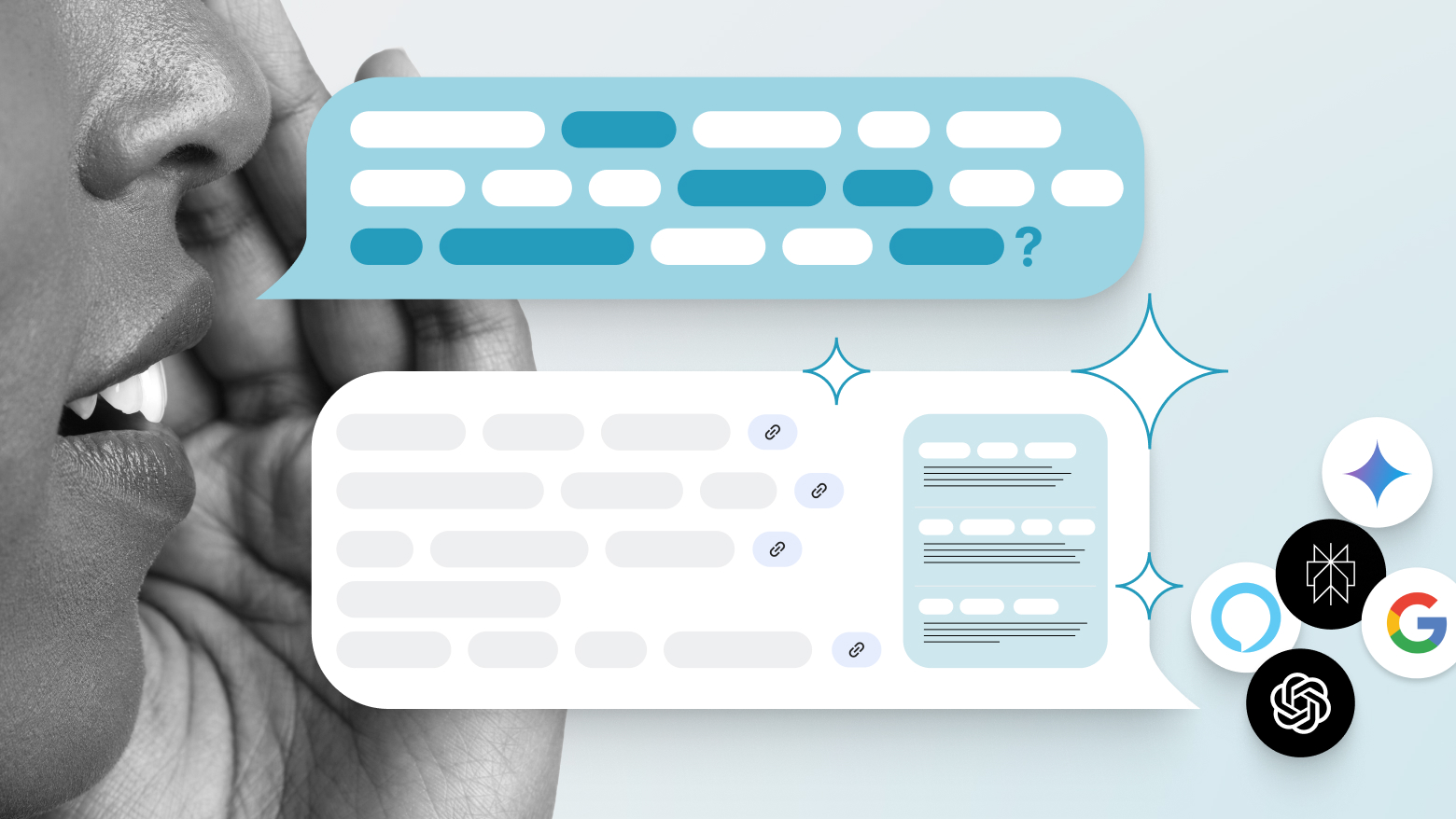
Natural language search marks the shift from keyword matching to casual, conversational search queries. Customers now ask questions in their own words vs. their best guesses about how to find the information they need. Meanwhile, search engines directly answer these conversational questions with everyday language, too. Natural language processing (NLP) and large language models (LLMs), two types of artificial intelligence, make natural language search possible.

NLP isn't about keyword matching; NLP is built for context comprehension. As a result, NLP delivers extremely specific search results to any question or prompt.

Meanwhile, LLMs are designed to think of language elements as data points, layered and interconnected, with each data element coded to communicate its meaning and value.

Together, NLP and LLMs make it possible for customers to talk to voice assistants and use search engines as if they're interacting with a friend, a doctor, or another trusted advisor:

  • Instead of searching Google for "Walmart hours July 4", they ask Alexa, "Is Walmart open on July 4?" and follow up with "Can I buy sparklers there?"

  • Instead of asking a stranger where they got their cute shoes, customers are sneaking a photo and shopping via Google (unbranded) image search right there from the bar at happy hour: "Where can I buy these shoes or something super similar, size 7?"

  • Instead of spending a weeknight searching for hotels, trails, and food in Bentonville, AK, customers are prompting Perplexity for their travel plans and getting answers they trust in seconds, not hours: "I'm an experienced mountain biker who wants to spend a week in Bentonville, Arkansas. Help me find the best singletrack trails. I want to hear about the hidden gems, too. Also, give me your top 3 recommendations for the best non-smoking hotel with air conditioning, a kitchenette, and pool (that's NOT under construction). Only show me places with 4 stars or higher. Bonus points for hotels within walking distance to a microbrewery or bike shop."

This moment, this convergence of AI technology and its impact on both customer expectations and the customer journey, is a tipping point. Search engine optimization for brand visibility is shifting into search everywhere optimization for brand discoverability.

The AI acceleration factor: Conversational, natural language search in action

Search feels different now because it is different. And the landscape keeps changing – fast. With Google evolving search into AIO, AI Mode, and Gemini, they're catching up to the innovation and disruption we first saw with OpenAI's ChatGPT, Antropic's Claude, and other AI-driven platforms. But no matter where they search, customers are looking for fast, clear, direct answers they can trust.

As natural language search keeps strengthening across search channels, and as the first generation of digital natives gains more cultural clout, expect to see those factors turbocharge search evolution. Already, 45% of customers are likely to use and trust AI tools.

Like fans at a horse race, boxing match, or Formula 1 track, customers are picking their favorite AI search engines. And the most competitive brands are rethinking — and responding — by placing smart bets on how to reach more customers using natural language search.

Natural language search is changing everything. So, AI readiness isn't just something you need a plan for. It's something your brand needs to start activating now. Here are the top four levers you can pull to uplevel your marketing engine and win discoverability in AI search:

  1. Build your website with FAQ schema – This markup uses a specific format (often JSON-LD because it's Google's preferred format) to define every question and its unique answer. AI is hungry for this type of structured data.

  2. Vigilantly structure data across content types – When creating content for multimodal search, use schema markup like VideoObject or AudioObject. Also, label images with metadescriptions and alt text. This helps AI provide zero-click experiences for customers and boosts your brand visibility in direct answers.

  3. Write everything you publish the way you'd say it – Or better, the way your customers say it. Conversational styles lend clarity and build trust with customers, while making it easy for NLP and LLMs to reference your brand (and your brand voice).

  4. Monitor zero-click visibility with Scout – Scout offers a view into how you're ranking in traditional and AI-driven search, your AI-search sentiment, and how your visibility compares to local competitors. You can actually measure what matters as you wrap your head around new search visibility and engagement metrics, like seeing how often your content appears in AI-generated overviews or is retrieved via image or voice search. These insights help you hone your strategy for optimal visibility.

AI search platforms are changing how customers discover brands. Ready to see where you stand?

Try Scout. You'll be able to monitor brand visibility across traditional search engines and AI search platforms like ChatGPT, Grok, Perplexity, etc. With Scout, you'll not only see where you stand against competitors. You can understand why they're beating you, and get insights to take (back) the lead in both AI and local search.

Learn more about Scout.

Share this Article

Read Next

loading icon

Join us for discussions about emerging AI technologies with leaders across industries.